Word of the Day: Tenebrous
Today’s word of the day, thanks to the Words Coach (https://www.wordscoach.com/dictionary), is tenebrous. Pronounced / ˈtɛn ə brəs /, this adjective means “dark; gloomy; obscure” (https://www.dictionary.com/browse/tenebrous).
The word first appears in English in the “late 15c., from Old French tenebrous ‘dark, gloomy’ (11c., Modern French ténébreux), from Latin tenebrosus ‘dark,’ from Tenebrae ‘darkness,‘ which, according to de Vaan, is dissimilated from earlier *temebrai, from PIE root *temsro- ‘dark’ (adj.), from *temos- ‘darkness,’ for which see temerity” (https://www.etymonline.com/search?q=tenebrous).
In its “Did You Know” section, Merriam-Webster says, “Tenebrous can mean both ‘obscure’ and ‘murky,’ but its history is crystal clear. Etymologists know that the word comes from the Latin noun tenebrae, meaning ‘darkness.’ Tenebrous has been used in English since the 15th century, and in subsequent centuries has been joined by some interesting and even less common relations. Tenebrionid is the name that may be given to any of at least 20,000 species of mostly nocturnal beetles, also called darkling beetles, many of whom love inhabiting dark places. Tenebrism refers to a style of painting—associated especially with the Italian painter Caravaggio—in which most of the figures are engulfed in shadow while some are dramatically illuminated by concentrated light. And let’s not forget the terrific tenebrific, a tenebrous synonym” (https://www.merriam-webster.com/dictionary/tenebrous). Of course, there is also tenebrious, which is either a synonym or a variant spelling.
According to On This Day, on this date in 1356, “English forces under Edward the Black Prince defeat the French at the Battle of Poitiers and capture French King John II during the Hundred Years’ War” (https://www.onthisday.com/events/september/19).
The trouble begins with the year 1066 when William, the Duke of Normandy, which is part of the French kingdom, defeats the Anglo-Saxon king Harald Godwinson at the Battle of Hastings. William thus became King of England as well as being the Duke of Normandy, an odd situation since as Duke he was a feudal vassal of the King of France. When he died, he left Normandy to his older son, Robert, and England to his younger son, William Rufus. I guess that tells you what he thought of England. English kings continued to be lords over different parts of France over the next four hundred years or so, and that is where the 100 Years’ War comes into play.
The war did not see continued fighting for 100 years (actually, 1337 to 1453). In 1337, Edward III was the king of England and the Duke of Gascony, a province of France. The king of France, Philip, who was chosen by the French barons over Edward, who had a closer blood claim to the throne of Charles IV when the latter died in 1328, decided to take Gascony away from Edward. Edward, of course, raised an army to defend his claim to the province and assert his claim to the French throne.
In 1346, the English claimed a major victory in the battle of Crecy. The French army was much bigger than the English army, and the French were pretty confident of winning. The battle began with the French crossbowmen and the English and Welsh longbow archers exchanging fire, a duel which the English won. Philip then called for a cavalry charge, but the French cavalry had to force their way through the crossbowmen, deal with holes dug by the English, and avoid slipping in the mud. To make a long story short, the English won despite the size disparity. They then moved on to lay siege to the city of Calais, which they also won (https://en.wikipedia.org/wiki/Battle_of_Cr%C3%A9cy). I’d recommend reading the wiki if you’re interested in the details of the battle, but it was clearly a case of the underdog winning.
After a decade of intermittent fighting, which the French normally won since they did not have to cross the Channel to get to the war, Edward the Black Prince, Edward III’s oldest son and the heir to the English throne, though he would never become king, led an army back across the Channel to reassert his father’s claim. It is one of the most famous battles in the history of the European Middle Ages.
“The Anglo-Gascon army is generally considered by modern historians to have consisted of 6,000 men: 3,000 men-at-arms, 2,000 English and Welsh longbowmen and 1,000 Gascon infantry. The latter included many equipped with either crossbows or javelins, both classed as light infantry. Some contemporary accounts give lower numbers of 4,800 or 5,000. The division of the men-at-arms between English and Gascons is not recorded, but the previous year, when campaigning with a similarly sized army, 1,000 of the Prince’s men-at-arms had been English. All of the Anglo-Gascons travelled on horses, but all or nearly all of them dismounted to fight” (https://en.wikipedia.org/wiki/Battle_of_Poitiers).
“The French army was made up of between 14,000 and 16,000 men: 10,000 to 12,000 were men-at-arms, 2,000 were crossbowmen and 2,000 were infantrymen who were not classed as men-at-arms.[118] Although most or all of the French had travelled mounted, they all fought dismounted at Poitiers except for two small groups of mounted knights, totalling either 300[119] or 500. These were selected from the Frenchmen who had the best armour, especially on their horses” (ibid.).
The big difference, other than the obvious difference in size, was the longbow. “The longbow used by the English and Welsh archers was unique to them; it took up to ten years to master and an experienced archer could discharge up to ten arrows per minute well over 330 yards (300 m). Computer analysis by Warsaw University of Technology in 2017 demonstrated that heavy bodkin point arrows could penetrate typical plate armour of the time at 250 yards (230 m). The depth of penetration would be slight at that range; predicted penetration increased as the range closed or against armour of less than the best quality available at the time. At short range longbow arrows could pierce any practicable thickness of plate armour if they struck at the correct angle. Archers carried one quiver of 24 arrows as standard. There may have been a resupply of ammunition from the wagons to the rear during the battle to at least some longbowmen” (ibid.). On the other hand, “Crossbowmen usually fought from behind pavises–-very large shields with their own bearers, behind each of which three crossbowmen could shelter. A trained crossbowman could shoot his weapon approximately twice a minute and had a shorter effective range than a longbowman of about 220 yards (200 m)” (ibid.).
“According to different modern sources 2,000 to 3,000 French men-at-arms and either 500 or 800 common soldiers were taken prisoner during the battle. As well as the King and his youngest son they included the archbishop of Sens, one of the two marshals of France, and the seneschals of Saintonge, Tours and Poitou. Approximately 2,500 French men-at-arms were killed, as were 3,300 common soldiers according to English accounts or 700 by French ones. Among the slain were the French King’s uncle; the grand constable of France; the other marshal; the Bishop of Châlons; and John’s standard bearer, Geoffroi de Charny. A contemporary opined that the French had suffered “a great harm, a great pity, and damage irreparable”. The Anglo-Gascons suffered many wounded but reported a mere 40 to 60 killed, of whom only 4 were men-at-arms. Hoskins comments that these “seem improbably low”. Modern sources estimate Anglo-Gascon fatalities at about 40 men-at-arms and an uncertain but much larger number of bowmen and other infantry” (ibid.) If you want more details about the battle, you can look at the wiki, or there are many books about the Battle of Poitiers. In fact, Bernard Cornwell has a series of novels regarding this period in English and French history, concluding with 1356: A Novel.
This incredible battle was mirrored nearly 60 years later when Henry V led the English to an incredible victory at the Battle of Agincourt. You can read experience it in Shakespeare’s Henry V, which includes the famous speech that gave us the “band of brothers” phrase.
Of course, eventually the French did drive the English off the continent completely. But September 19 was a day of celebration for the English even though it was tenebrous for the French.
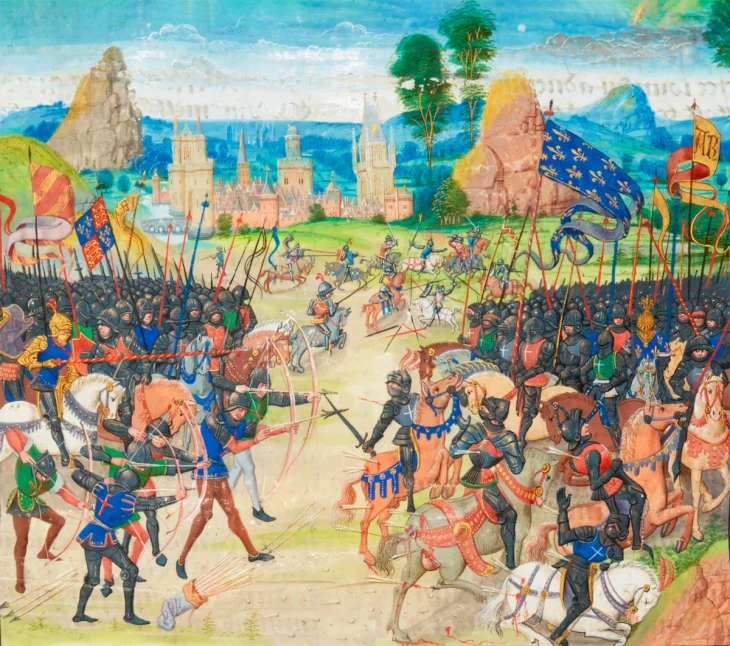
Today’s image is of “Battle of Poitiers at Nouaillé-Maupertuis in 1356, from Froissart’s Chronicles, Gruuthuse Manuscripts” (https://www.culturefrontier.com/battles-of-crecy-poitiers-agincourt/). You can tell which side is the English by the presence of long bows.