Word of the Day: Pertinacious
Today’s word of the day, courtesy of the Words Coach (https://www.wordscoach.com/dictionary) is pertinacious. Pronounced / ˌpɜr tnˈeɪ ʃəs /, this adjective means “holding tenaciously to a purpose, course of action, or opinion; resolute,” “stubborn or obstinate,” or “extremely or objectionably persistent” (https://www.dictionary.com/browse/pertinacious).
In its Did You Know section, Merriam-Webster says, “Remove the first syllable of pertinacious and say what remains out loud: you’ll hear something that sounds a lot like the word tenacious, meaning ‘tending to adhere or cling.’ The similarity between pertinacious and tenacious isn’t mere coincidence; both words derive from tenax, the Latin word for ‘tenacious,’ and ultimately from the verb tenēre, meaning ‘to hold.’ Another descendant of tenēre is tenure, a word that is typically used of the right to hold a job (especially a teaching position) for as long as desired” (https://www.merriam-webster.com/dictionary/pertinacious).
The word appears in English in the “1620s, from pertinacy ‘stubbornness’ (late 14c.), from Latin pertinacia, from pertinax ‘very firm, tenacious’” (https://www.etymonline.com/word/pertinacious). It’s connected to the word pertinacity, which appeared “c. 1500, from French pertinacité (early 15c.), from Old French pertinace ‘obstinate, stubborn,’ from Latin pertinacem (nominative pertinax) ‘very firm, tenacious, steadfast, persevering,’ from per ‘very’ (see per) + tenax (see tenacious). It drove out earlier pertinacy (late 14c.), which was especially ‘persevering in disbelief’” (ibid.). It seems both aggressive and anthropomorphic to say that one word “drove out” another word, as if pertinacy went running for its life.
The root word, the ten-, is a “Proto-Indo-European root meaning ‘to stretch,’ with derivatives meaning ‘something stretched, a string; thin’” (ibid.).
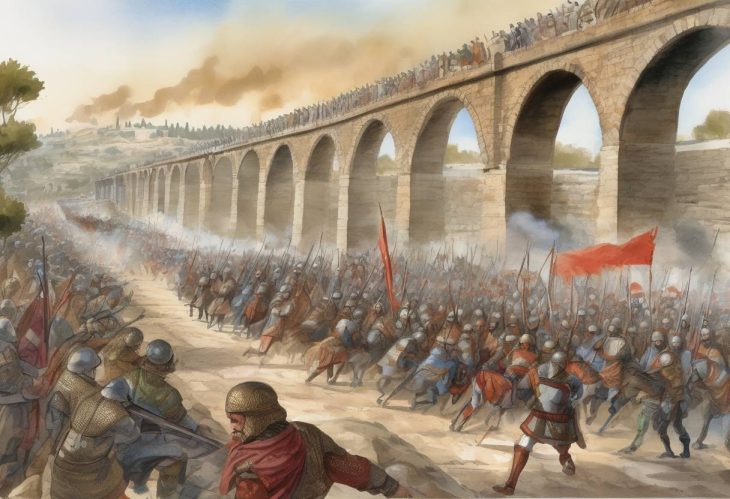
According to On This Day, on this date in 637, “Antioch surrenders to the Muslim forces under Rashidun Caliphate after the Battle of Iron bridge” (https://www.onthisday.com/events/october/30).
“The Battle of the Iron Bridge was fought between the Muslim Rashidun army and the Byzantine army in 637 AD. The battle, which the Muslims won, took its name from a nearby nine-arch stone bridge over the Orontes River (also known as Jisr al-Hadid), which had gates trimmed with iron blades. It was one of the last battles fought between the Byzantines and Rashidun Caliphate in the province of Syria. In the aftermath of the battle, the province’s capital, Antioch, fell, marking the near-complete annexation of the province into the Rashidun Caliphate” (https://en.wikipedia.org/wiki/Battle_of_the_Iron_Bridge).
To provide some context, Muhammad established the first Muslim state in Medina in 622 AD, just 15 years before the fall of Antioch. What followed was a series of conquests by Muslim armies. “The Rashidun Caliphate was the early Islamic polity led by the first four successive caliphs (lit. ”successors”): Abu Bakr, Umar, Uthman, and Ali, collectively known as the Rashidun, or ‘Rightly Guided’ caliphs. These early caliphs led the Muslim community (Ummah) from the death of the Islamic prophet Muhammad in 632 CE to the establishment of the succeeding Umayyad Caliphate in 661 CE” (https://en.wikipedia.org/wiki/Rashidun_Caliphate).
Under the Prophet Muhammad, until his death in 632, Islam expanded to include all of modern-day Saudi Arabia, Yemen, Oman, the UAE, and a small part of Jordan. The Rashidun expanded the Muslim empire further to include most of Persia, Syria, Iraq, part of Turkey, and part of North Africa. The conquest of Syria, and the fall of Antioch, was early in the expansion of the Rashidun caliphate.
It was the Byzantine army that was trying to prevent the Muslims from taking over Syria. “The remnants of the defeated Byzantine force retreated to Antioch. The Rashidun army later moved up and laid siege to Antioch, focusing on the Bridge and the Eastern gate (also Beroea gate). The city surrendered on 30 October 637. According to the treaty the citizens were allowed to depart in peace or forced to pay a tax” (https://en.wikipedia.org/wiki/Battle_of_the_Iron_Bridge). “The campaign was ended in early January 638. After the defeat of pro-Byzantine Christian Arabs from Al Jazira, who laid siege to Emessa in March 638, Abu Ubaidah sent more columns under Khalid ibn Walid and Iyad ibn Ghanm to subdue Jazira near the Syrian frontiers and in Anatolia. These columns went northwards as far as the Ararat plain and west towards the Taurus Mountains. The Taurus Mountains in Anatolia thus marked the westernmost frontier of the Rashidun Caliphate in Anatolia” (ibid.).
For additional context, the Rashinun caliphate had taken the Levant, including a siege of Jerusalem, in 636, again defeating the Byzantine Empire. Apparently, the Rashidun, following the commands of Muhammad, were pertinacious about Muslim expansion.
Today’s image is of the Battle of Iron Bridge in 637 (https://historysnacks.io/event/ADka3MDP/the-battle-of-the-iron-bridge-took-place-near-antioch-where-the-rashidun/).