Word of the Day: Legerity
Today’s word of the day, courtesy of the Words Coach (https://www.wordscoach.com/dictionary), is legerity. Pronounced / ləˈdʒɛr ɪ ti /, with a soft g sound, this noun means “physical or mental quickness; nimbleness; agility” (https://www.dictionary.com/browse/legerity).
In its Did You Know? section, Merriam-Webster says, “When legerity first appeared in English in the 1500s, it drew significantly upon the concept of being ‘light on one’s feet,’ and appropriately so. It is derived from the Middle and Old French legereté (‘lightness’), which was formed from the Old French adjective leger (‘light in weight’). Leger comes from an assumed Vulgar Latin adjective, leviarius, a descendent of the older Latin levis (‘having little weight’). These days, legerity can describe a nimbleness of mind as well as of the feet. A cousin of legerity in English is legerdemain, meaning ‘sleight of hand’ or ‘a display of skill or adroitness.’ Legerdemain comes from the French phrase leger de main, meaning ‘light of hand’” (https://www.merriam-webster.com/dictionary/legerity).
One interesting side note: there was no entry for legerity on Etymonline.com.
According to On This Day, on this date in 1776, “Benjamin Franklin departs for France on a mission to seek French support for the American Revolution” (https://www.onthisday.com/events/october/26).
Benjamin Franklin was the smartest person in American history. I learned that from my father. His explanation? When just 17 years old, Franklin moved from Boston to Philadelphia. My dad was, of course, from Philadelphia, and he would have been happy to explain to you why the Philadelphia Symphony Orchestra was better than the Boston Symphony. My father’s love of Philadelphia is my first connection with Ben Franklin.
Franklin was born in Boston, the 10th son of Josiah Franklin, and the son of Josiah’s second wife, Abiah Folger Franklin. This is my second connection to Ben Franklin. My wife’s maiden name is Folger; her parents were third cousins, and they both had the last name Folger. She can trace her ancestry back to Peter Folger, the maternal grandfather of Ben Franklin. Peter Folger came from England to Nantucket Island, one of the earliest settlers on that island. Oh, and Peter Folger’s father was John Folger, Jr., which was my father-in-law’s name.
Franklin fled Boston to escape his older brother, to whom he was apprenticed as a printer. He had been to school for two years, but his father couldn’t afford more than that, so he became an autodidact, a person who educates himself. When he was 12, he started his apprenticeship with his older brother and learned how to be a printer.
“When Benjamin was 15, James founded The New-England Courant, which was the third newspaper founded in Boston. When denied the chance to write a letter to the paper for publication, Franklin adopted the pseudonym of ‘Silence Dogood’, a middle-aged widow. Mrs. Dogood’s letters were published and became a subject of conversation around town. Neither James nor the Courant’s readers were aware of the ruse, and James was unhappy with Benjamin when he discovered the popular correspondent was his younger brother. Franklin was an advocate of free speech from an early age. When his brother was jailed for three weeks in 1722 for publishing material unflattering to the governor, young Franklin took over the newspaper and had Mrs. Dogood proclaim, quoting Cato’s Letters, ‘Without freedom of thought there can be no such thing as wisdom and no such thing as public liberty without freedom of speech’” (https://en.wikipedia.org/wiki/Benjamin_Franklin).
After spending some time in London, Franklin returned to Philadelphia where he established a discussion group, along the lines of the coffee house discussion groups which had become popular in London. The group, called the Junto, was instrumental in establishing the country’s first public library. Frankin wrote, “A proposition was made by me that since our books were often referr’d to in our disquisitions upon the inquiries, it might be convenient for us to have them altogether where we met, that upon occasion they might be consulted; and by thus clubbing our books to a common library, we should, while we lik’d to keep them together, have each of us the advantage of using the books of all the other members, which would be nearly as beneficial as if each owned the whole” (https://en.wikipedia.org/wiki/Benjamin_Franklin). This beginning led to the establishment of the Library Company of Philadelphia.
As a printer, Franklin published a newspaper, the Pennsylvania Gazette, and the first Deutsch newspaper. He also published books and pamphlets. For instance, “Franklin … printed Moravian religious books in German. He often visited Bethlehem, Pennsylvania, staying at the Moravian Sun Inn” (ibid.). So there is my third connection to Ben Franklin, since I was born and raised in Bethlehem, PA.
Some of Franklin’s accomplishments:
Poor Richard’s Almanack, which included many of Franklin’s aphorisms, some of which were borrowed.
The Union Fire Company.
The founding of the American Philosophical Society
Political jobs, like Clerk of Court, member of the Pennsylvania Assembly, and, of course, ambassador to England before the Revolution and to France during the Revolution
Postmaster of Philadelphia
Member of the Society for the Encouragement of Arts, Manufactures & Commerce
Honorary doctorate, given by Oxford University in 1762 (given to a man who had only two years of organized schooling)
A Scheme for a new Alphabet and a Reformed Mode of Spelling, in which he developed a phonetic alphabet for English
Signing the Declaration of Independence and participating in the writing of the US Constitution
And much, much more, including the invention of the Franklin stove, bifocals, and the lightning rod.
Benjamin Franklin was an autodidact, a polymath (a person who knows a lot about a lot of different things), an entrepreneur, a statesman, and a man of great wisdom. He couldn’t have been all those things without legerity.
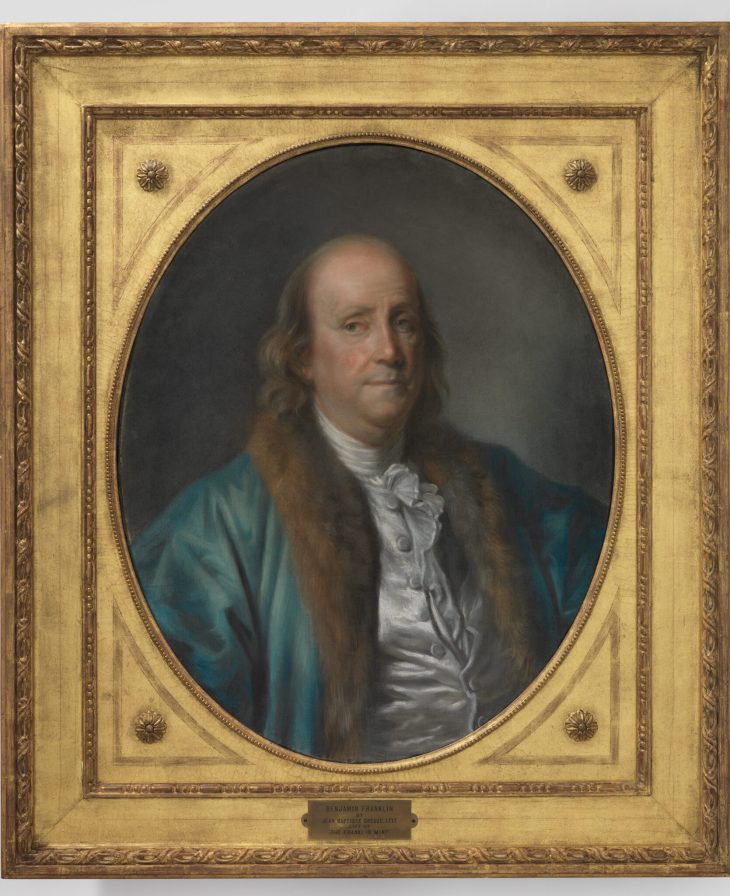
Today’s image is a 1777 portrait of Franklin by Jean-Baptiste Greuze (French, 1725-1805), pastel on paper (https://www.diplomaticrooms.state.gov/objects/portrait-of-benjamin-franklin/).