Word of the Day: Stipulate
Today’s word of the day, thanks to the Words Coach (https://www.wordscoach.com/dictionary), is stipulate. Pronounced / ˈstɪp jəˌleɪt /, with a secondary stress on the third syllable, it means “to make an express demand or arrangement as a condition of agreement” (intransitive), “to arrange expressly or specify in terms of agreement,” “to require as an essential condition in making an agreement,” or “to promise, in making an agreement” (transitive) (https://www.dictionary.com/browse/stipulate).
Merriam-Webster adds, “to give a guarantee of” (https://www.merriam-webster.com/dictionary/stipulate). In its Did You Know section, M-W also says, “Like many terms used in the legal profession, stipulate, an English word since the 17th century, has its roots in Latin. It comes from stipulatus, the past participle of stipulari, a verb meaning ‘to demand a guarantee (from a prospective debtor).’ In Roman law, oral contracts were deemed valid only if they followed a proper question-and-answer format; stipulate was sometimes used specifically of this same process of contract making, though it also could be used more generally for any means of making a contract or agreement. The ‘to specify as a condition or requirement’ meaning of stipulate also dates to the 17th century, and is the sense of the word most often encountered today” (ibid.).
The word appears in English in the “1620s, ‘bargain, make a contract’ (intransitive, a sense now obsolete), a back-formation from stipulation, or else from Latin stipulatus, past participle of stipulari ‘exact (a promise), bargain for.’
“The transitive sense of ‘demand as a condition of agreement’ is from 1640s. In reference to a document or agreement, ‘require or insist upon,’ by 1680s” (https://www.etymonline.com/word/stipulate).
Just as a reminder, a back-formation “is the process or result of creating a new word via morphology, typically by removing or substituting actual or supposed affixes from a lexical item, in a way that expands the number of lexemes associated with the corresponding root word” (https://en.wikipedia.org/wiki/Back-formation). An affix is a word-forming element that is added to a root at the beginning (a prefix), at the end (a suffix) or in the middle (an infix). In formal English, there are no infixes, but other languages do have them, and sometimes we can find infixes in casual English (“absof***inglutely). For instance, the word resurrection was borrowed from Old French around the year 1300, but the verb resurrect doesn’t appear until the 1700s, and it was created by dropping the -ion. The same thing happened with connection and connect and protection and protect.
Oh, and a lexeme is “a unit of lexical meaning that underlies a set of words that are related through inflection” (https://en.wikipedia.org/wiki/Lexeme). For instance, stipulate is a lexeme that includes the inflected forms stipulates, stipulated, and stipulating. It is a more precise word than word.
According to On This Day, on this date in 1884 “Sporting Life announces that both pennant winners will meet in 3 game series Oct 23-25 at Polo Grounds NYC to determine baseball champion” (https://www.onthisday.com/events/october/22).
The Sporting Life was a “weekly newspaper, published from 1883 to 1917 and from 1922 to 1924, that provided national coverage on sports with a particular focus on baseball and trap shooting” (https://en.wikipedia.org/wiki/Sporting_Life_(American_newspaper)).
“In 1884, [New York] Metropolitans manager Jim Mutrie issued a challenge to his NL counterpart, Frank Bancroft of the [Providence] Grays. Mutrie’s challenge was for a best-of-three series. Each team would put up a thousand dollars with the winner taking all.
“This pre-modern-era World Series would feature a pitching match-up of future Hall of Famers and 300-game winners Charles “Old Hoss” Radbourn and Tim Keefe. That was the year Radbourn won his season-record 59 games (some sources say 60) for the Grays. Keefe was a ‘mere’ 37–17. Playing under American Association rules, Radbourn and the Grays defeated the New York team in the first two games, 6–0 and 3–1.
“Only the first game went the full nine innings; the others were called after seven and six, because of darkness and extreme cold, respectively. The third game arguably should never have been played as the format was best-of-three, and Providence clinched in two. It was played with the hope of generating further revenue.
“The crowd for the third game comprised only 300 people due to bitter cold. The Grays did not want to play due to the weather but were given the option of choosing the umpire if they would play. The Grays accepted and strategically chose Keefe, the Mets best pitcher. Radbourn, pitching his third complete game in three days, led the Grays to a 12–2 rout. For the series, Radbourn allowed 11 hits and no earned runs in 22 innings.
“Local newspaper The New York Clipper called the series ;The Championship of the United States.’ Several newspapers such as The Sporting Life penned the Grays as ‘World Champions’, and the new title stuck.
“The total attendance for the three games was 3,800. Despite the low attendance, the two leagues continued the series, and attendance and prize money increased each of the next two years” (https://en.wikipedia.org/wiki/1884_World_Series).
Providence was part of the National League, and the Metropolitans were part of the American Association of Baseball Clubs, or just American Association, a league which lasted only from 1882 to 1891. What Major League Baseball calls the World Series was established in 1903 between the National League, which had been around since 1876, and the newly established American League, which became a major league in 1901.
One of the most fascinating parts of the story to me is that New York gave Providence the opportunity to choose the umpire for that third game. I wondered if perhaps in the early days of professional baseball the teams chose umpires from their sides, but the first professional umpire actually officiated the first National League game in 1876, a game between Boston and Philadelphia. Given that the series was really over after the first two games, I wonder if the umpires for the game refused to work it. It was, after all, quite cold, cold enough to get the teams to call the game early. In any case, it was interesting that New York would stipulate that Providence get to choose the umpire for the game, and Providence really took advantage of the arrangement.
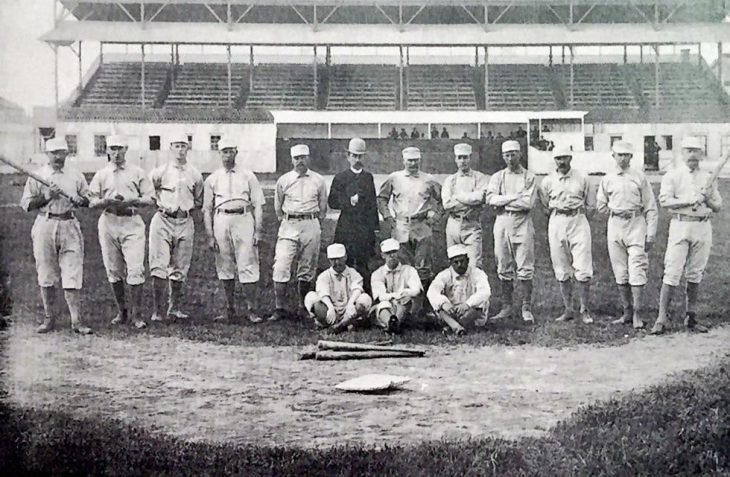
Today’s image is of the “1884 World Series champion Providence Grays baseball team Standing, left to right: Charles Radbourn, Charlie Sweeney, Miah Murray, Jerry Denny, Paul Hines, Frank Bancroft, Joe Start, Charley Bassett, John Cattanach, Cliff Carroll, Arthur Irwin, Jack Farrell Sitting, left to right: Barney Gilligan, Paul Radford, Sandy Nava” (https://en.wikipedia.org/wiki/1884_World_Series#/media/File:1884grays.jpg).
