Word of the Day: Meliorism
Today’s word of the day, courtesy of the Words Coach (https://www.wordscoach.com/dictionary), is meliorism. Pronounced / ˈmil jəˌrɪz əm /, this noun means “the doctrine that the world tends to become better or may be made better by human effort” (https://www.dictionary.com/browse/meliorism).
Etymonline.com says that it is “a metaphysical concept, ‘belief that the world tends to become better or is capable of improvement;’ in practical terms, ‘the improvement of society by regulated practical means;’ by 1868, attributed to ‘George Eliot’ (Mary Anne Evans), from Latin melior ‘better’ (see meliorate) + -ism. Related: Meliorist (1835); melioristic.
“’In her general attitude towards life, George Eliot was neither optimist nor pessimist. She held to the middle term, which she invented for herself, of “meliorist.” She was cheered by the hope and by the belief in gradual improvement of the mass; for in her view each individual must find the better part of happiness in helping another. [‘Life and Letters’]” (https://www.etymonline.com/search?q=meliorism).
Interestingly, Merriam-Webster says, in its Did You Know section, “In 1877, British novelist George Eliot believed she had coined meliorist when she wrote, ‘I don’t know that I ever heard anybody use the word “meliorist” except myself.’ Her contemporaries credited her with coining both meliorist and meliorism, and one of her letters contains an early documented use of meliorism; however, there is evidence that meliorist had been around decades before she started using it. Whoever coined it did so by drawing on the Latin word melior, meaning ‘better.’ It is likely that the English coinages were also influenced by another Melior descendant, meliorate, a synonym of ameliorate (‘to make better or more tolerable’) that was introduced to English in the 1500s” (https://www.merriam-webster.com/dictionary/meliorism). That quote from George Elliot is also included in the etymonline.com entry. Again, linguistics, particularly historical linguistics, is a science, but like any science, there are disagreements among the practitioners.
I should also mention that there is an entry for -ism: “word-forming element making nouns implying a practice, system, doctrine, etc., from French -isme or directly from Latin -isma, -ismus (source also of Italian, Spanish -ismo, Dutch, German -ismus), from Greek -ismos, noun ending signifying the practice or teaching of a thing, from the stem of verbs in -izein, a verb-forming element denoting the doing of the noun or adjective to which it is attached” (https://www.etymonline.com/word/-ism).
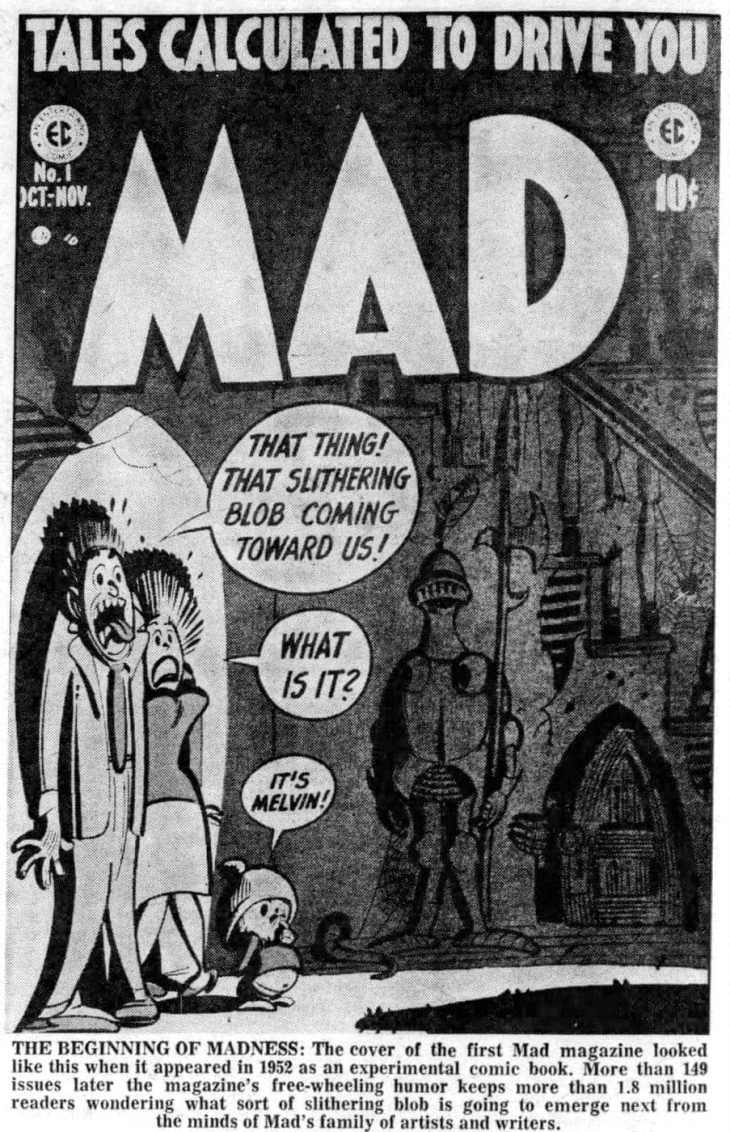
On this date, according to On This Day, in 1952, “The first issue of Mad magazine is published” (https://www.onthisday.com/events/october/18).
I’m not sure why On This Day chose this particular date for the initial publication of that magazine, because the wiki says, “Mad began as a comic book published by EC, debuting in August 1952 (cover date October–November)” (https://en.wikipedia.org/wiki/Mad_(magazine)).
According to Britannica, “American humorist Harvey Kurtzman created Mad as a way to boost his income as an editor at EC Comics [EC started as an education comic book company but transitioned to horror, crime, and other comics in the 1950s), where he began working in 1949. Fellow editor Al Feldstein had a higher salary than Kurtzman, because he wrote and edited seven bimonthly horror, science-fiction, and suspense titles, whereas Kurtzman wrote and edited the company’s two war/action-oriented titles, Two-Fisted Tales and Frontline Combat. EC publisher William Maxwell Gaines suggested that Kurtzman could earn a raise by starting a magazine dedicated to humour, which was Kurtzman’s forte. It is uncertain who came up with the title Mad. Kurtzman claimed that he originated the title; Gaines believed it came from him or Feldstein.
“The first few issues of Mad primarily parodied comic books and comic strips, and sales initially were weak. Sales picked up with the fourth issue, which contained a parody of Superman titled ‘Superduperman!’ and written by Kurtzman and illustrated by artist Wallace Wood. DC Comics, which published Superman, threatened Gaines with a lawsuit over perceived copyright infringement, but Gaines simply ignored the threat” (https://www.britannica.com/topic/Mad).
Originally published as a comic book, in 1955 the format converted to magazine. Kurtzman stayed on as the editor for about a year, but after some difficulties with Gaines, he left to try another venture. Gaines then appointed Al Feldstein as editor. He “swiftly brought aboard contributors such as Don Martin, Frank Jacobs, and Mort Drucker, and later Antonio Prohías, Dave Berg, and Sergio Aragonés. The magazine’s circulation more than quadrupled during Feldstein’s tenure, peaking at 2,132,655 in 1974; it later declined to a third of this figure by the end of his time as editor” (https://en.wikipedia.org/wiki/Mad_(magazine)).
According to the wiki, “Mad is often credited with filling a vital gap in political satire from the 1950s to 1970s” (ibid.). “The magazine often featured parodies of ongoing American culture, including advertising campaigns, the nuclear family, the media, big business, education and publishing. In the 1960s and beyond, it satirized such burgeoning topics as the sexual revolution, hippies, the generation gap, psychoanalysis, gun politics, pollution, the Vietnam War and recreational drug use. The magazine took a generally negative tone towards counterculture drugs such as cannabis and LSD, but it also savaged mainstream drugs such as tobacco and alcohol. Mad always satirized Democrats as mercilessly as it did Republicans. In 2007, Al Feldstein recalled, ‘We even used to rake the hippies over the coals. They were protesting the Vietnam War, but we took aspects of their culture and had fun with it. Mad was wide open. Bill loved it, and he was a capitalist Republican. I loved it, and I was a liberal Democrat. That went for the writers, too; they all had their own political leanings, and everybody had a voice. But the voices were mostly critical. It was social commentary, after all.” Mad also ran a good deal of less topical or contentious material on such varied subjects as fairy tales, nursery rhymes, greeting cards, sports, small talk, poetry, marriage, comic strips, awards shows, cars and many other areas of general interest” (ibid.).
In a Facebook post, somebody wrote, “In the 1960s when I was 9 years old I started reading MAD magazine. It was a blast! My mom said that Alfred E. Neumann with his goofy grin drove her crazy” (https://www.facebook.com/groups/294755109282927/posts/1239199364838492/). I would dare to say that a lot of parents in the 1960s and 1970s felt exactly the same way. In fact, I would bet that a lot of parents refused to let their kids read the magazine, though a lot of those kids probably went to a friends house and read it at a friend’s house over the weekend.
Mad engaged in parody and satire. “The crucial difference between satire and parody is their target. Satire’s target is always a social, moral, or political reality — a form of vice, folly, or corruption in the world. The satirical text may use parodic imitation as one of its tools, but the ultimate object of the satirical critique is something in the world, not the text being imitated. Parody’s immediate target is always a text or style — the object of critique is the original work and its conventions. When Swift writes a ‘Modest Proposal’ in the style of the economic tracts of his day, he is using parody as a tool of satire: he imitates the genre to criticize the economic thinking and political cruelty that the genre expresses. The parody is in the service of the satire.
“This means that satire without parody is entirely possible — and indeed, most satire does not depend on parody — while parody without satirical intent is equally possible. Many parodies are affectionate rather than critical; they celebrate and enjoy the original rather than attacking it. The academic study of parody consistently emphasizes this point: parody and satire are related but neither is a subset of the other, and conflating them produces misunderstanding of both. For the practicing satirist, the practical implication is clear: choosing to use parodic imitation is a formal decision, not an automatic expression of satirical intent, and the satirical argument must be constructed independently of the parodic form” (https://satire.info/parody-vs-satire-where-the-two-forms-meet-and-diverge/).
But here’s the thing about satire and parody. People who employ them don’t do so for fun; they really want something to change, even if it is only a particular style. They believe by satirizing or parodying someone, that someone will look in the mirror and realize that they can do better. In other words, satirists believe in meliorism; otherwise, why bother.
Today’s image is of that very first Mad magazine from 1952 (https://clickamericana.com/media/magazines/vintage-mad-magazine-covers-company-history).