Word of the Day: Chimera
Today’s word of the day, courtesy of The Dictionary Project, which sends out a daily email, is chimera. Pronounced / kaɪˈmɪər ə /, this noun means “a fire-breathing monster, commonly represented with a lion’s head, a goat’s body, and a serpent’s tail,” “any grotesque monster having disparate parts, as depicted or described in art, legend, fantasy fiction, video games, etc.,” “a strange, horrible, or impossible idea or figment of the imagination,” anything created by taking parts or aspects of different kinds of things and combining them,” or “an organism composed of two or more genetically distinct tissues, such as one produced artificially by combining cells or tissues from different species” (that last definition comes from the science of genetics) (https://www.dictionary.com/browse/chimera). The Dictionary Project also includes as a definition “a foolish fancy.”
The word first appears in English in the “late 14c., from Old French chimere or directly from Medieval Latin chimera, from Latin Chimaera, from Greek khimaira, name of a mythical fire-breathing creature (slain by Bellerophon) with a lion’s head, a goat’s body, and a dragon’s tail, a word that also meant ‘year-old she-goat’ (masc. khimaros), from kheima ‘winter season,’ from PIE root *gheim- ‘winter.’
“Supposedly a personification of snow or winter, but the connection to winter might be no more than the ancient habit of reckoning years as ‘winters.’ It was held by the ancients to represent a volcano; perhaps it was a symbol of ‘winter storms’ (another sense of Greek kheima) and generally of destructive natural forces. The word was used generically for ‘any grotesque monster formed from parts of other animals;’ hence the figurative meaning ‘wild fantasy’ first recorded 1580s in English (13c. in French).
“Beestis clepid chymeres, that han a part of ech beest, and suche ben not, no but oonly in opynyoun. [Wycliffe, ‘Prologue’]” (https://www.etymonline.com/word/chimera).
In its Did You Know section, Merriam-Webster says, “’In head and shoulders, she was like a lion, / in back and tail, a snake, and in the middle, / a she-goat, and she breathed a dreadful blast / of blazing fire.’ So did Homer describe the fearsome Chimera in The Iliad (as translated by scholar Emily Wilson in 2023). The Chimera terrorized the people of Lycia until slain by the hero Bellerophon, but the beast lived on in people’s imaginations, and English speakers adopted her name for any monster similarly composed of the parts of different animals. Later, chimera took on another meaning that is common in today’s lexicon: ‘an illusion of the mind, especially an unrealized dream.’ This sense of chimera is often used to refer to a fantasy or delusion” (https://www.merriam-webster.com/dictionary/chimera).
In addition, a “chimera, in genetics, an organism or tissue that contains at least two different sets of DNA, most often originating from the fusion of as many different zygotes (fertilized eggs)…. Included among the different known types of animal chimeras are dispermic and twin chimeras, microchimeras, and parthenogenetic and androgenetic chimeras” (https://www.britannica.com/science/chimera-genetics). But I’m going to stop right there.
According to On This Day, on this date in 1644, “’Areopagitica’, a pamphlet by John Milton decrying censorship, is published” (https://www.onthisday.com/events/november/23).
You may know John Milton as the author of Paradise Lost; at least, I hope you do. That is one of the great epic poems in literary history, although I have to admit that if you want to read it you should probably read it in the context of a reading group or a class with someone who knows what is going on. The first time I read Paradise Lost, back when I was in high school, I struggled with it, with that iambic pentameter and those periodic sentences that Milton loved to use, not to mention his use of Latinate words with their Latin meanings. But the second time I read it, when I was in college, it really made sense. Then, when I was in grad school doing a seminar on Milton with Dr. Coburn Freer, with his help I really began to see the humor and the pathos.
And if you do know the name John Milton, you probably know that he was a Puritan. In fact, he worked for the government of the Commonwealth, during the Inter-Regnum. He was appointed Secretary of Foreign Tongues by the Council of State. “Milton’s new job, which carried a salary of £288 a year (at least £60,000 today) with two assistants and quarters in Whitehall, involved him in translating official communications with foreign governments into Latin and translating the replies into English. As few foreign governments wished to have much to do with the regime in England, Milton could spend his time writing propaganda tracts for his employers. One of them was Eikonoklastes (‘The Image-Breaker’), which came out in October, 1649. It was a counterblast to the Eikon Basilike (‘The Royal Image’), believed to be an account of the last days of his life by the martyred Charles himself, which was treasured as virtually holy writ in many Royalist households. Milton also supervised the pro-government newspaper Mercurius Politicus. He wrote little poetry during this period of his life” (https://www.historytoday.com/archive/milton-appointed-latin-secretary). In other words, he was kind of the propagandist for the Puritan government.
And the Puritans, who cut off the head of Charles I and ruled England from 1649 to 1660, were known then and are still known as very religious and some might say rigid people. It was the Puritans who closed the theaters in 1642 because theaters were a cause for idleness and an invitation to vice.
So it may come as a surprise to learn why Milton wrote “Areopagitica” and what exactly he is arguing in this pamphlet.
Milton was born in 1608. In 1642, after gaining a university degree, writing a lot of poetry, and traveling around Europe, he “married Mary Powell in 1642, Milton was a few months afterward deserted by his wife, who returned to her family’s residence in Oxfordshire. The reason for their separation is unknown, though perhaps Mary adhered to the Royalist inclinations of her family whereas her husband was progressively anti-Royalist. Or perhaps the discrepancy in their ages—he was 34, she was 17—led to a lack of mutual understanding. During her absence of approximately three years, Milton may have been planning marriage to another woman. But after Mary’s return, she and Milton evidently overcame the causes of their estrangement. Three daughters (Anne, Mary, and Deborah) were born, but a son, John, died at age one. Milton’s wife died in 1652 after giving birth to Deborah” (https://www.britannica.com/biography/John-Milton/Early-translations-and-poems).
“During his domestic strife and after his wife’s desertion, Milton probably began to frame the arguments of four prose tracts: The Doctrine and Discipline of Divorce (1643, enlarged 2nd ed. 1644), The Judgment of Martin Bucer Concerning Divorce (1644), Tetrachordon (1645), and Colasterion (1645). Whether or not his personal experience with Mary affected his views on marriage, Milton mounts a cogent, radical argument for divorce, an argument informed by the concepts of personal liberty and individual volition, the latter being instrumental in maintaining or ending a marriage. For Milton, marriage depends on the compatibility of the partners, and to maintain a marriage that is without mutual love and sympathy violates one’s personal liberty. In such circumstances, the marriage has already ceased. In his later divorce tracts, Milton buttresses his arguments with citations of scholars, such as the 16th-century reformer Martin Bucer, and with biblical passages that he marshals as proof texts” (ibid.).
But in 1643, Milton got in trouble with the authorities over his pro-divorce writings. Prior to the rise of Parliament, the English Crown engaged in fairly substantial censorship. The Star Chamber Court had been founded in the 15th century “to ensure the fair enforcement of laws against socially and politically prominent people sufficiently powerful that ordinary courts might hesitate to convict them of their crimes” (https://en.wikipedia.org/wiki/Star_Chamber). But “King Charles I used the Court of Star Chamber as a Parliamentary substitute during the eleven years of Personal Rule, when he ruled without a Parliament [from 1629 to 1640]. King Charles made extensive use of the Court of Star Chamber to prosecute dissenters, including the Puritans who fled to New England” (ibid.). Parliament banned the Star Chamber in 1640 or 1641. The end of the Star Chamber meant a temporary end to censorship in England, and people began to publish all sorts of pamphlets, leading to the Pamphlet Wars of 1641, which included Milton, Henry Walker, and John Taylor.
But the Puritans in charge of Parliament couldn’t appreciate the exchange of ideas, so they passed “An Ordinance for the Regulating of Printing of 14 June 1643” (https://en.wikipedia.org/wiki/Licensing_Order_of_1643). Among other things, it re-established pre-publication censorship and allowed Parliament to confiscate printing equipment if the rules weren’t followed. And that is why Milton wrote Areopagitica.
“It takes its title in part from Areopagitikós (Greek: Ἀρεοπαγιτικός), a speech written by Athenian orator Isocrates in the 4th century BC. The Areopagus is a hill in Athens, the site of real and legendary tribunals, and was the name of a council whose power Isocrates hoped to restore. Some argue that it is more importantly also a reference to the defence that St Paul made before the Areopagus in Athens against charges of promulgating foreign gods and strange teachings, as recorded in Acts 17:18–34” (https://en.wikipedia.org/wiki/Areopagitica).
“Before presenting his argument, Milton defends the very idea of writing a treatise such as Areopagitica. He compliments England for having overcome the tyranny of Charles I and the prelates, but his purpose is to voice his grievances. Milton defends this purpose, holding that to bring forth complaints before the Parliament is a matter of civil liberty and loyalty, because constructive criticism is better than false flattery. He concludes his introduction by encouraging Parliament to obey ‘the voice of reason’ and to be ‘willing to repeal any Act’ for the sake of truth and upright judgment” (ibid.).
I’ll throw out a few quotes from it: “unlesse warinesse be us’d, as good almost kill a Man as kill a good Book; who kills a Man kills a reasonable creature, Gods Image; but hee who destroyes a good Booke, kills reason it selfe, kills the Image of God, as it were in the eye. Many a man lives a burden to the Earth; but a good Booke is the pretious life-blood of a master spirit, imbalm’d and treasur’d up on purpose to a life beyond life” (https://milton.host.dartmouth.edu/reading_room/areopagitica/text.shtml).
And, “many there be that complain of divin Providence for suffering Adam to transgresse, foolish tongues! when God gave him reason, he gave him freedom to choose, for reason is but choosing; he had bin else a meer artificiall Adam, such an Adam as he is in the motions. We our selves esteem not of that obedience, or love, or gift, which is of force: God therefore left him free, set before him a provoking object, ever almost in his eyes herein consisted his merit, herein the right of his reward, the praise of his abstinence. Wherefore did he creat passions within us, pleasures round about us, but that these rightly temper’d are the very ingredients of vertu? They are not skilfull considerers of human things, who imagin to remove sin by removing the matter of sin…. Though ye take from a covetous man all his treasure, he has yet one jewell left, ye cannot bereave him of his covetousnesse. Banish all objects of lust, shut up all youth into the severest discipline that can be exercis’d in any hermitage, ye cannot make them chaste, that came not thither so: such great care and wisdom is requir’d to the right managing of this point. Suppose we could expell sin by this means; look how much we thus expell of sin, so much we expell of vertue: for the matter of them both is the same; remove that, and ye remove them both alike” (ibid.).
“Where there is much desire to learn, there of necessity will be much arguing, much writing, many opinions; for opinion in good men is but knowledge in the making” (ibid.).
“And though all the windes of doctrin were let loose to play upon the earth, so Truth be in the field, we do injuriously, by licencing and prohibiting to misdoubt her strength. Let her and Falshood grapple; who ever knew Truth put to the wors, in a free and open encounter” (ibid.).
That should give you the general idea—it’s very, very long for a modern audience. But it’s remarkable that a man known for his Puritan sympathies would construct such a great argument for freedom of speech and freedom of the press. Maybe he was an intellectual chimera.
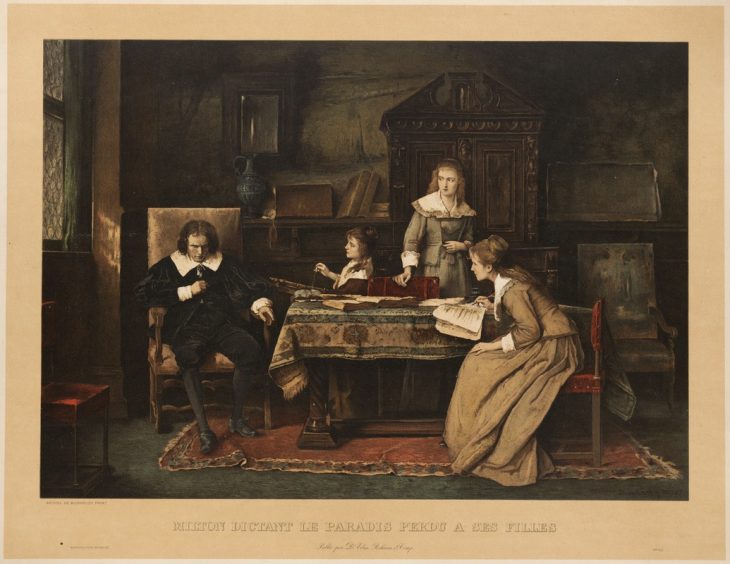
Milton went blind later in life, perhaps from all the reading, translating, and writing he did for the Commonwealth government. And it was in his blindness that he wrote Paradise Lost. He would compose it in his head at night and dictate it to his daughters, those daughters from his marriage to Mary, during the day. And that is the image for today: “John Milton dictating ‘Paradise Lost’ to his daughters” by Munkácsy, Mihály, 1844-1900 (https://www.digitalcommonwealth.org/search/commonwealth:vx022077z).