Word of the Day: Inamorata
Today’s word of the day, courtesy of the Words Coach (https://www.wordscoach.com/dictionary), is inamorata. Pronounced / ɪnˌæm əˈrɑ tə /, with a secondary stress on the second syllable and the primary stress on the fourth syllable, this noun means “a woman who loves or is loved; female sweetheart or lover” (https://www.dictionary.com/browse/inamorata).
The word first appears in English in the “1650s, from Italian innamorata ‘mistress, sweetheart,’ noun use of fem. of innamorato, past participle of innamorare ‘to fall in love,’ from in ‘in’ (from Latin, see in) + amore ‘love,’ from Latin amor” (https://www.etymonline.com/search?q=inamorata). The male version, inamorato, actually appears earlier, in the “1590s, from Italian innamorato, noun use of masc. past participle of innamorare ‘to fall in love’” (ibid.). You may have noticed that the only difference between the Italian and the English is that the English dropped an n.
I first came across a form of this word when I was in college, majoring in theater.
There is, in the history of theater, a type of improvisational drama called commedia dell’arte; “It was formerly called Italian comedy in English and is also known as commedia alla maschera, commedia improvviso, and commedia dell’arte all’improvviso” (https://en.wikipedia.org/wiki/Commedia_dell’arte). Translated, those terms are “comedy of art,” “comedy of masks,” “improvisational comedy,” and “improvisational comedy of art.”
“The first recorded commedia dell’arte performances came from Rome as early as 1551. Commedia dell’arte was performed outdoors in temporary venues by professional actors who were costumed and masked, as opposed to commedia erudita (lit. ’learned comedy’), which were written comedies, presented indoors by untrained and unmasked actors. This view may be somewhat romanticized since records describe the Gelosi performing Tasso’s Aminta, for example, and much was done at court rather than in the street. By the mid-16th century, specific troupes of commedia performers began to coalesce, and by 1568 the Gelosi became a distinct company. In keeping with the tradition of the Italian Academies, the Gelosi adopted as their impress (or coat of arms) the two-faced Roman god Janus” (ibid.). I would try to contextualize this type of theater within the history of the theater in the Middle Ages and Renaissance, but suffice it to say that prior to the 1500s professional actors weren’t really a thing. Amateur actors go back to the mystery or cycle plays of the Middle Ages, and boys or young men in schools performed classical plays, like those of Plautus and Terence, and gradually began performing original plays or adaptations.
Many of us are familiar with the plays of the English Renaissance, the plays of Shakespeare and Marlowe, Jonson and Middleton, among many others. The French classics came in the 17th century—Moliere, Racine, Corneil. Those were all scripted plays. What made the commedia different was that the plays were, as the above names indicate, improvisational.
“The characters of the commedia usually represent fixed social types and stock characters, such as foolish old men, devious servants, or military officers full of false bravado. The characters are exaggerated ‘real characters’, such as a know-it-all doctor called il Dottore, a clever and mischievous servant known as Arlecchino, a greedy old man called Pantalone, or a perfect relationship like the innamorati” (ibid.).
“Commedia dell’arte has four stock character groups:
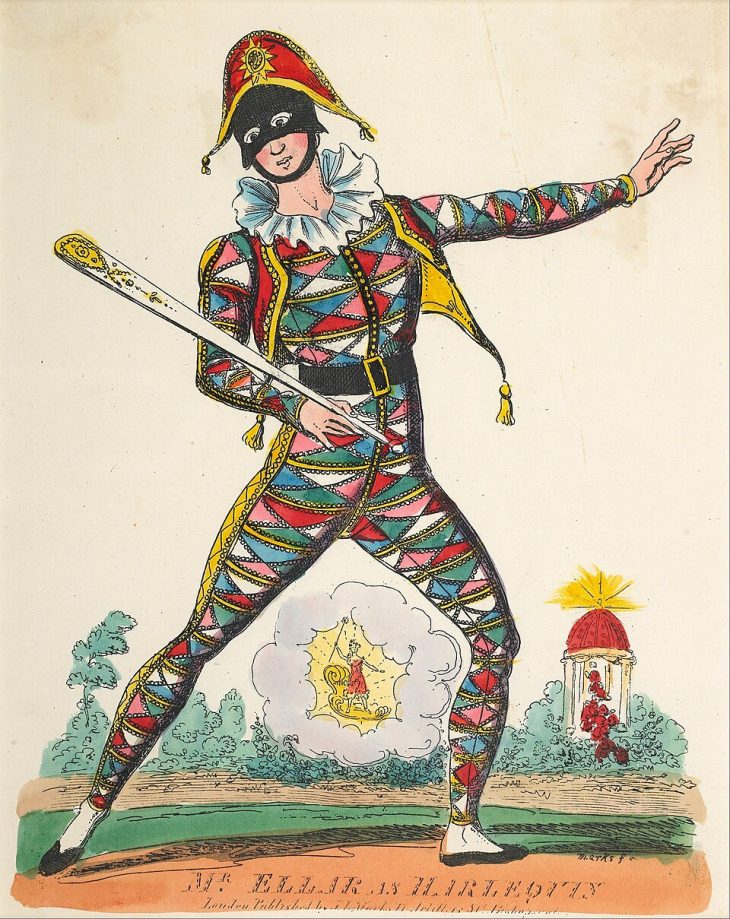
- Zanni: servants, clowns; characters such as Arlecchino (also known as Harlequin), Brighella, Scapino, Pulcinella and Pedrolino
- Vecchi: wealthy old men, masters; characters such as Pantalone and il Dottore
- Innamorati: young upper class lovers; who would have names such as Flavio and Isabella
- Il Capitano: self-styled captains, braggarts (Scaramuccia); can also be la Signora if a female
“Masked characters are often referred to as ‘masks’ (Italian: maschere), which, according to John Rudlin, cannot be separated from the character. In other words, the characteristics of the character and the characteristics of the mask are the same. In time however, the word maschere came to refer to all of the characters of the commedia dell’arte whether masked or not. Female characters (including female servants) are most often not masked (female amorose are never masked). The female character in the masters group is called Prima Donna and can be one of the lovers. There is also a female character known as The Courtisane who can also have a servant. Female servants wore bonnets. Their character was played with a malicious wit or gossipy gaiety. The amorosi are often children of a male character in the masters group, but not of any female character in the masters group, which may represent younger women who have e.g. married an old man, or a high-class courtesan. Female characters in the masters group, while younger than their male counterparts, are nevertheless older than the amorosi. Some of the better known commedia dell’arte characters are Pierrot and Pierrette, Pantalone, Gianduja, il Dottore, Brighella, il Capitano, Colombina, the innamorati, Pedrolino, Pulcinella, Arlecchino, Sandrone, Scaramuccia (also known as Scaramouche), la Signora, and Tartaglia” (https://en.wikipedia.org/wiki/Commedia_dell’arte).
So here, in a nutshell, is how I think it worked. The troup had a basic plot outline. But as the show progressed, the characters ad libbed the dialogue as they went through the play. I’m sure they had patterns of lines that they had performed many times. But one thing they could do was expand upon a scene that was working for a particular audience or shorten a scene that wasn’t working so well. “Since the productions were improvised, dialogue and action could easily be changed to satirize local scandals, current events, or regional tastes, while still using old jokes and punchlines” (https://en.wikipedia.org/wiki/Commedia_dell’arte).
The servant characters, particularly Arlecchino, would have engaged in a lot of physical humor. The physical humor today is called slapstick. “The name ‘slapstick’ originates from the Italian batacchio or bataccio—called the ‘slap stick’ in English—a club-like object composed of two wooden slats used in commedia dell’arte. When struck, the Batacchio produces a loud smacking noise, though it is only a little force that is transferred from the object to the person being struck. Actors may thus hit one another repeatedly with great audible effect while causing no damage and only very minor, if any, pain. Along with the inflatable bladder (of which the whoopee cushion is a modern variant), it was among the earliest special effects” (https://en.wikipedia.org/wiki/Slapstick).
“Conventional plot lines were written on themes of sex, jealousy, love, and old age. Many of the basic plot elements can be traced back to the Roman comedies of Plautus and Terence, some of which were themselves translations of lost Greek comedies of the 4th century BC. However, it is more probable that the comici used contemporary novella or traditional sources, and drew from current events and local news of the day. Not all scenarios were comic, there were some mixed forms and even tragedies” (https://en.wikipedia.org/wiki/Commedia_dell’arte). Some of Shakespeare’s comedies, particularly the Comedy of Errors, bear similarities to these plots.
In other words, the basic plots involved young lovers who were being blocked from marriage by other characters, blocking agents, particularly a father or an older man who wanted to marry the young woman. These lovers were the inamorati, and the young woman was the inamorata.
In the eighteenth century, Carlo Goldoni wrote a number of plays in the style of the Commedia dell’arte. One of these classics is called The Servant of Two Masters (1745), which I saw in college. It was funny and entertaining.
Today’s image is of “Mr Ellar as Harlequin” (https://commons.wikimedia.org/wiki/File:Marks,_J.L._-_theatrical_portrait_-_Mr_Ellar_as_Harlequin_-_Google_Art_Project.jpg), a theatrical portrait that is a print on paper from sometime in the early 19th century. You can’t really see the double layer of wood, but you’ll have to trust me that it is there.
