Word of the Day: Usufruct
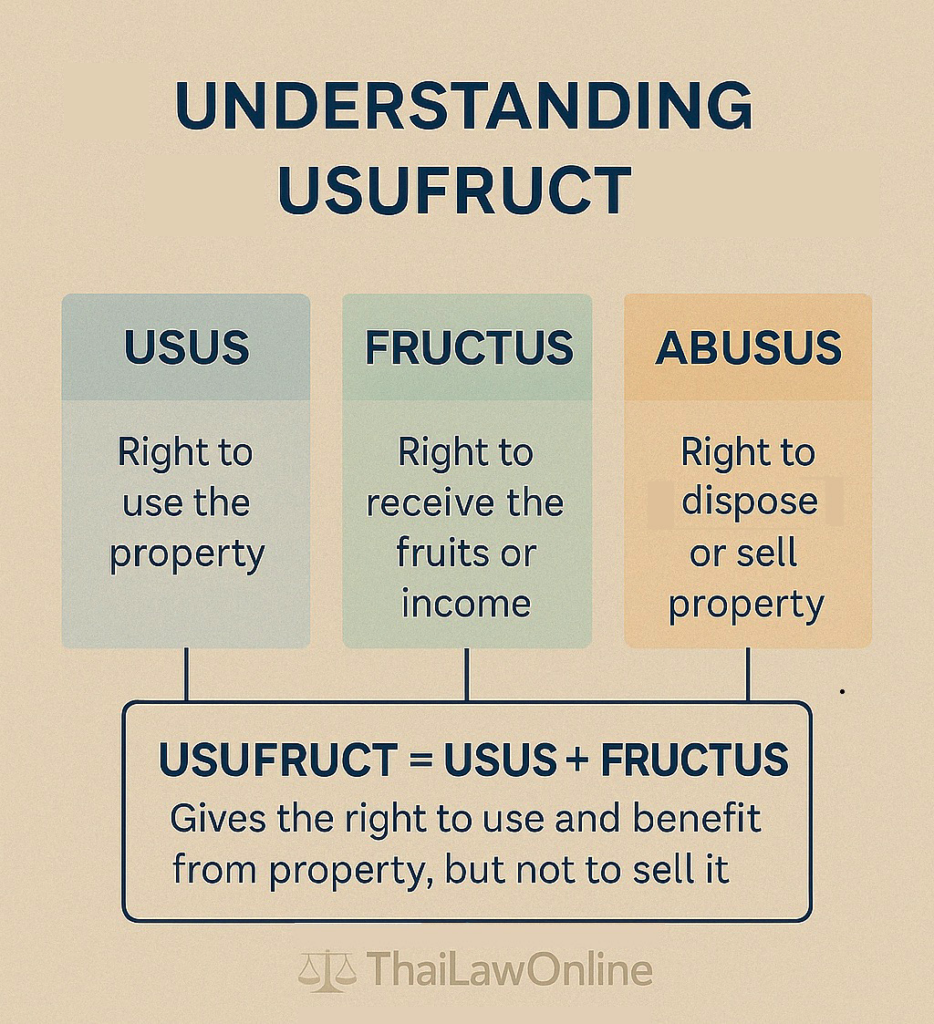
Today’s word of the day, courtesy of the Words Coach (https://www.wordscoach.com/dictionary), is usufruct. Pronounced / ˈju zʊˌfrʌkt / or / ˈju sʊˌfrʌkt /, with a secondary stress on the third syllable, and with an option of the voiced or voiceless alveolar sibilant, this noun means “the right of enjoying all the advantages derivable from the use of something that belongs to another, as far as is compatible with the substance of the thing not being destroyed or injured” (https://www.dictionary.com/browse/usufruct).
In its Did You Know section, Merriam-Webster writes about “Usufruct and Thomas Jefferson,” saying, “Thomas Jefferson said, ‘The earth belongs in usufruct to the living.’ He apparently understood that when you hold something in usufruct, you gain something of significant value, but only temporarily. The gains granted by usufruct can be clearly seen in the Latin phrase from which the word developed, usus et fructus, which means ‘use and enjoyment.’ Latin speakers condensed that phrase to ususfructus, the term English speakers used as the model for our modern word. Usufruct has been used as a noun for the legal right to use something since the mid-1600s. Any right granted by usufruct ends at a specific point, usually the death of the individual who holds it” (https://www.merriam-webster.com/dictionary/usufructhttps://www.merriam-webster.com/dictionary/usufruct).
The word first appears in English law in the “1610s (implied in usufructuary), from Late Latin usufructus, in full usus et fructus ‘use and enjoyment,’ from Latin usus ‘a use’ (see use (n.)) + fructus ‘enjoyment,’ also ‘fruit’ (from PIE root *bhrug- ‘to enjoy,’ with derivatives referring to agricultural products). Attested earlier as half-delatinized usufruit (late 15c.)” (https://www.etymonline.com/word/usufruct). Use appears “c. 1300, ‘act of employing (something) fact of being used or employed;’ also ‘individual habit or practice; manner of living, way of using;’ from Anglo-French and Old French us, hus ‘custom, practice, usage.’ This is from Latin usus ‘use, custom, practice, employment, skill, habit,’ from past-participle stem of uti ‘make use of, profit by, take advantage of’” (ibid.).
The word use actually first came into the language, around 1200, as a verb. You can tell the difference between the noun and the verb not by the spelling but by the pronunciation: the verb employs a voiced alveolar sibilant (/z/), while the noun employs the voiceless alveolar sibilant (/s/). English has done a lot of reborrowing over the years, and one example of that is the word utilize, which means “’make useful, make use of’” and first appears in “1794, from French utiliser, from Italian utilizzare, from utile ‘usable,’ from Latin utilis ‘usable,’ from uti ‘make use of, profit by, take advantage of’” (https://www.etymonline.com/search?q=utilize). So the verb use and the verb utilize both come from the Latin uti.
According to On This Day, on this date in 1980, “Anchorman Dan Rather alleges cabbie tried to kidnap him, refuses to pay his fare in dispute with cab driver” (https://www.onthisday.com/events/november/10).
Younger people may not know the name Dan Rather at all, and somewhat older people will recognize him as a telejournalist from the CBS Evening News, of which he was the anchor from 1981 until 2006. But his career actually began in the early 1950s, when he was a journalism student at Sam Houston State Teachers College. After earning his degree, he briefly joined the Marines but was kicked out after the Corps found that he had had rheumatic fever as a boy.
He first came to national attention when he covered Hurricane Carla in 1962 for the local Houston CBS affiliate. He was the first reporter to use radar images to show his audience the size and scope of a hurricane, and he got credited with saving thousands of lives when 350,000 people evacuated (https://en.wikipedia.org/wiki/Dan_Rather). He happened to be in Dallas on November 23, 1963, when President John F. Kennedy was assassinated, and his reporting in the days following impressed the bosses at CBS enough to make him the network’s Washington correspondent. “In 1965, Rather served as a foreign correspondent for CBS in London, and in 1966 in Vietnam. He served again as White House correspondent during the presidency of Richard Nixon. In 1970, he was also assigned as anchor for the CBS Sunday Night News (1970–73; 1974–75), and later for the CBS Saturday Evening News (1973–76) and rotated with Bob Schieffer on the CBS Sunday “Evening News” (1976). Rather was among those journalists who accompanied Nixon to China. He later covered the Watergate investigation, as well as the impeachment proceedings against Richard Nixon in Congress” (ibid.).
“After President Nixon’s resignation in 1974, Rather became chief correspondent for the documentary series CBS Reports. In December 1975, he became a correspondent of the long-running Sunday night news show 60 Minutes—at the time the program was moved from a Sunday afternoon time-slot to primetime. Success there helped Rather pull ahead of longtime correspondent Roger Mudd, who was in line to succeed Walter Cronkite as anchor and Managing Editor of The CBS Evening News” (ibid.).
Rather was a very prominent journalist in the second half of the twentieth and the beginning of the twenty-first centuries. But unlike his predecessor, Walter Cronkite, he was not perceived as objective. Even his colleague Andy Rooney described him as “transparently liberal” (ibid.). And liberals in the USA were, in the twentieth century, seen as favoring the working class. So what happened in 1980, though disputed in its details, was rather shocking.
According to a UPI article at the time, Rather took a cab to the home of writer Studs Terkel for an interview. The cab driver, Gene Phillips, had a bit of trouble finding the address and got a little frustrated. Finally, upon finding the address, the cab driver was stiffed by Rather. “Rather went to get his wallet, then he leaned forward and said, ‘Driver, where’s your license?’ Phillips said. I had received a ticket, and they had my chauffeur’s license (the one displayed in the cab) as bond. I’m permitted to drive on a ticket.”
So instead of letting Rather out of the cab, Phillips took off down the road. “You see, that’s the only thing a driver can legally do when somebody says they aren’t going to pay. If I try to stop him physically, then he’s got me for assault. If I keep his luggage, they they’ve got me for theft of his property. If I follow him into the house, they’ve got me for trespassing.”
Rather asked the city of Chicago to rescind his taxi license and accused him of kidnapping. The result was that Phillips got to keep driving while the case was investigated, but he did spend a little time in jail and was charged with disorderly conduct and something else. But the charges were dropped, and CBS send Phillips the $12 that Rather, according to Phillips, refused to pay. Most of the coverage at the time favored Rather’s version of the story, but it was reported that Phillips called Rather a “big fat liar.”
Ultimately, it’s impossible for us to know exactly what happened because we weren’t in the cab. Still, it is shocking that a person with Rather’s prestige and fame would take advantage of his position and status to accuse a lowly cab driver. Perhaps Rather thought he should have usufruct of Phillips’s vehicle.
Today’s image is of a handy little illustration of usufruct, and its limits (https://www.thailawonline.com/wp-content/uploads/2026/03/understanding-usufruct-usus-fructus-abusus-civil-law-934×1024.png). BTW, there is a personal element in this. My parents-in-law left two houses in trust to their daughters, allowing them to live in the houses or rent them out for the income. Ultimately, the houses will be inherited by their children, to be shared like and alike. So my wife and her sister have usufruct of these houses.