Word of the Day: Cogent
Today’s word of the day, courtesy of the Words Coach (https://www.wordscoach.com/dictionary) is cogent. Pronounced / ˈkoʊ dʒənt /, this adjective means “convincing or believable by virtue of forcible, clear, or incisive presentation; telling” or “to the point; relevant; pertinent” (https://www.dictionary.com/browse/cogent).
In its Did You Know? section, Merriam-Webster writes, “A cogent argument is one that really drives its point home because it is clear, coherent, and readily understandable, and perhaps also because of the etymological history of cogent. Cogent comes from the Latin verb cōgere, meaning ‘to drive or force together.’ Something described as cogent fuses thoughts and ideas into a meaningful whole that others can readily grasp and accept. A cogent explanation is a convincing one, and cogent analysis has us nodding along because it is clear and pertinent. Cōgere was formed in Latin by combining the prefix co– with the verb agere, ‘to drive, lead, or act,’ a root which is also the source of our familiar noun agent. Handily enough, one definition of agent is ‘a means or instrument by which a guiding intelligence achieves a result.’ It follows logically then that cogency is often a worthwhile agent, indeed” (https://www.merriam-webster.com/dictionary/cogent).
The word first appears in English in the “1650s, from French cogent ‘necessary, urgent’ (14c.), from Latin cogentem (nominative cogens), present participle of cogere ‘to curdle; to compel; to collect,’ literally ‘to drive together,’ from assimilated form of com ‘together’ (see co-) + agere ‘to set in motion, drive, drive forward; to do, perform’ (from PIE root *ag- ‘to drive, draw out or forth, move’)” (https://www.etymonline.com/word/cogent).
On this date in 392, according to On This Day, “Roman Emperor Theodosius I declares Christianity the state religion” (https://www.onthisday.com/events/november/8).
The Christian religion begins around the 33 CE (or, more traditionally, AD, which stands for Anno Domini, or the Year of Our Lord, meaning the number of years after Jesus’s birth). For a while it was perceived as just a cult within the Jewish faith, but eventually it was recognized as a different religion altogether. It grew quickly throughout the Roman Empire, in large part because of the apostles, like Paul, who spread the word. For the first few decades, it was largely ignored by the authorities.
“According to Tacitus, the first wave of organized persecution occurred under Nero (r. 54–68), who blamed Christians for the Great Fire of Rome in 64. A number of mostly localized persecutions occurred during the reign of Marcus Aurelius (r. 161–180). After a lull, persecution resumed under Decius (r. 249–251) and Trebonianus Gallus (r. 251–253). The Decian persecution was particularly extensive, as Decius strived to restore the Roman golden age in part by forcing pagan practices upon the Christian community. Another wave of persecution began under Valerian (r. 253–260), but ceased abruptly after he was captured and taken prisoner by the Sasanian Empire during the Battle of Edessa of the Roman–Persian Wars. Under his successor Gallienus (r. 253–268), whose reign was marred by rapidly escalating military conflicts of the Crisis of the Third Century, the first ever decree of tolerance was issued for Christian practices and places of worship, although it stopped short of recognizing Christianity as a religion with legal status.
“Emperor Diocletian (r. 283–305) began the Diocletianic persecution, which was the final and the most severe wave of persecution of Christians by the Roman state. His edict allowed for the destruction of Christian churches, burning their scriptures, confiscating property, banning Christians from taking legal actions, the loss of privileges for high ranking officials who became and stayed Christian, and even imprisonment. It was enforced until the accession of Galerius (r. 305–311), who issued the Edict of Serdica” (https://en.wikipedia.org/wiki/Persecution_of_Christians_in_the_Roman_Empire). The Edict of Serdica, issued in 311, officially ended the Dicletianic persecution in the Eastern Roman Empire. “The Edict implicitly granted Christianity the status of religio licita, a worship that was recognized and accepted by the Roman Empire. It was the first edict legalizing Christianity and preceded the Edict of Milan by two years” (https://en.wikipedia.org/wiki/Edict_of_Serdica).
The most famous event in the history of the Church and the Empire occurred in 312. The Battle of the Milvian Bridge, a bridge over the Tiber River, the river upon whose banks the city of Rome was founded. This battle was fought between the Roman Emperor Constantine and his rival the Emperor Maxentius. “It is commonly understood that on the evening of 27 October with the armies preparing for battle, Constantine had a vision which led him to fight under the protection of the Christian God…. Lactantius states that, on the night before the battle, Constantine was commanded in a dream to “delineate the heavenly sign on the shields of his soldiers” (On the Deaths of the Persecutors 44.5). He followed the commands of his dream and marked the shields with a sign ‘denoting Christ.’
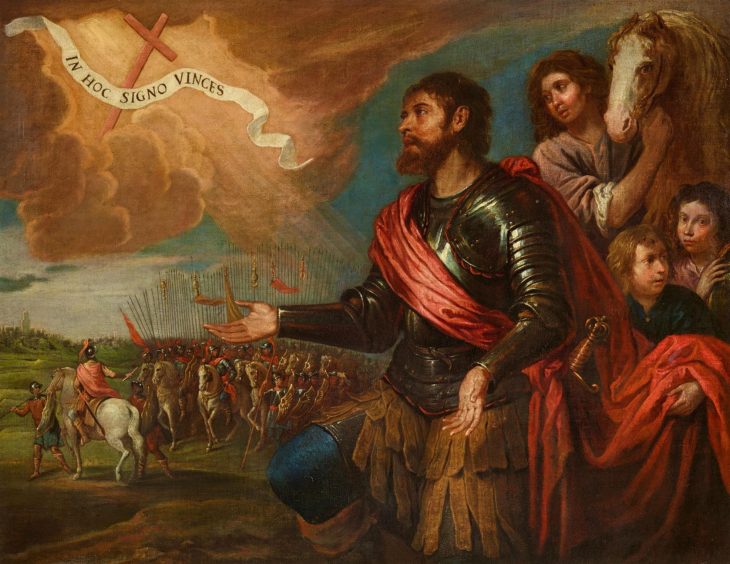
“From Eusebius, two accounts of the battle survive. The first, shorter one in the Ecclesiastical History promotes the belief that the Christian God helped Constantine but does not mention any vision. In his later Life of Constantine, Eusebius gives a detailed account of a vision and stresses that he had heard the story from the Emperor himself. According to this version, Constantine with his army was marching (Eusebius does not specify the actual location of the event, but it was clearly not in the camp at Rome), when he looked up to the sun and saw a cross of light above it, and with it the Greek words ‘Ἐν Τούτῳ Νίκα’, En toutōi níka, usually translated into Latin as “in hoc signo vinces“. The literal meaning of the phrase in Greek is ‘in this (sign), conquer’ while in Latin it’s ‘in this sign, you shall conquer”; a more free translation would be ‘Through this sign [you shall] conquer’” (https://en.wikipedia.org/wiki/Battle_of_the_Milvian_Bridge).
Constantine did indeed win the battle. “Paul K. Davis writes that, ‘Constantine’s victory gave him total control of the Western Roman Empire paving the way for Christianity to become the dominant religion for the Roman Empire and ultimately for Europe.” The following year, 313, Constantine and Licinius [Constantine’s co-emperor over the Eastern Roman Empire] issued the Edict of Milan, which made Christianity an officially recognised and tolerated religion in the Roman Empire” (https://en.wikipedia.org/wiki/Battle_of_the_Milvian_Bridge). And that’s fine. All religions, or at least religions which do not actively advocate the killing and maiming of others, should be tolerated and maybe even recognized, whatever that might mean.
But there was strife in the church. Arianism, what is now considered a Christian heresy, was becoming more popular. So Constantine called the first Council of Nicea in 325 “in an attempt to end the controversy by establishing an empire-wide, i.e., ‘ecumenical’ orthodoxy. The council produced the original text of the Nicene Creed, which rejected the Arian confession and upheld that Christ is ‘true God’ and ‘of one essence with the Father’” (https://en.wikipedia.org/wiki/Edict_of_Thessalonica). But the Council’s proclamations were not accepted by all Christians.
“Constantius II, Constantine’s son and successor in the eastern empire, was partial to the Arian party, and even exiled pro-Nicene bishops. Constantius’ successor Julian (later called ‘The Apostate’ by Christian writers) was the only emperor after the conversion of Constantine to reject Christianity, attempting to fragment the Church and erode its influence by encouraging a revival of religious diversity, calling himself a ‘Hellene’ and supporting forms of Hellenistic religion. He championed the traditional religious cultus of Rome as well as Judaism, and furthermore declared toleration for all the various unorthodox Christian sects and schismatic movements. Julian’s successor Jovian, a Christian, reigned for only eight months and never entered the city of Constantinople. He was succeeded in the east by Valens, an Arian.
“By 379, when Valens was succeeded by Theodosius I, Arianism was widespread in the eastern half of the Empire, while the west had remained steadfastly Nicene. Theodosius, who had been born in Hispania, was himself a Nicene Christian and very devout. In August, his western counterpart Gratian promoted persecution of heretics in the west” (ibid.).
So in February of 380, Theodosius, along with Gratian, issued the Edict of Thessalonica, which constituted “the first known secular law which includes in its preamble a clear definition of what a Christian Roman ruler considers as religious orthodoxy, opening the way of repression against dissidents qualified as ‘heretics’. The Edict of Thessalonica was subsequently incorporated into Book XVI of the Theodosian Code and was the milestone of the official Christianization of the Roman Empire” (ibid.).
“At Constantinople on 8 November 392, the government of Emperor Theodosius I issued a law that reached from public temples into private Roman households. It forbade blood sacrifice, the burning of incense, the hanging of garlands, the lighting of lamps at shrines and divinatory rites. The penalties threatened property as well as people.…
“The measure preserved in the Codex Theodosianus as 16.10.12 is one of late antiquity’s most important documents. It marks the expanding alliance between Roman imperial authority and Nicene Christianity. It is often described as the moment paganism was banned. That shorthand captures the law’s reach, but it can mislead: traditional cults did not vanish in one day, enforcement varied, and religious change had been under way for generations” (https://discovertodayinhistory.com/theodosius-pagan-worship-law-november-8-392/).
This act may be the single most destructive one in the history of the Christian Church. It used the power of the secular, earthly government to enforce a particular persuasion of a religion. Perhaps I am wrong, but it seems to me that real conversion to a faith happens not through the force of arms and the threat of violence but through cogent arguments. Christianity engaged in attempts to enforce faith for centuries after 16.10.12. It’s been only recently that it has stopped using violence to gain converts. It also seems to me that the Church thrives most when it opposed governments, not when it is coopted by them. Today’s image is of Constantine’s Vision of the Holy Cross, attributed to the 17th century Flemish painter Johann Boeckhorst (1604-1668), oil on canvas (https://www.lempertz.com/en/catalogues/lot/1108-1/1069-johann-boeckhorst-attributed-to.html), including the Latin In Hoc Signo Vinces, “In this sign you will conquer.”