Word of the Day: Manticore
Today’s word of the day, courtesy of the Words Coach (https://www.wordscoach.com/dictionary) is manticore. Pronounced / ˈmæn tɪˌkɔr /, with a secondary stress on the third syllable, this noun refers to “a legendary monster with a man’s head, horns, a lion’s body, and the tail of a dragon or, sometimes, a scorpion” (https://www.dictionary.com/browse/manticore).
The word first appears in English “c. 1300, from Latin manticora, from Greek mantikhoras, corruption of martikhoras, perhaps from Iranian compound *mar-tiya-khvara ‘man-eater.’
“The first element is represented by Old Persian maritya- ‘man,’ from PIE *mar-t-yo-, from *mer- ‘to die,’ thus ‘mortal, human;’ from PIE root *mer- ‘to rub away, harm’ (also ‘to die’ and forming words referring to death and to beings subject to death). The second element is represented by Old Persian kvar- ‘to eat,’ from PIE root *swel- (1) ‘to eat, drink’” (https://www.etymonline.com/word/manticore).
In its Did You Know section, Merriam-Webster says, “A mythical creature of ancient fables, the manticore keeps company with the better-known unicorn, dragon, and griffin. Descriptions of the manticore’s features sometimes differ (some accounts mention porcupine quills or poisonous spikes, for example; others depict the tail as having a serpent’s head), but the animal is by all accounts a dreadful beast. The word manticore came to English through the Greek mantichōras and Latin mantichora, and is probably ultimately of Iranian origin. Etymologists think it is related to an Old Persian word for ‘man-eater’” (https://www.merriam-webster.com/dictionary/manticore).
In the Middle Ages, at least up until the invention of the moveable-type printing press around 1440, one of the most popular types of books was what is called a bestiary. A bestiary was a compendium of entries about different kinds of animals, both real and imaginary (though imaginary might be different today than it was 600 or 700 years ago).
The Rochester Bestiary is one example. It’s “a richly illuminated manuscript copy of a mediaeval bestiary, a book describing the appearance and habits of a large number of familiar and exotic animals, both real and legendary. The animals’ characteristics are frequently allegorised, with the addition of a Christian moral” (https://en.wikipedia.org/wiki/Rochester_Bestiary). It’s “a parchment manuscript dating from c. 1230–1240. Its principle contents are a bestiary, but it also contains a short lapidary (a treatise on stones) in French prose and, as the flyleaves, two leaves of a 14th-century service book. It is illustrated with 55 finished miniatures of various animals, each at the end of the passage describing that animal.[11] On some pages, instructions to the illuminator are visible, briefly describing what the planned picture should depict. About a third of the way through the manuscript (f. 52v and following, after the vulture), the illustrations cease: while spaces remain where they were intended to be placed, no illustrations were ever added” (ibid.).
“The manuscript is usually assumed to have been made at St. Andrew’s Priory at Rochester Cathedral. An inscription places the book there with certainty in the fourteenth century. At some point, it appears that the book was stolen from the priory, as another fourteenth-century inscription notes its return by a “brother John Malling”, who may have been the culprit: a man named John Malling was listed in an inventory of the royal library at Westminster in that year. King George II donated it, together with the rest of the Old Royal Library, to the British Museum in 1757, and it is now at the British Library (ibid.).
Among the animals included in the Rochester Bestiary are the unicorn, the griffin, the bonasus, the leucrota, the yale (an animal with the tail of an elephant and the jaws of a goat), the dragon, the basilisk, and, of course, the manticore.
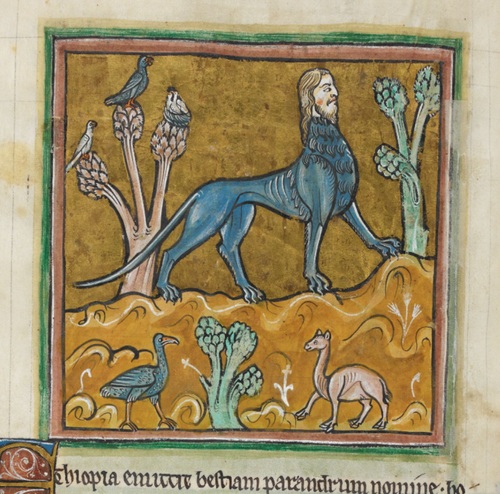
Here’s the description: “The manticore is a beast born in India. It has three rows of teeth that intertwine like the teeth of a comb. It has the face of a human, greyish-blue eyes and a blood-red colour. It has a leonine body, and its tail resembles a scorpion’s sting. It has a sharp, hissing voice similar to the sound of flutes and bagpipes. It eagerly longs for human flesh. It is so swift and jumps so high that neither the vastest areas nor the most insuperable obstacles can force it to die” (https://www.kentarchaeology.org.uk/records/rochester-bestiary-manticore).
And today’s illustration is the manticore from the Rochester Bestiary (ibid.).