Word of the Day: Absquatulate
Today’s word of the day, thanks to the Words Coach (https://www.wordscoach.com/dictionary) is absquatulate. Pronounced / æbˈskwɒtʃ əˌleɪt /, with the stress on the second syllable, this verb means “to flee; abscond” (https://www.dictionary.com/browse/absquatulate). Dictionary.com’s etymology says that it appears “1820–30; pseudo-Latinism, from ab-, squat, and –ulate, paralleling Latin-derived words with initial abs- (e.g., abscond, abstention) and final -tulate (e.g., congratulate)” (ibid.). It then goes on to say, “Absquatulate is a deeply silly word that means to make off with something or someone. Why say a thief ran away with your money when it’s much more fun to say he absquatulated with it?
“The word absquatulate came out of an odd fad in America in the 1830s for making playful words that sounded vaguely Latin. Bloviate (‘speak pompously’) and discombobulate (‘make confused’) are two other pseudo-Latin coinages from that era. Absquatulate takes the word squat and adds the prefix ab- ‘off, away’ and the verb ending -ulate to suggest getting up and leaving quickly. It’s hardly ever used nowadays, mostly showing up as an example of an absurd word” (https://www.vocabulary.com/dictionary/absquatulate?utm_campaign=dcom_explanation).
Etymonline.com says that it first appears in English in “1840, earlier absquotilate (1837), ‘Facetious U.S. coinage’ [Weekley], perhaps based on a mock-Latin negation of squat (v.) ‘to settle.’ Said to have been used on the London stage in in the lines of rough, bragging, comical American character ‘Nimrod Wildfire’ in the play ‘The Kentuckian’ as re-written by British author William B. Bernard, perhaps it was in James K. Paulding’s American original, ‘The Lion of the West.’ Civil War slang established skedaddle in its place” (https://www.etymonline.com/search?q=absquatulate).
I have never come across the word absquatulate before, at least not as I can remember. But I do know the words bloviate and discombobulate. A Wiktionary appendix lists a number of these words, including blustrification (“boisterous celebration”), confusticate (“to confuse”), dumfungled (“worn out”), and goshbustified (“pleased, satisfied”) (https://en.wiktionary.org/wiki/Appendix:Fanciful_19th_century_American_coinages). This kind of Latin is often referred to as Dog Latin, which includes popular pseudo-Latin phrases like Illegitimi non carborundum (“don’t let the bastards get you down”) and Semper ubi sub ubi (literally transliterated as “always where under where” but interpreted as “always wear underwear”) (https://en.wikipedia.org/wiki/Dog_Latin).
According to On This Day, on this date in 1756 “Giacomo Casanova escapes from ‘The Leads’ prison in Venice by climbing onto the roof” (https://www.onthisday.com/events/october/31).
“I begin by declaring to my reader that, by everything good or bad that I have done throughout my life, I am sure that I have earned merit or incurred guilt, and that hence I must consider myself a free agent. … Despite an excellent moral foundation, the inevitable fruit of the divine principles which were rooted in my heart, I was all my life the victim of my senses; I have delighted in going astray and I have constantly lived in error, with no other consolation than that of knowing I have erred…. My follies are the follies of youth. You will see that I laugh at them, and if you are kind you will laugh at them with me” (https://en.wikipedia.org/wiki/Giacomo_Casanova). Thus begins Histoire de ma vie, or The Story of My Life, by Giacomo Casanova.
Casanova (1725-1798) was born in Venice, then an independent city-state. Italy didn’t become a country, as we know it today, until 1861, and Venice did not become a part of Italy until 1871. “Born to a family of actors, Casanova studied law at the University of Padua and received minor orders in the Catholic Church with a view towards pursuing a career as a canon lawyer. However, he had no enthusiasm for the law or vocation for the church, and he soon abandoned those plans and launched instead upon an itinerant life as a gambler, violinist, confidence trickster, and man of letters” (ibid.). He traveled and lived in a wide variety of places throughout Europe. He apparently seduced many women, frequently women of the upper classes, though he did have a brief period of owning a silk mill and using the women who worked for him as a sort of harem. Despite his relatively humble beginnings, he met and spent time with people of the nobility and other famous people, including Voltaire and Benjamin Franklin.
He was also a gambler, and he frequently found himself in debt. He also was arrested and spent time in prison at least once. He also had to flee a city on numerous occasions. “On 26 July 1755, at age 30, Casanova was arrested for affront to religion and common decency: ‘The Tribunal, having taken cognizance of the grave faults committed by G. Casanova primarily in public outrages against the holy religion, their Excellencies have caused him to be arrested and imprisoned under the Leads’” (ibid.).
“Piombi (‘The Leads’ in English [so likely pronounced / lɛdz /]) is a former prison in the Doge’s Palace in Venice. The name of the prison refers to its position in the attic, directly under the roof of the palace, which was covered with slabs of lead. In winter, these slabs let the cold pass and they acted as a conductor in the summer heat, imposing harsh conditions for inmates” (https://en.wikipedia.org/wiki/Piombi).
He was placed in a single-person room with clothing, a pallet bed, table, and armchair in ‘the worst of all the cells’, where he suffered greatly from the darkness, summer heat, and ‘millions of fleas’. He was later housed with a series of cellmates. After five months and a personal appeal from Count Bragadin, he was given warm winter bedding and a monthly stipend for books and better food. During exercise walks he was granted in the prison garret, he found a piece of black marble and an iron bar which he smuggled back to his cell; he hid the bar inside his armchair. When he was temporarily without cellmates, he spent two weeks sharpening the bar into a spike on the stone. Then he began to gouge through the wooden floor underneath his bed, knowing that his cell was directly above the Inquisitor’s chamber. Just three days before his intended escape during a festival, when no officials would be in the chamber below, Casanova was moved to a larger, lighter cell with a view, despite his protests that he was perfectly happy where he was” (https://en.wikipedia.org/wiki/Giacomo_Casanova).
“Casanova set upon another escape plan. He solicited the help of the prisoner in the adjacent cell, Father Balbi, a renegade priest. The spike, carried to the new cell inside the armchair, was passed to the priest in a folio Bible carried under a heaping plate of pasta by the hoodwinked jailer. The priest made a hole in his ceiling, climbed across and made a hole in the ceiling of Casanova’s cell. To neutralize his new cellmate, who was a spy, Casanova played on his superstitions and terrorized him into silence. When Balbi broke through to Casanova’s cell, Casanova lifted himself through the ceiling, leaving behind a note that quoted the 117th Psalm (from the Latin Vulgate): ‘I shall not die, but live, and declare the works of the Lord’” (ibid.). Casanova later wrote of this escape, “’Thus did God provide me with what I needed for an escape which was to be a wonder if not a miracle. I admit that I am proud of it; but my pride does not come from my having succeeded, for luck had a good deal to do with that; it comes from my having concluded that the thing could be done and having had the courage to undertake it’” (ibid.).
Years later, when Casanova wanted to return to Venice, he ingratiated himself with the authorities, including the Inquisitors, by doing some spying for them. He wrote to them, asking for permission to freely travel back to Venice. “At last, he received his long-sought permission and burst into tears upon reading ‘We, Inquisitors of State, for reasons known to us, give Giacomo Casanova a free safe-conduct … empowering him to come, go, stop, and return, hold communication wheresoever he pleases without let or hindrance. So is our will.’ Casanova was permitted to return to Venice in September 1774 after 18 years of exile” (ibid.). They even wanted him to recount for them how he had escaped from Piombi.
Casanova was, apparently, proud of the life he had chosen. His name has even become a noun. But I doubt anyone would call him a role model. There are not a lot of people, I would think, who would want to absquatulate from the authorities as often as Casanova did.
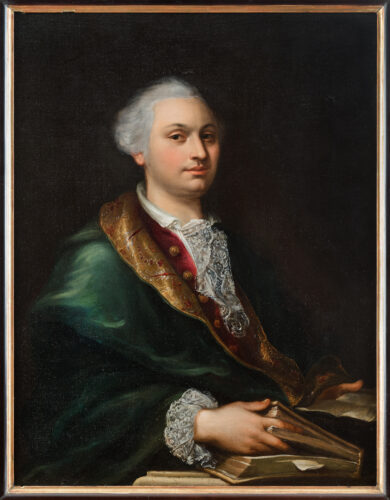
Today’s image is a portrait of Giacomo Casanova (oil on canvas) by Anton Heckel (1758-1789), when Casanova was the librarian at Dux Castle, a position he took in 1785 (https://bilddetek.hypotheses.org/2449).