Word of the Day: Suffrage
Today’s word of the day, courtesy of the Dictionary Project email, is suffrage. Pronounced / ˈsʌf rɪdʒ /, this noun means “the right to vote, especially in a political election,” “a vote given in favor of a proposed measure, candidate, or the like,” or “a prayer, especially a short intercessory prayer or petition” (https://www.dictionary.com/browse/suffrage).
In its Did You Know section, Merriam-Webster says, “Why would a 17th-century writer warn people that a chapel was only for ‘private or secret suffrages’? Because suffrage has been used since the 14th century to mean ‘prayer’ (especially a prayer requesting divine help or intercession). So how did suffrage come to mean ‘a vote’ or ‘the right to vote’? In answering that question, we get a lesson about the ways Latin words enter English. The Latin word suffrāgium has a number of vote-related meanings, including ‘a vote cast in an assembly’ and ‘the right to vote.’ In Medieval Latin, this same word had expanded to mean ‘vote, selection, aid, support, intercessory prayer,’ and it’s this suffrāgium that gave us the prayer kind of suffrage in the 14th century. It wasn’t until the 16th century that English speakers mined the older—the classical—Latin suffrāgium for a word to use with regard to voting, and especially to refer to the right to vote” (https://www.merriam-webster.com/dictionary/suffrage).
As indicated by the M-W entry, the word appears in English in the “late 14c., ‘prayer,’ especially ‘intercessory prayers or pleas on behalf of another,’ from Old French sofrage ‘plea, intercession’ (13c.) and directly from Medieval Latin suffragium, from Latin suffragium ‘support, ballot, vote cast in an assembly; right of voting; a voting tablet,’ from suffragari ‘express public support, vote for someone.’
“This is of uncertain origin. It is conjectured to be a compound of sub in some sense, perhaps ‘up from under’ (see sub-) + fragor ‘crash, din, shouts (as of approval)’ or its relative frangere ‘to break’ (from PIE root *bhreg- ‘to break’). One theory (Watkins, etc.) is that the notion is ‘use a broken piece of tile as a ballot’ (as in ostracism). But de Vaan writes:
“’ Clearly, these forms are based on a verb *sub-fragere or a noun *sub-frag-o ‘support’. Since the oldest meanings all refer to the process of voting for or against a candidate, one might support the view that *sub-frag- belongs to frangere “to break”: *sub-frag- “who shout in support of a candidate” (but fragor “noise” is not attested before Lucr[etius].).’
“He also cites another modern theory that derives the -fragium from a root meaning ‘hind part, tail-bone’ and ‘hypothesizes for suffragium a semantic change from “support under the hind part” to “political support”,’ but this he finds ‘too fantastic to be credible.’
“The meaning ‘a vote for or against anything’ is from 1530s; specifically ‘a vote or voice in deciding a question or in a contest for office’ by 1590s. By 1660s as ‘act of voting in a representative government;’ the meaning ‘political right to vote as a member of a body’ is first found in the U.S. Constitution, 1787, in reference to the states. Also sometimes ‘the collective opinion of a body of persons’ (1570s)” (https://www.etymonline.com/search?q=suffrage).
While de Vaan thinks that the semantic change from “support under the hind part” to “political support” is “too fantastic,” I kind of like it because the semantic change is understandable. Because supporting a politician isn’t too different from supporting the hind part.
Today is election day in the USA, where I live. And I’m really thankful. It seems like we’ve been talking about politics for the last two years, and seeing political ads for at least the last year. First there’s the primaries, and all the fighting within the two major political parties. And then, when the candidates for the two major parties are chosen, months of election coverage, the polls, and the advertisements.
In the USA, we have two major political parties and several minor parties that rarely get any of the votes cast. Right now, in my home state of South Carolina, the leading third-party vote getter for the US Senate seat has 0.9% of the vote. And because our political system is controlled by the two major parties, every issue we face seems to be treated in a binary fashion—it’s either the Democrats’ way or the Republicans’ way.
Here’s an example: about 16 to 35years ago, we had a national debate about marriage, specifically whether gay and lesbian people should be allowed to get married. The result was actually decided by the courts. “Seven same-sex couples represented by Gay & Lesbian Advocates & Defenders (GLAD) initiated a lawsuit in state court, Goodridge v. Department of Public Health, on April 11, 2001. GLAD attorney, Jennifer Levi, argued the case in Superior Court on behalf of the plaintiffs. Levi argued that denying same-sex couples equal marriage rights was unconstitutional under the State Constitution” (https://en.wikipedia.org/wiki/Same-sex_marriage_in_Massachusetts). The Massachusetts court eventually sided with the same-sex couples At first the Massachusetts legislature tried to meet the requirements set out by the court by passing legislation allowing for civil unions for same-sex couples, but the court said that it was marriage for all or marriage for none, so the legislature complied.
People in other states then tried to force their states to follow Massachusetts’s example, and many states did follow suit. But not all. So lawyers representing couples from six states sued in federal court asking for state-wide bans on same-sex marriages be overturned. One of the cases became the case that was decided by the Supreme Court: Obergefell v. Hodges. “The Obergefell petitioners asked the Court to consider whether Ohio’s refusal to recognize marriages from other jurisdictions violated the Fourteenth Amendment’s guarantees of due process and equal protection, and whether the state’s refusal to recognize the adoption judgment of another state violated the U.S. Constitution’s Full Faith and Credit Clause” (https://en.wikipedia.org/wiki/Obergefell_v._Hodges). Due process and equal protection are pretty obvious, I think, but let me just briefly explain the Full Faith and Credit Clause: “Article IV, Section 1 of the United States Constitution, the Full Faith and Credit Clause, addresses the duty that states within the United States have to respect the ‘public acts, records, and judicial proceedings of every other state….’ Barring exceptional circumstances, one state must enforce a judgment by a court in another, unless that court lacked jurisdiction, even if the enforcing court otherwise disagrees with the result” (https://en.wikipedia.org/wiki/Full_Faith_and_Credit_Clause). In other words, if a same-sex couple gets married in one state, other states have to recognize the validity of the marriage.
“On June 26, 2015, the U.S. Supreme Court held in a 5–4 decision that the Fourteenth Amendment requires all states to grant same-sex marriages and recognize same-sex marriages granted in other states. The Court overruled its prior decision in Baker v. Nelson, which the Sixth Circuit had invoked as precedent.
“The Obergefell v. Hodges decision came on the second anniversary of the United States v. Windsor ruling that struck down Section 3 of the Defense of Marriage Act (DOMA), which denied federal recognition to same-sex marriages, as being unconstitutional” (https://en.wikipedia.org/wiki/Obergefell_v._Hodges). So now the law of the land in the USA is that marriage can be between one man and one woman, or between two men, or between two women. The alternative, the one that lost in court, was that marriage should be only between one man and one woman. The Republicans basically took that latter position, while the Democrats stood up for the winning decision, although the 2008 Democrat presidential candidates, Barack Obama and Hillary Clinton, both said that they opposed same-sex marriage.
And here is what was never even considered. First, why should marriage be limited to two people. Many cultures throughout history have allowed for polygamy, or more accurately, polygyny since it’s almost always the man marrying more than one wife. Now, I’m not a proponent of polygamy, but what is the basis for making polygamy illegal in a secular state? And the real question is, why was that never considered by the courts.
Second, why should the state control who gets married anyway? Our state and federal governments who rules regarding married couples, particularly in the area of tax law. Married couples are treated differently from two people who just happen to live together. That seems unfair. Some people have argued that marriage is necessary for same-sex couples because hospitals will not let non-family members in to visit patients and insurance companies treat married couples differently. But it doesn’t have to be that way. Hospital rules and insurance regulations could be rewritten to accommodate people who want to be allied without a legal designation. And we have an example in Congresswoman Ilhan Omar of someone who was married religiously but not legally: “Omar’s relationship history begins in 2002 when the Democrat has said she and Ahmed Abdisalan Hirisi sought a marriage license but did not complete a legal marriage. Instead, they married in their Muslim faith tradition” (https://www.newsweek.com/ilhan-omar-marriage-timeline-what-public-records-show-12618887). So why can’t everybody get married like that?
Suffrage is an important part of life in the United States. But is it really suffrage when the people are limited to only two options? I know this for sure: watching our political process, it makes me think that what we really need is the other kind of suffrage, the prayer kind.
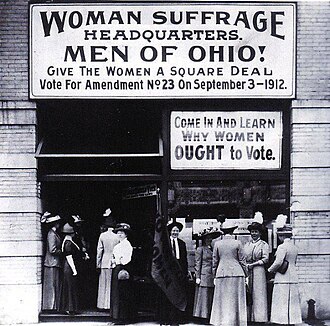
Today’s image is a photo from the campaign for women’s suffrage back in 1912 (https://en.wikipedia.org/wiki/Suffrage).