Word of the Day: Widdershins
Today’s word of the day, courtesy of the Words Coach (https://www.wordscoach.com/dictionary) is widdershins. Pronounced / ˈwɪdərˌʃɪnz / (non-rhotic accents will pronounce it / ˈwɪdəˌʃɪnz /), with a secondary stress on the third syllable, it’s “a variant spelling of withershins,” which means “in a direction contrary to the natural one, especially contrary to the apparent course of the sun or counterclockwise: considered as unlucky or causing disaster” and is considered a Scottish word.
Merriam-Webster, in its Did You Know? section, says, “English speakers today are most likely to encounter widdershins as a synonym of counterclockwise. But in earliest known uses, found in texts from the early 1500s, widdershins was used more broadly in the sense of ‘in the wrong way or opposite direction.’ To say that one’s hair ‘stood widdershins’ was, in essence, to say that one was having a bad hair day. By the mid-1500s, English speakers had adopted widdershins to specifically describe movement opposite to the apparent clockwise direction (as seen from the northern hemisphere) of the sun traveling across the sky, which, at the time, could be considered evil or unlucky. The word originates from the Old High German widar, meaning ‘back’ or ‘against,’ and sinnen, meaning ‘to travel’” (https://www.merriam-webster.com/dictionary/widdershins).
The word appears in English in the “1510s, chiefly Scottish, originally ‘contrary to the course of the sun or a clock’ (movement in this direction being considered unlucky), probably from Middle Low German weddersinnes, literally ‘against the way’ (i.e. ‘in the opposite direction’), from widersinnen ‘to go against,’ from wider ‘against’ (see with) + sinnen ‘to travel, go,’ from Old High German sinnen, related to sind ‘journey’ (see send)” (https://www.etymonline.com/word/widdershins). If you look on the etymonline.com website for withershins, you’ll find that it sends you to widdershins, which makes it seem that the variant spelling is actually the former.
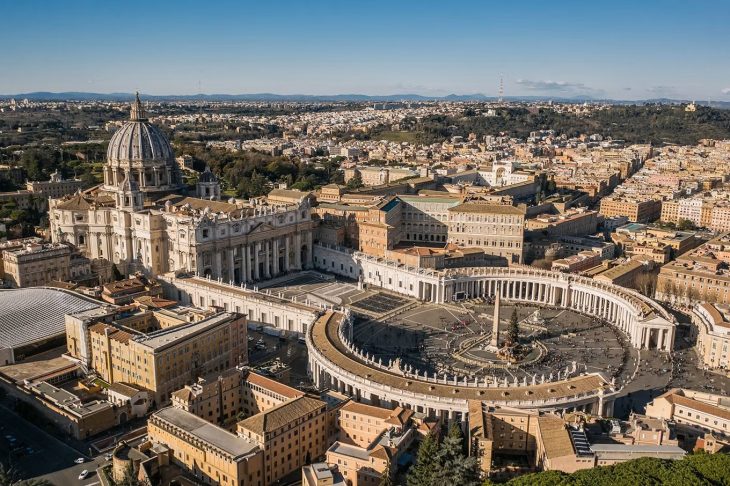
According to the On This Day website, on this date in 326, “Old St. Peter’s Basilica consecrated in Rome (stood 4th – 16th century), later replaced by current Basilica.” In addition, on this date in 1626, exactly 1300 years later, “St. Peter’s Basilica is consecrated in Rome, replacing an earlier basilica on the same site and becoming the world’s largest Christian church” (https://www.onthisday.com/events/november/18).
The old basilica was commissioned by Constantine, the first Christian emperor of Rome. It was built on the site of St. Peter’s grave, at least as far as Constantine and Pope Sylvester I believed (https://en.wikipedia.org/wiki/Old_St._Peter’s_Basilica). And it saw quite a bit of history over its 1300 years in use. In 800 it hosted the coronation of Charlemagne. In 846 it was looted and damaged by Muslims, which led to the building of the Leonine Wall between 848 and 852, a three-kilometer wall that protects the Leonine City.
But by the 15th century, particularly during the period of the two popes, the old basilica was falling into disrepair. The initial impetus for restoring the basilica came from Pope Nicholas V. “Soon after his election, he brought to an end the schism caused by rivalries between popes and councils. By 1455 he had restored peace to the Papal States and to Italy. He began a program for the rebuilding of many of Rome’s architectural wonders, including St. Peter’s Church (see St. Peter’s Basilica), and became the patron of many artists and scholars” (https://www.britannica.com/biography/Nicholas-V-pope). “He had plans for building a new St. Peter’s Church but was able only to rebuild what was crumbling, to reconstruct the Vatican palace, and to surround the whole with a wall. The restoration and embellishment of many Roman architectural treasures, such as the senatorial palace on the Capitoline Hill, are credited to him, but he pillaged ancient monuments to quarry materials for his new constructions. At his initiative, Rome became a centre for goldsmiths and silversmiths, he employed French, Belgian, and German tapestry makers, and he commissioned artists of note, among them the great Florentine painter Fra Angelico (1387–1455), to beautify his constructions” (ibid.).
Pope Julius II took up the project in 1503, but he decided to tear down the old basilica and build a brand new one. “Pope Julius II’s decision to replace Old St. Peter’s Basilica was driven by his grand vision for the papacy and his desire to restore the glory of the ancient Roman Empire, a concept known as renovatio imperii” (https://www.britannica.com/biography/Why-did-Pope-Julius-II-decide-to-replace-Old-St-Peters-Basilica). “Many people of the time were shocked by the proposal, as the building represented papal continuity going back to Saint Peter. The original altar was to be preserved in the new structure that housed it. The church was gradually demolished over 100 years, its last original part being demolished in 1605 and construction of the new church began the following year” (https://en.wikipedia.org/wiki/Old_St._Peter’s_Basilica). But it took a very long time to build the new basilica: “competition was held, and a number of the designs have survived at the Uffizi Gallery. A succession of popes and architects followed in the next 120 years, their combined efforts resulting in the present building. The scheme begun by Julius II continued through the reigns of Leo X (1513–1521), Adrian VI (1522–1523), Clement VII (1523–1534), Paul III (1534–1549), Julius III (1550–1555), Marcellus II (1555), Paul IV (1555–1559), Pius IV (1559–1565), Pius V (saint) (1565–1572), Gregory XIII (1572–1585), Sixtus V (1585–1590), Urban VII (1590), Gregory XIV (1590–1591), Innocent IX (1591), Clement VIII (1592–1605), Leo XI (1605), Paul V (1605–1621), Gregory XV (1621–1623), Urban VIII (1623–1644) and Innocent X (1644–1655)” (https://en.wikipedia.org/wiki/St._Peter%27s_Basilica).
One of the more controversial things about the building of St. Peter’s Basilica was the financing. “One method employed to finance the building of St. Peter’s Basilica was the granting of indulgences in return for contributions. A major promoter of this method of fund-raising was Albrecht, Archbishop of Mainz and Magdeburg, who had to clear debts owed to the Roman Curia by contributing to the rebuilding program. To facilitate this, he appointed the German Dominican preacher Johann Tetzel, whose salesmanship provoked a scandal and led to the Protestant Reformation” (ibid.). So ultimately Julius II’s desire to build a massive cathedral for the Roman Catholic Church (a cathedral that would also contain Julius’s elaborate tomb) led to the fracturing of the church and the birth of Lutherans, Anglicans, and all manner of other denominations. Sometimes the best laid plans of mice and men go widdershins.
What did these indulgences promise? “According to Johann Tetzel, a Dominican friar and preacher, indulgences had the power to remit both the temporal and eternal punishment due to sin, even if the sin had not yet been committed. He claimed that indulgences could even save the souls of those who had already died and were suffering in purgatory” (https://www.historyback.com/en/world/europe/1001029360.html). That is one heck of a promise, especially the remittance of future sins. Kind of opens the door.
Today’s image is of St. Peter’s Basilica, surrounded by Vatican City (https://www.hotels.com/go/italy/st-peter-s-basilica-rome). It’s a very impressive building and a pilgrimage site for Roman Catholics, and others, around the world. Still, one wonders….