Word of the Day: Equivocate
Today’s word of the day, courtesy of the Words Coach (https://www.wordscoach.com/dictionary), is equivocate. Pronounced / ɪˈkwɪv əˌkeɪt /, this verb means “to use ambiguous or unclear expressions, usually to avoid commitment or in order to mislead; prevaricate or hedge” (https://www.dictionary.com/browse/equivocate). Merriam-Webster says that equivocate “implies using words having more than one sense so as to seem to say one thing but intend another” (https://www.merriam-webster.com/dictionary/equivocate).
The word appears in English in the “early 15c., equivocaten, from Medieval Latin equivocatus, past participle of equivocare ‘to call by the same name, be called by the same name, have the same sound,’ from Late Latin aequivocus ‘of identical sound’ (see equivocation)” (https://www.etymonline.com/search?q=equivocate). Equivocation actually appears in English before equivocate, being first seen in the “late 14c., equivocacioun, ‘the fallacy of using a word in different senses at different stages of the reasoning’ (a loan-translation of Greek homonymia, literally ‘having the same name’), from Old French equivocation, from Late Latin aequivocationem (nominative aequivocatio), noun of action from aequivocus ‘of identical sound, of equal voice, of equal significance, ambiguous, of like sound,’ past participle of aequivocare, from aequus ‘equal’ (see equal (adj.)) + vocare ‘to call,’ which is related to vox (genitive vocis) ‘voice’ (from PIE root *wekw- ‘to speak’)” (https://www.etymonline.com/word/equivocation). It’s interesting in this case that etymonline.com does not label equivocate a backformation.
So just a couple of reminders. First, I use the International Phonetic Alphabet to illustrate the pronunciation of words. If you are unfamiliar with the IPA, you can learn about it at https://www.internationalphoneticalphabet.org/ipa-sounds/ipa-chart-with-sounds/#ipachartstart. The nice thing about this website is that it will actually say the sounds if you click on the symbols. Second, PIE stands for Proto-Indo-European, the precursor language for the Romance languages and the Germanic languages, as well as languages like Sanskrit. It is a proto language because we do not have any textual evidence for it; our evidence is based upon comparing the languages which evolved from it based upon numerous sound change laws. The asterisk before the PIE root above indicates that we do not have textual evidence. And, btw, there are studies of Indo-European culture that are based upon the vocabulary of that language, like there is a word for a certain kind of tree, and thus we know they lived in a place that had that kind of tree.
According to On This Day, on this date in 1917, “Vladimir Lenin defends ‘temporary’ removal of freedom of the press” (https://www.onthisday.com/events/november/17).
Here’s how the statement opens: “In the serious decisive hour of the revolution, and the day immediately following it, the Provisional Revolutionary Committee was compelled to adopt a whole series of measures against the counter revolutionary press of all shades.
“Immediately on all sides cries arose that the new socialist authority was violating, in this way, the essential principles of its program by an attempt against the freedom of the press.
“The Workers’ and Soldiers’ Government draws the attention of the population to the fact that in our country, behind this liberal shield, there is practically hidden the liberty for the richer class to seize into their hand the lion’s share of the whole press and by this means to poison the minds and bring confusion into the consciousness of the masses” (https://www.marxists.org/history/ussr/government/1917/10/27.htm).
Lenin goes on to say that this suppression of the freedom of the press is temporary and determined according to set rules:
“1. The following organs of the press shall be subject to be closed: (a) those inciting to open resistance or disobedience towards the Workers’ and Peasants’ Government; (b) those sowing confusion by means of an obviously calumniatory perversion of facts; (c) those inciting to acts of a criminal character punishable by the penal laws.
“2. The temporary or permanent closing of any organ of the press shall be carried out only by a resolution of the Council of People’s Commissaries.
“3. The present decree is of a temporary nature and will be revoked by special ukaz when the normal conditions of public life will be reestablished” (ibid.). An указ (or ukaz) is a decree.
Temporary means “lasting, existing, serving, or effective for a time only; not permanent” (https://www.dictionary.com/browse/temporary). But saying that something is temporary does not indicate exactly what that amount of time is. In this case, the censorship of the press lasted only until the collapse of the Soviet Union, which happened in 1991.
According to Dr. LaRae Larking, “Initially, during the early years of the Soviet state under Lenin, cultural repression was minimal due to political chaos. However, with Stalin’s rise to power in the late 1920s, censorship intensified dramatically, particularly targeting the intelligentsia. The introduction of Socialist Realism mandated that literature and the arts serve the interests of the Communist Party, suppressing individual creativity and dissent. The Great Purges of the 1930s decimated the artistic community, with thousands of writers and intellectuals arrested or exiled.
“Following World War II, the Zhdanovshchina campaign further entrenched censorship, labeling many artists as ‘enemies’ for their perceived Western influences. The control fluctuated under subsequent leaders like Khrushchev and Brezhnev, yet the overarching policy of cultural conformity persisted” (https://www.ebsco.com/research-starters/history/censorship-during-soviet-union/).
I suppose that one could argue that Lenin would have lifted censorship had he not died in 1924, just 53 years old. One could blame the persistent censorship on the Soviet leaders who succeeded Lenin. Or one could argue that censorship was temporary, lasting only 74 years. Or maybe the explanation is that Lenin was aware of the benefits of equivocating.
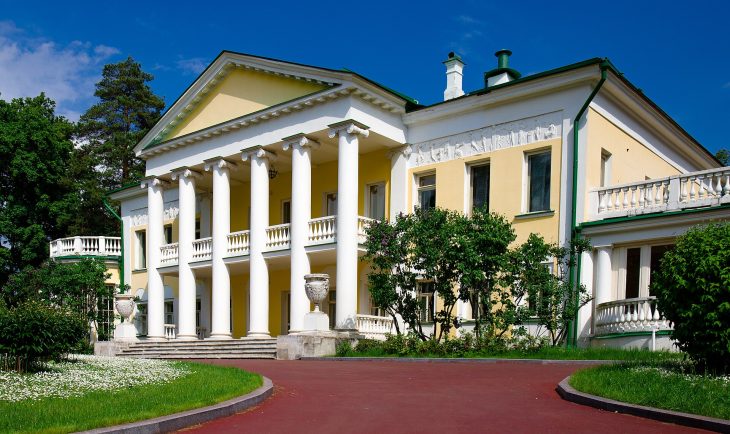
Today’s image is of “Lenin’s Gorki mansion, where he spent much of his final years (pictured in 2022)” (https://en.wikipedia.org/wiki/Vladimir_Lenin#/media/File:Gorki-Leninskie-2022.jpg. “To each according to his need….”
