Word of the Day: Badinage
Today’s word of the day, courtesy of the Words Coach (https://www.wordscoach.com/dictionary) is badinage. Pronounced / ˌbæd nˈɑʒ /, with a secondary stress on the first syllable and the primary stress on the third syllable, and with a soft “g” sound (the ʒ) as in azure, it means “light, playful banter or raillery” (https://www.dictionary.com/browse/badinage).
Merriam-Webster lists the following as synonyms of badinage: banter, raillery, joke, repartee,laugh, jesting, persiflage, humorousness, give-and-take, humor, chaff, chatter, and joshing. That’s quite a collection. Almost makes you wonder why we need so many different words for kidding around.
The word first appears in English in the “1650s, from French badinage ‘playfulness, jesting,’ from badiner (v.) ‘to jest, joke,’ from badin ‘silly, jesting’ (16c.), from Old Provençal badar ‘to yawn, gape,’ from Late Latin badare ‘to gape,’ from *bat– ‘to yawn’ (see abash). One who indulges in it is a badineur (https://www.etymonline.com/search?q=badinage). Okay, now: you have to find it somewhat ironic that a word that means “playful banter” comes from a word that means “to yawn.” You can almost hear the generational dispute between the jokers and their elders, can’t you?
According to On This Day, on this date in 1936 “Noël Coward’s anthology ‘Tonight at 8:30’ premieres in NYC, runs for 118 performances” (https://www.onthisday.com/events/november/24).
Noel Coward (1899-1973) may have been the original theater kid. Though born into a working-class family, Coward got involved in performing early on. He went to a choir school and a dance school, encouraged by his mother, and got his first professional job when he was just eleven years old. He wrote later, “One day … a little advertisement appeared in the Daily Mirror…. It stated that a talented boy of attractive appearance was required by a Miss Lila Field to appear in her production of an all-children fairy play: The Goldfish. This seemed to dispose of all argument. I was a talented boy, God knows, and, when washed and smarmed down a bit, passably attractive. There appeared to be no earthly reason why Miss Lila Field shouldn’t jump at me, and we both believed that she would be a fool indeed to miss such a magnificent opportunity” (https://en.wikipedia.org/wiki/No%C3%ABl_Coward).
During the next decade, Coward performed in plays and wrote songs. Then, “In 1920, at the age of 20, Coward starred in his own play, the light comedy I’ll Leave It to You. After a three-week run in Manchester it opened in London at the New Theatre (renamed the Noël Coward Theatre in 2006), his first full-length play in the West End…. The play ran for a month (and was Coward’s first play seen in America), after which Coward returned to acting in works by other writers” (ibid.).
“In 1924, Coward achieved his first great critical and financial success as a playwright with The Vortex. The story is about a nymphomaniac socialite and her cocaine-addicted son (played by Coward). Some saw the drugs as a mask for homosexuality;[47] Kenneth Tynan later described it as “a jeremiad against narcotics with dialogue that sounds today not so much stilted as high-heeled”.[48] The Vortex was considered shocking in its day for its depiction of sexual vanity and drug abuse among the upper classes. Its notoriety and fiery performances attracted large audiences, justifying a move from a small suburban theatre to a larger one in the West End” (ibid.). The Vortex created a market for plays by Noel Coward, and Coward supplied the market throughout the second half of the 1920s with no fewer than eleven full-length plays, and all the while he continued acting. The furious pace led to a collapse, and Coward was ordered to rest for a month, but instead he sailed for the United States to rehearse another new play. In New York, he collapsed again, leading to a period of recuperation in Hawaii.
“By 1929 Coward was one of the world’s highest-earning writers, with an annual income of £50,000, more than £3 million in terms of 2020 values.[61] Coward thrived during the Great Depression, writing a succession of popular hits.[62] They ranged from large-scale spectaculars to intimate comedies. Examples of the former were the operetta Bitter Sweet (1929), about a woman who elopes with her music teacher,[63] and the historical extravaganza Cavalcade (1931) at Drury Lane, about thirty years in the lives of two families, which required a huge cast, gargantuan sets and a complex hydraulic stage. Its 1933 film adaptation won the Academy Award for best picture” (ibid.).
In 1936, Coward “wrote, directed and co-starred with Lawrence in Tonight at 8.30, a cycle of ten short plays, presented in various permutations across three evenings. One of these plays, “Still Life,” was expanded into the 1945 David Lean film Brief Encounter” (ibid.). Generally, when produced in full, the plays are presented three at a time, rotating the presentation on different nights. But that doesn’t really happen very often anymore.
“By the end of the 1960s, Coward developed arteriosclerosis and, during the run of Suite in Three Keys, struggled with bouts of memory loss. This also affected his work in The Italian Job, and he retired from acting immediately afterwards. Coward was knighted in 1970, and was elected a fellow of the Royal Society of Literature. He received a Tony Award for lifetime achievement in 1970…. At the age of 73, Coward died at his home, Firefly Estate, in Jamaica on 26 March 1973 of heart failure” (ibid.).
What makes Noel Coward’s plays special is the dialogue. Most of his work was comedic, and the comedy arose not from pratfalls or slapsticks but from the repartee. When I was in college, I was in a production of one of the 10 plays, “Hands Across the Sea.” Honestly, I cannot even remember what character I played, but I do remember that the lightning quick dialogue was a real challenge. Regarding the original performance, “The Times said of the play: ‘As a piece of production it is, technically, of the utmost brilliance; as an entertainment, in its own kind frothily faultless.’ Coward’s fellow-dramatist Terence Rattigan considered it ‘the best short comedy ever written.’ In the introduction to his collected plays Coward comments: ‘It is a gay, unpretentious little play, and it was acted by Gertie with incomparable brilliance. I cannot think of it without remembering the infinite variety of her inflections; her absurd scatterbrained conversations on the telephone; her frantic desire to be hospitable and charming and her expression of blank dismay when she suddenly realised that her visitors were not who she thought they were at all’” (ibid.).
Coward has been compared to another great English playwright, Oscar Wilde, who was also a master of badinage.
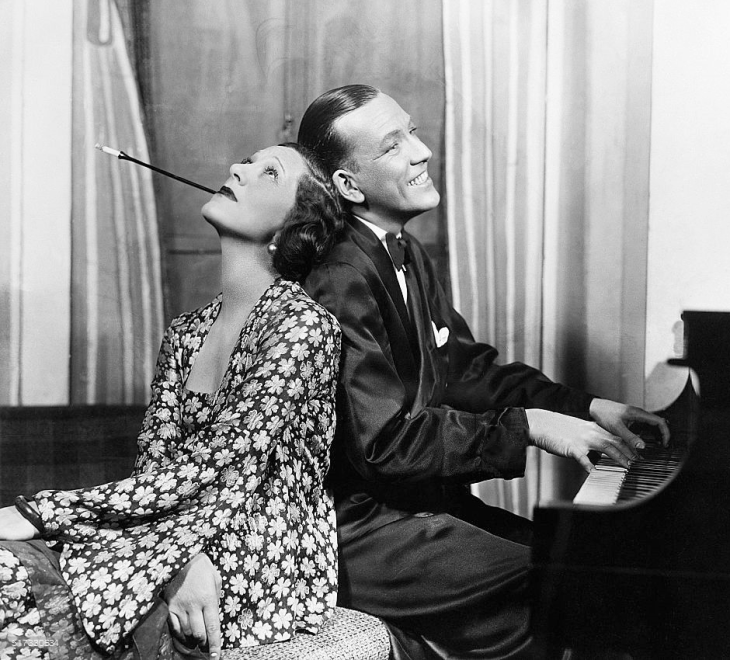
Today’s image is “Gertrude Lawrence and Noël Coward in the 1931 Broadway production of Private Lives (Magazine)/Wikimedia Commons (https://theamericanscholar.org/requiem-for-a-lost-art/).