Word of the Day: Embellish
Today’s word of the day, thanks to the Dictionary Project daily email, is embellish. It’s a verb pronounced / ɛmˈbɛl ɪʃ /, and it means “to beautify by or as if by ornament,” “to ornament,” “to adorn,” and by metaphoric extension, “to enhance (a statement or narrative) with fictitious additions” (https://www.dictionary.com/browse/embellish).
It appears in English in the “mid-14c., ‘to render beautiful,’ from Old French embelliss-, stem of embellir ‘make beautiful, ornament,’ from assimilated form of en- (see en- (1)) + bel ‘beautiful,’ from Latin bellus ‘handsome, pretty, fine’ (see belle). Meaning ‘dress up (a narration) with fictitious matter’ Is from mid-15c” (https://www.etymonline.com/search?q=embellish). As reminder, in linguistics, an assimilated form is a form whose pronunciation (and spelling) has changed to become more similar to nearby sounds. The /b/ is a bilabial plosive, and the /n/, which is a voiced alveolar nasal, is replaced by the /m/, which is a voiced bilabial nasal, so it’s easier to go from /m/ to /b/ than from /n/ to /b/.
In its “Did You Know” section, Merriam-Webster says, “Embellish came to English, by way of Anglo-French, from the Latin word bellus, meaning ‘beautiful.’ It’s in good company: modern language is adorned with bellus descendants. Examples include such classics as beauty, belle, and beau. And the beauty of bellus reaches beyond English: its influence is seen in the French bel, a word meaning ‘beautiful’ that is directly related to the English embellish. And in Spanish, bellus is evidenced in the word bello, also meaning ‘beautiful’ (https://www.merriam-webster.com/dictionary/embellish). While there is some disagreement about exactly what the term Anglo-Norman means, it basically refers to the version of French spoken in England after the Norman conquest. The Normans, who came from Normandy, were a blend of the Norse Vikings and the people of Western France (or West Francia). There version of French was less refined than Parisian French, but it was spoken in England for a couple of hundred years or so.
According to the wiki: “Although Anglo-Norman and Anglo-French were eventually eclipsed by Modern English, they had been used widely enough to influence English vocabulary permanently. This means that many original Germanic words, cognates of which can still be found in Nordic, German, and Dutch, have been lost or, as is more often the case, exist alongside synonyms of Anglo-Norman French origin. Anglo-Norman had little lasting influence on English grammar, as opposed to vocabulary, although it is still evident in official and legal terms where the ordinary sequence of noun and adjective is reversed, as and body politic.“The royal coat of arms of the United Kingdom still features in French the mottos of both the British Monarch, Dieu et mon droit (‘God and my right’), and the Order of the Garter, Honi soit qui mal y pense (‘Shamed be he who thinks evil of it’)” (https://en.wikipedia.org/wiki/Anglo-Norman_language).
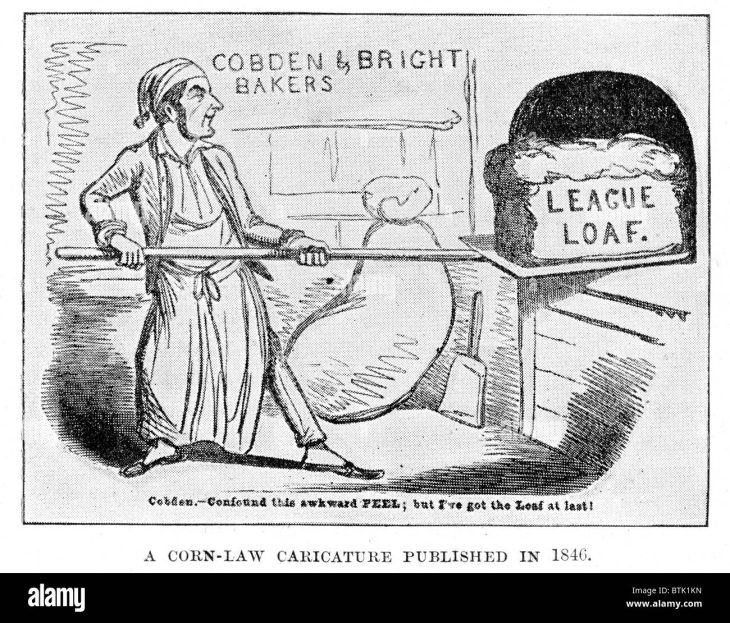
According to On This Day, on this date in 1838 the “Anti-Corn Law League [was] established in Great Britain by Richard Cobden” (https://www.onthisday.com/today/events.php).
Perhaps we should start with the Corn Laws. First, the word corn meant any kind of grain, specifically a grain that still had its seed in it. Today, when we speak of corn, we are talking about maize, which was called “Indian corn” when it was first introduced in Europe. Now we use corn exclusively to refer to maize.
So the Corn Laws were about a variety of grains grown in England. And such grains were sometimes exported to other countries and sometimes imported from other countries. As early as the reign of Elizabeth I the English government tried to control trade in grains. In 1772, the first Corn Law was passed by Parliament, a bill that “shut off exports and allowed imports when the price was above 48 shillings per quarter” (https://en.wikipedia.org/wiki/Corn_Laws).
But here’s the thing about farming: it’s uncertain. Sometimes things happen to make grains plentiful, and when that happens, the price decreases. It’s called the Law of Supply and Demand. When the supply of a good increases and the demand remains stable, the price of that good will decline. When the supply of a good decreases and the demand remains stable, the price will increase. And this uncertainty was more profound before the advent of modern farming technology, so the 18th and 19th centuries saw real ups and downs.
In the early 1810s, Europe was dealing with the Napoleonic Wars, and that made farming a bit difficult. Those wars ended in 1815, and consequently the price of corn decreased, making it more difficult for farmers to make ends meet. So Parliament passed the “Importation Act 1815 (officially An Act to amend the Laws now in force for regulating the Importation of Corn) to keep bread prices high” (ibid.). While producers were happy, many citizens were infuriated. I mean, after all, wouldn’t you want to see prices come down after a war that had driven the prices up had ended?
The next year, 1816, was the Year without a Summer, caused by a volcanic eruption in Indonesia. The corn crop was greatly diminished. But as governments often do, the English government did not repeal the 1815 law, and people went hungry as well as being cold. And that corn law of 1815 did not substantially change for the next 30 years.
“In 1820, the Merchants’ Petition, written by Thomas Tooke, was presented to the House of Commons. The petition demanded free trade and an end to protective tariffs. The prime minister, Lord Liverpool, who claimed to be in favour of free trade, blocked the petition. He argued, speciously, that complicated restrictions made it difficult to repeal protectionist laws. He added, though, that he believed Britain’s economic dominance grew in spite of, not because of, the protectionist system. In 1821, the president of the Board of Trade, William Huskisson, composed a Commons committee report which recommended a return to the “practically free” trade of the pre-1815 years” (ibid.).
“The first Anti–Corn Law Association was set up in London in 1836; but it was not until 1838 that the nationwide League, combining all such local associations, was founded, with Richard Cobden and John Bright among its leaders. Cobden was the chief strategist; Bright was its great orator. A representative activist was Thomas Perronet Thompson, who specialized in the grass-roots mobilisation of opinion through pamphlets, newspaper articles, correspondence, speeches, and endless local planning meetings. The League was based in Manchester and had support from numerous industrialists, especially in the textile industry” (https://en.wikipedia.org/wiki/Anti%E2%80%93Corn_Law_League).
Finally, “In 1845 and 1846, the first two years of the Great Famine in Ireland, there was a disastrous fall in food supplies. Prime Minister Peel called for repeal despite the opposition of most of his Conservative Party. The Anti-Corn Law League played a minor role in the passage of legislation—it had paved the way through its agitation but was now on the sidelines. On 27 January 1846, Peel gave his government’s plan. He said that the Corn Laws would be abolished on 1 February 1849 after three years of gradual reductions of the tariff, leaving only a 1 shilling duty per quarter” (https://en.wikipedia.org/wiki/Corn_Laws). There was opposition, but the free-trade position finally won out.
The Corn Laws were not a beautiful thing, but the story of bringing them to an end is good enough that it needs no embellishment. Sadly, the fight between free-traders and protectionists continues.
Today’s image is a political cartoon published in 1846 (https://vamosarema.com/).