Word of the Day: Pulchritude
Today’s word of the day, courtesy of the Words Coach (https://www.wordscoach.com/dictionary) is pulchritude, which Words Coach defines as “physical beauty (especially of a woman).” This noun is pronounced / ˈpʌlkrɪˌtjuːd /, and Dictionary.com says that it is “formal” (https://www.dictionary.com/browse/pulchritude).
It appears in English “c. 1400, pulcritude, from Latin pulchritude ‘beauty; excellence, attractiveness,’ from pulcher ‘beautiful,’ a word of unknown origin. De Vaan writes that the Latin -ch- spelling is by Greek influence and posits a stem *polkro- or *pelkro-, but that’s as far as he confidently takes it” (https://www.etymonline.com/word/pulchritude). By the way, the asterisk before those possible word-forming elements from Greek indicate that there is no textual evidence that such a word or element existed.
In its Did You Know section, Merriam-Webster says, “The Beautiful History of Pulchritude
Pulchritude is a descendant of the Latin adjective pulcher, which means ‘beautiful.’ Pulcher hasn’t exactly been a wellspring of English terms, but it did give English both pulchritude and pulchritudinous, an adjective meaning ‘attractive’ or ‘beautiful.’ The verb pulchrify (a synonym of beautify), the noun pulchritudeness (same meaning as pulchritude), and the adjective pulchrous (meaning ‘fair or beautiful’) are other pulcher offspring, but those terms have proved that, in at least some linguistic cases, beauty is fleeting” (https://www.merriam-webster.com/dictionary/pulchritude). Pulchritudeness is a coining that seems completely unnecessary since it means exactly the same thing as the shorter pulchritude, but English seems to like to occasionally create unnecessary words, like orientate, which means exactly the same thing as the verb orient.
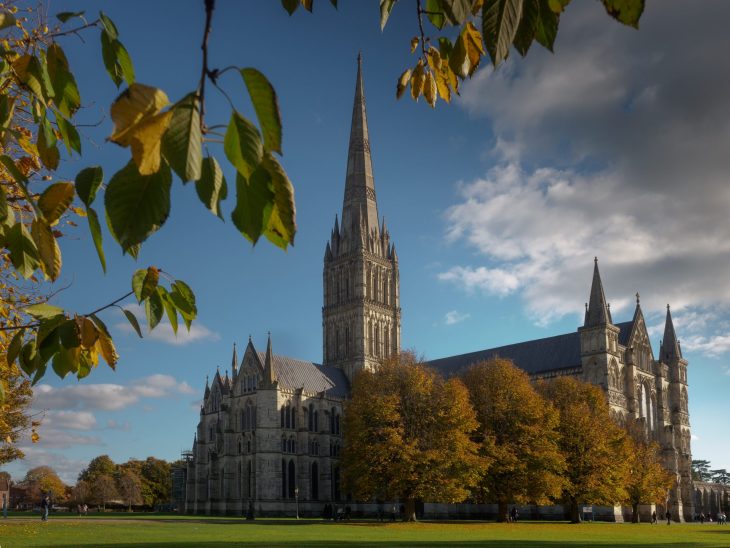
According to On This Day, on this date in 1258, “Salisbury Cathedral in south west England [was] inaugurated” (https://www.onthisday.com/events/september/20). Personally, I think a better word would have been consecrated. Inaugurate can mean “to make a formal beginning of,” “to induct into office with formal ceremonies,” or “to introduce into public use by some formal ceremony” (https://www.dictionary.com/browse/inaugurate), and that third definition might fit, but a cathedral isn’t really “public use.” Consecrate, on the other hand, means “An image of the word consecrate as defined by to make or declare sacred; set apart or dedicate to the service of a deity.
to make or declare sacred; set apart or dedicate to the service of a deity” (https://www.dictionary.com/browse/consecrate).
Salisbury, a small city in England about 90 miles southwest of London. The original settlement, about 3 miles from Salisbury, is now called Old Sarum, and when Salisbury became a cathedral city (meaning it has a bishop and a cathedral), the cathedral was on the hill at Old Sarum. Old Sarum was also the site of a fort constructed by William the Conqueror. But the clerics decided that they needed a new home, perhaps because they were having difficulties with the soldiers.
Bishop Herbert Poore sought permission to relocate the cathedral in 1197, and with that permission they began to build their new cathedral in 1220. “Construction was paid for by donations, principally from the canons and vicars of southeast England, who were asked to contribute a fixed annual sum until the building was completed. The foundation stones were laid on 28 April 1220 by William Longespée, 3rd Earl of Salisbury, and by Ela of Salisbury, 3rd Countess of Salisbury. Much of the freestone for the cathedral came from the Teffont Evias Quarry. As a result of the high water table on the new site, the cathedral was built on foundations only 4 feet (1.2 m) deep. By 1258, the nave, transepts, and choir were complete. As a result of being mostly built in only 38 years, Salisbury has by far the most consistent architectural style of any medieval English cathedral. The style used is known as Early English Gothic or Lancet Gothic, the latter referring to the use of lancet windows which are not divided by tracery” (https://en.wikipedia.org/wiki/Salisbury_Cathedral).
“The only major sections begun later were the cloisters, added in 1240, the chapter house in 1263, the tower and spire, which at 404 feet (123 m) dominated the skyline from 1330. In total, 70,000 tons of stone, 3,000 tons of timber and 450 tons of lead were used in the construction of the cathedral. Upon completion, it had the highest masonry spire in England and the third highest overall, after Lincoln and St Paul’s. The collapse of the latter two spires in the mid-16th century left Salisbury’s as the highest overall.
“In the 17th century, Christopher Wren designed restoration measures to strengthen the central pillars, which by then had visibly deformed under the weight of the tower and spire. Significant changes to the cathedral were made by the architect James Wyatt in 1790, including the replacement of the original rood screen and demolition of a bell tower which stood about 320 feet (98 m) northwest of the main building” (ibid.).
One of the interesting features of Salisbury Cathedral is that it is the home of “the best-preserved of the four surviving original copies of Magna Carta. This copy came to Salisbury because Elias of Dereham, who was present at Runnymede in 1215, was given the task of distributing some of the original copies. Elias later became a canon of Salisbury and supervised the construction of the cathedral” (ibid.).
I visited the UK the first time about 16 years ago, and I did a tour that included Salisbury Cathedral. We got off the tour bus and lined up outside the cathedral. Then the men who were wearing hats were told the hats had to be removed. The tour included seeing that copy of the Magna Carta, but we were not allowed to take pictures of the document. In fact, it was behind a screen of sorts, as I remember.
I’m from the United States, currently living in South Carolina. But I spent a few years in Georgia, and I learned about Sherman’s famous march. He burned many of the buildings as he progressed through the state, but there were a couple towns he ignored, notably Washington, GA (the home of Robert Toombs), and Madison, GA. These two towns have quite a few ante-bellum homes, some of historical interest. In case you don’t know, ante-bellum means “before the war,” and in this case “the war” means the Civil War. So some of these homes are over 200 years old. But they pale in comparison to Salisbury Cathedral, which is 750 years old and still in service as a cathedral. Then again, Salisbury is just a few miles from the site of Stonehenge, which is 4500 years old.
Even at 750 years old, Salisbury shows the pulchritude of medieval building. And the image today is of that famous cathedral (https://www.salisburycathedral.org.uk/).