Word of the Day: Debonair
Today’s word of the day, courtesy of The New York Times (https://www.nytimes.com/2026/10/07/learning/word-of-the-day-debonair.html), is debonair. Pronounced / ˌdɛb əˈnɛər /, with a secondary stress on the first syllable and the primary stress on the third, it means “courteous, gracious, and having a sophisticated charm” (https://www.dictionary.com/browse/debonair).
It appears in English “c. 1200, ‘mild, gentle, kind courteous,’ from Old French debonaire, from de bon’ aire ‘of good race,’ originally used of hawks, hence, ‘thoroughbred’ (opposite of French demalaire); aire here is perhaps from Latin ager ‘place, field’ (from PIE root *agro- ‘field’) on notion of ‘place of origin.’ Used in Middle English to mean ‘docile, courteous,’ it became obsolete and was revived with an altered sense of ‘pleasantly light-hearted and affable’ (1680s). OED says it is ‘now a literary archaism, often assimilated in spelling to mod.F. débonnaire’” (https://www.etymonline.com/word/debonair)). And when I have seen the word in prose, it is usually spelled the modern French way instead of the simpler Anglo way. But I would pronounce it the same way; I wouldn’t try to make it sound French. Perhaps some writers think that the French spelling looks more sophisticated, or perhaps they don’t realize that there is an Anglicized way to spell it.
Speaking of sounding sophisticated, here’s what Merriam-Webster says in their Did You Know section: “Calling someone debonair is another way of saying they’ve got a certain je ne sais quoi, or to be more specific (and complete the rhyme): savoir faire. Ooh la la! If this all sounds ultra chic to you, you’re not alone. French has a certain cachet, a fanciness and prestige owing in part to its deep etymological, historical, and political connections with English. This extends to many French words that English has borrowed outright or adapted, including debonair. In Anglo-French, someone who was genteel and thought to be well-brought-up was described as deboneire—literally ‘of good family or nature’ (from the three-word phrase de bon aire). When the word was borrowed into English in the 13th century, it basically meant ‘courteous,’ but today’s debonair incorporates suaveness, nonchalance, and maybe even a soupçon of esprit (carefree sophistication with a dash of wit)” (https://www.merriam-webster.com/dictionary/debonair).
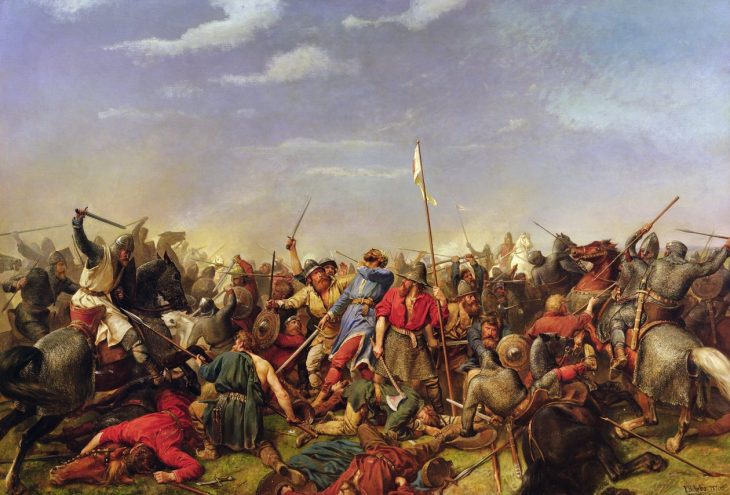
This idea that French is more sophisticated than English goes back to the Norman Conquest of England that began in 1066. William of Normandy defeated Harold Godwinson, the last Anglo-Saxon king of England, at the Battle of Hastings in October of 1066. Harold had just defeated Harald Hardrada, King of Norway, at the Battle of Stamford Bridge on September 25. Harold had been planning for an invasion by William, but he had to divert to take care of Harald and Tostig, Harold’s brother. The long march from York to the southern coast of England, a march of nearly 300 miles, took a lot out of Harold’s army, and William’s army defeated Harold’s.
William took over the rest of England by systematically replacing (that’s a euphemism) the Anglo-Saxon nobility with his Norman followers. It created a society in which the upper echelon spoke French, although it was Norman French, while the peasants, the servants, and the other working-class people spoke Anglo-Saxon. French was the language of the nobility and thus perceived to be more of an educated language, though not as educated as the Latin spoken by the clergy. Later kings learned English; Richard II (1367-1400; r. 1377-1399) was the first English king to promote English literature; he was the king whom Geoffrey Chaucer entertained with his Canterbury Tales. And Henry IV, who usurped the throne from Richard II, is considered the first native English speaking king since before William I.
One of the results of this division in the language of English society was that there were different words for the same thing, depending upon the contest. So peasants watched over the English sheep, but when the sheep was served at the lord’s table, it was mutton. Peasants hunted down the hart in the lord’s woods, but it was served as venison. The elites had different words for things, French words.
According to On This Day, on this date in 2023, “Hamas launches a major air and ground attack on Israel from Gaza, killing over a thousand people and taking hundreds of hostages, prompting Prime Minister Benjamin Netanyahu to declare, ‘We are at war’” (https://www.onthisday.com/events/october/7). And that’s all I can say about that because I cannot speak about it and be debonair.
Today’s image is of a painting of The Battle of Stamford Bridge (1870; oil on canvas) by Peter Nicolai Arbo (1831-1892). He “was a Norwegian historical painter, who specialized in portraits and large narrative scenes from Norwegian history and Norse mythology. His best known work is The Wild Hunt of Odin (Oslo), a dramatic subject based on the Wild Hunt legend and Valkyrie, the two versions of which (in Stockholm and Oslo) depict a female figure from Norse mythology” (https://en.wikipedia.org/wiki/Peter_Nicolai_Arbo).