Word of the Day: Rhapsodize
Today’s word of the day, courtesy of the Words Coach (https://www.wordscoach.com/dictionary), is rhapsodize. Pronounced / ˈræp səˌdaɪz /, this intransitive verb means “to talk with extravagant enthusiasm” or “to speak or write rhapsodies” (https://www.dictionary.com/browse/rhapsodize). I think I may have mentioned how it is annoying to have a word defined by a different version of the word, and that second definition is an example. So now we have to look up rhapsody, of which there are numerous definitions: “an instrumental composition irregular in form and suggestive of improvisation”; “an ecstatic expression of feeling or enthusiasm”; “an epic poem, or a part of such a poem, as a book of the Iliad, suitable for recitation at one time”; “a similar piece of modern literature”; “an unusually intense or irregular poem or piece of prose”; or “Archaic. a miscellaneous collection; jumble” (https://www.dictionary.com/browse/rhapsody). The first definition for rhapsodize seems most connected to the second definition of rhapsody.
Merriam-Webster says that the “The first known use of rhapsodize was in 1787” (https://www.merriam-webster.com/dictionary/rhapsodize), but Etymonline.com has it appearing somewhat earlier: “c. 1600, ‘to piece together (narratives),’ a sense now obsolete; 1806, ‘to talk rhapsodically, express with poetical enthusiasm’” (https://www.etymonline.com/search?q=rhapsodize).
The etymology of rhapsody is a lot more informative. It appears in English in the “1540s, ‘epic poem,’ also ‘a book of an epic’ (suitable for recitation at one time), from French rhapsodie, from Latin rhapsodia, from Greek rhapsōidia ‘verse composition, recitation of epic poetry; a book, a lay, a canto,’ from rhapsōdos ‘reciter of epic poems,’ literally ‘one who stitches or strings songs together,’ from stem of rhaptein ‘to stitch, sew, weave’ (according to Watkins from PIE root *wer- (2) ‘to turn, bend’) + ōidē ‘song’ (see ode).
“According to Beekes, the notion in the Greek word is ‘originally “who sews a poem together”, referring to the uninterrupted sequence of epic verses as opposed to the strophic compositions of lyrics.’ William Mure [‘Language and Literature of Antient Greece,’ 1850] writes that the Homeric rhapsōidia ‘originally applied to the portions of the poems habitually allotted to different performers in the order of recital, afterwards transferred to the twenty-four books, or cantos, into which each work was permanently divided by the Alexandrian grammarians.’
“The word in English had various specific or extended senses 16c.-17c., mostly now obsolete or archaic. Among them was ‘miscellaneous collection, confused mass (of things),’ thus ‘literary work consisting of miscellaneous or disconnected pieces, a rambling composition.’ This, now obsolete, might be the path of the word to the meaning ‘an exalted or exaggeratedly enthusiastic expression of sentiment or feeling, speech or writing with more enthusiasm than accuracy or logical connection of ideas’ (1630s).
“The meaning ‘sprightly musical composition’ is recorded by 1850s” (https://www.etymonline.com/word/rhapsody).
When I think of classical music composers, I imagine people who became classical prodigies at a very young age, like Wolfgang Amadeus Mozart or Ludwig von Beethoven. Mozart composed his first symphony when he was eight. Beethoven began studying composition at the age of ten. But at the age of ten, George Gershwin was running around as an urchin in New York City. “Then, as a ten-year-old, he was intrigued upon hearing his friend Maxie Rosenzweig’s violin recital. The sound, and the way his friend played, captivated him. At about the same time, George’s parents had bought a piano for his older brother Ira. To his parents’ surprise, though, and to Ira’s relief, it was George who spent more time playing it as he continued to enjoy it” (https://en.wikipedia.org/wiki/George_Gershwin).
“In 1913, Gershwin left school at the age of 15 to work as a ‘song plugger’ on New York City’s Tin Pan Alley. He earned $15 a week from Jerome H. Remick and Company, a Detroit-based publishing firm with a branch office in New York. His first published song was ‘When You Want ‘Em, You Can’t Get ‘Em, When You’ve Got ‘Em, You Don’t Want ‘Em’ in 1916. It earned the 17-year-old 50 cents” (ibid.). “A song plugger or song demonstrator is an individual who promotes music to musicians, record labels, and customers. Song pluggers work for a music publishing company or operate independently. The function of the role has evolved as advances in music technology changed the music industry over the course of the 20th and 21st centuries” (https://en.wikipedia.org/wiki/Song_plugger). I imagine that today one can demonstrate a song electronically, but in 1913, one probably had to demonstrate the song in person.
Despite that perhaps inauspicious beginning, Gershwin became one of the great American composers, skilled in not only classical composition but also popular music and show music. Among Gershwin’s compositions are Broadway musicals like Lady, Be Good (1924), Funny Face (1927), and Of Thee I Sing (1931), movie scores such as Shall We Dance (1937), A Damsel in Distress (1937), and The Goldwyn Follies (1938), the opera Porgy and Bess (1938), popular songs such as “Swanee” (1919), “Fascinatin’ Rhythm” (1924), “Embraceable You” (1928), “I Got Rhythm” (1930), and “They Can’t Take That away from Me” (1937), and orchestral compositions such as An American in Paris (1928) and Rhapsody in Blue (1924).
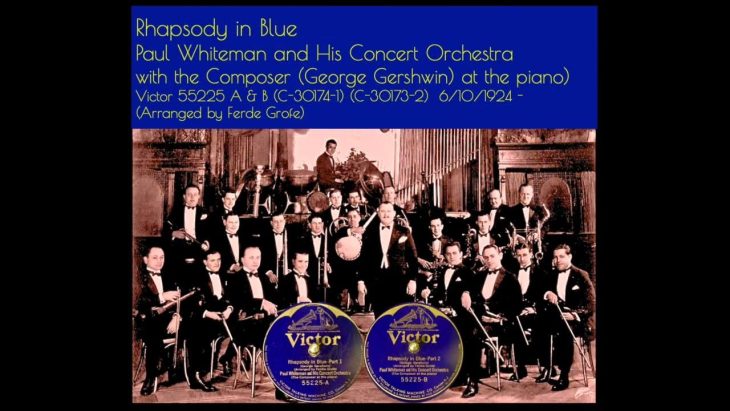
That last one “is a 1924 musical composition for solo piano and jazz band…. Commissioned by bandleader Paul Whiteman, the work combines elements of classical music with jazz-influenced effects and premiered in a concert titled “An Experiment in Modern Music” on February 12, 1924, in Aeolian Hall, New York City. Whiteman’s band performed the rhapsody with Gershwin playing the piano” (https://en.wikipedia.org/wiki/Rhapsody_in_Blue). The opening clarinet solo is as recognizable a piece of music as anything in classical music, at least for those who listen to such. I know that I love it, though I will refrain from rhapsodizing about it.
This link will take you to a 1924 recording of Rhapsody in Blue (https://music.youtube.com/watch?v=cCpJIt1F4s0). And the image today is the record jacket from Paul Whiteman and His Orchestra (https://i.ytimg.com/vi/cCpJIt1F4s0/maxresdefault.jpg?sqp=-oaymwEmCIAKENAF8quKqQMa8AEB-AH-CYAC0AWKAgwIABABGBMgHCh_MA8=&rs=AOn4CLA5dbwLhS1T0V2_Hs45UhssXXlKOg).
