Word of the Day: Sardonic
Today’s word of the day, thanks to the Words Coach (https://www.wordscoach.com/dictionary), is sardonic. Pronounced / sɑrˈdɒn ɪk /, with the stress on the second syllable, this adjective means (https://www.dictionary.com/browse/sardonic).
In its Choose the Right Synonym section, Merriam-Webster says, “sarcastic, satiric, ironic, sardonic mean marked by bitterness and a power or will to cut or sting.
“Sarcastic implies an intentional inflicting of pain by deriding, taunting, or ridiculing.
“Satiric implies that the intent of the ridiculing is censure and reprobation.
“Ironic implies an attempt to be amusing or provocative by saying usually the opposite of what is meant.
“Sardonic implies scorn, mockery, or derision that is manifested by either verbal or facial expression” (https://www.merriam-webster.com/dictionary/sardonic).
Etymonline.com defines the word as “’apparently but not really proceeding from gaiety,’ especially of laughter, a grin, etc.,” and says that first appears in English in the “1630s, from French sardonique (16c.), from Latin sardonius (but as if from *sardonicus) as used in the phrase Sardonius risus, a loan-translation of Greek sardonios gelōs ‘of bitter or scornful laughter.’
“The Greek word was altered from Homeric sardanios (which is of uncertain origin) apparently by influence of Sardonios ‘Sardinian’ (see Sardinia) because the Greeks believed that eating a certain plant they called sardonion (‘plant from Sardinia’) caused facial convulsions resembling those of sardonic laughter (usually followed by death). The etymology has been confused since ancient times and is much debated.
“For nuances, see humor (n.). Earlier in same sense sardonian (1580s), from Latin sardonius. Of persons, ‘bitterly ironical, sarcastic,’ by 1833” (https://www.etymonline.com/word/sardonic).
According to On This Day, on this date in 1835, “A ship carrying 500 armed Maori from Ngati Tama and Ngati Mutunga arrives on the Chatham Islands; those Moriori (indigenous people of the Chatham Islands) that are not killed are enslaved” (https://www.onthisday.com/events/november/19).
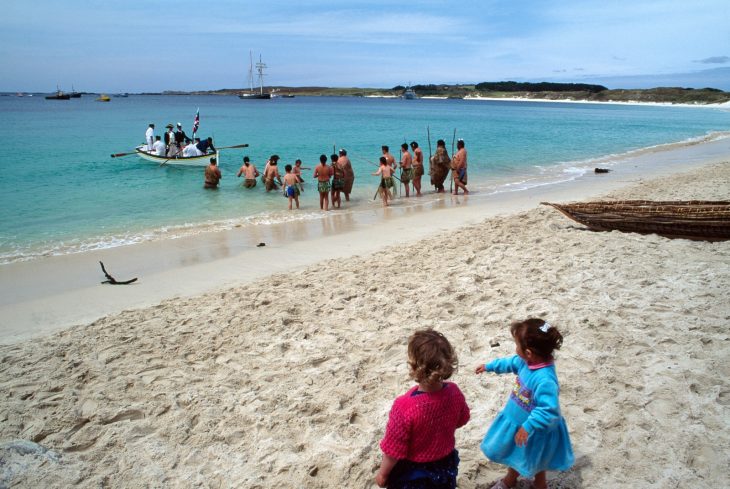
“The Moriori are the indigenous people of the Chatham Islands (Rēkohu in Moriori; Wharekauri in Māori). They are Polynesians who came from the New Zealand mainland by at least 1500 AD, and possibly around the mid-15th century, likely with some earlier immigration directly from East Polynesia. The settlers’ culture diverged from mainland Māori, and they developed a distinct Moriori language, mythology, artistic expression and way of life” (https://en.wikipedia.org/wiki/Moriori).
“Early Moriori formed tribal groups based on eastern Polynesian social customs and organisation. Later, a prominent pacifist culture emerged; this was known as the law of nunuku, based on the teachings of the 16th century Moriori leader Nunuku-whenua” (ibid.). I had never heard of the Moriori before, but this part of their culture seems really interesting. Libertarians in the USA in the 20th and 21st centuries developed what is called the Non-aggression Policy, or NAP. But the Moriori took the idea of pacifism even further, as you’ll see below.
According to the wiki, the Chatham Islands are “colder and less hospitable” than New Zealand, and so the Moriori developed a hunter-gatherer lifestyle, with their protein and fat coming primarily from the sea. According to E. A. Welch and J. Barnard Davis (1871), “An Account of the Chatham Islands, Their Discovery, Inhabitants, Conquest by the Maories, and the Fate of the Aborigines” in the Journal of the Anthropological Society of London, “They were idle in the extreme, only seeking food when pressed by hunger, and depending mostly on what was cast ashore by the sea, a stranded whale, grampus, or porpoise being an especial delicacy, as was also a seal or mass of whale blubber, which being often cast ashore was looked upon as the gift of a good spirit who supplied their wants” (ibid.). In other words, the Moriori were the original hippies: unambitious, pacifist, and totally chill. There were only about 2000 people on the island, but that may be what the island could sustain.
“The Moriori lived in isolation from the outside world until 1791, when the first Europeans arrived. They the northern Pacific from England, via Dusky Sound. The Chatham’s captain, William R. Broughton, named the island after John Pitt, 2nd Earl of Chatham and claimed it for Great Britain. The landing party came to shore in Kaingaroa Harbour on the far Northeast coast of Chatham Island. The Moriori retreated Moriori oral tradition as containing the god of fire, given the pipes they were smoking, and likely female from the clothes they were wearing. It was this interpretation that led to the men returning from the forest to meet the landing party. A brief period of hostility was quickly calmed by the crew putting gifts on the end of Moriori spears, though attempts at trade were unsuccessful. After exploring the area for water the crew again became fearful of Moriori aggression. Some misunderstanding led to an escalation of violence and one Moriori was shot and killed. HMS Chatham then left the island with all its crew. Both the diary of Broughton and local oral tradition record that both sides regretted the incident and to some extent blamed themselves for overreacting” (ibid.). After that, when Europeans landed on the islands, they were greeted warmly. Unfortunately, perhaps, the Europeans turned the Chatham Islands into a base for whaling and seal hunting, which wiped out the seals on the islands. They did bring potatoes and pigs, but that didn’t replace the seals.
Then came the Musket Wars. Traders and merchants from Europe introduced the musket to Maori culture in New Zealand, and in the first half of the 19th century the Maori began to use muskets in their intertribal warfare. “Their first known use in intertribal fighting was in the 1807 battle of Moremonui between Ngāpuhi and Ngāti Whātua in Northland near present-day Dargaville. Although they had some muskets, Ngāpuhi warriors struggled to load and reload them quickly enough and were defeated by an enemy armed only with traditional weapons—the clubs and blades known as patu and taiaha. However, soon after, members of the Ngāti Korokoro hapū of Ngāpuhi suffered severe losses in a raid on the Kai Tutae hapu despite outnumbering their foe ten to one, because the Kai Tutae were equipped with muskets” (https://en.wikipedia.org/wiki/Musket_Wars). These battles were, for the most part, on the islands of New Zealand.
However, “In 1835 Ngāti Mutunga and Ngāti Tama hijacked a ship to take them to the Chatham Islands where they killed about 10 per cent of the Moriori people and enslaved the survivors, before waging war with each other” (ibid.). “A hui or council of all Moriori men was convened at the settlement called Te Awapatiki. Despite knowing that the Māori did not share their pacifism, and despite the argument by younger men that the principle of Nunuku was not appropriate now, two chiefs–Tapata and Torea–declared that ‘the law of Nunuku was not a strategy for survival, to be varied as conditions changed; it was a moral imperative.’ Although this council decided in favour of peace, the invading Māori inferred it was a prelude to war, as was common practice during the Musket Wars. This precipitated a massacre, most complete in the Waitangi area, followed by an enslavement of the Moriori survivors” (https://en.wikipedia.org/wiki/Moriori).
“A Moriori survivor recalled: ‘[The Taranaki invaders] commenced to kill us like sheep…. [We] were terrified, fled to the bush, concealed ourselves in holes underground, and in any place to escape our enemies. It was of no avail; we were discovered and killed–men, women and children indiscriminately.’ A Taranaki Māori conqueror explained, ‘We took possession… in accordance with our customs and we caught all the people. Not one escaped…..’ The invaders ritually killed some 10% of the population. Stakes were driven into some of the women, who were left to die in pain” (ibid.).
The story is horrific. But it was not the end of the Moriori: “Today, despite the difficulties that the Moriori have faced, their culture is enjoying a renaissance, both in the Chatham Islands and New Zealand’s mainland. This has been symbolised with the renewal of the Covenant of Peace at the new Kōpinga marae in January 2005 on Chatham Island. As of 2016, the marae has registered almost 800 Moriori descendants, with more than 3000 associated children” (ibid.). Unfortunately, the Moriori language is extinct.
Europeans have a lot to answer for regarding colonization and the deaths of thousands upon thousands of indigenous people around the world. But Europeans are not unique in history. The notion that they are should call forth sardonic laughter by anyone who knows more about history than what they learned in 10th grade history.
If you want to read more about the Moriori, there is an article in NZGeo by Michael King, “Moriori, a Pride Reborn” (https://www.nzgeo.com/stories/moriori-a-pride-reborn/). That is also the source of today’s visual.