Word of the Day: Persiflage
Today’s word of the day, courtesy of the Words Coach (https://www.wordscoach.com/dictionary) is persiflage. Pronounced / ˈpɜr səˌflɑʒ /, with a secondary stress on the third syllable, this noun means “light, bantering talk or writing” or “a frivolous or flippant style of treating a subject” (https://www.dictionary.com/browse/persiflage).
The word appears in English in “1757, from French persiflage, from persifler ‘to banter’ (18c.), from Latin per ‘through’ (from PIE root *per- (1) ‘forward,’ hence ‘through’) + French siffler ‘to whistle, hiss,’ from collateral form of Latin sibilare ‘to hiss,’ which possibly is of imitative origin. Said to have been introduced in English by Chesterfield” (https://www.etymonline.com/search?q=persiflage).
In its Did You Know? section, Merriam-Webster says, “Unwanted persiflage on television might provoke an impatient audience to hiss or boo, but from an etymological standpoint, no other reaction could be more appropriate. English speakers picked up persiflage from French in the 18th century. Its ancestor is the French verb persifler, which means ‘to banter’ and was formed from the prefix per-, meaning ‘thoroughly,’ plus siffler, meaning ‘to whistle, hiss, or boo.’ Siffler in turn derived from the Latin verb sibilare, meaning ‘to whistle or hiss.’ By the way, sibilare is also the source of sibilant, a word linguists use to describe sounds like those made by ‘s’ and ‘sh’ in sash. That Latin root also underlies the verb sibilate, meaning ‘to hiss’ or ‘to pronounce with or utter an initial sibilant’ (https://www.merriam-webster.com/dictionary/persiflage).
On this date in 1952, according to On This Day, “Agatha Christie’s play ‘The Mousetrap’ opens in London” (https://www.onthisday.com/events/october/6).
Agatha Christie, the queen of the murder mystery, wrote “Three Blind Mice” as a radio play. She also wrote a short story based upon the play, but she dictated that the story not be published until the play had finished its run. She wrote it “as a birthday present for Queen Mary, the consort of King George V. It was broadcast on 30 May 1947…. The story drew from the real-life case of Dennis O’Neill, who died after he and his brother Terence suffered extreme abuse while in the foster care of a Shropshire farmer and his wife in 1945” (https://en.wikipedia.org/wiki/The_Mousetrap). And while the short story has still not been published in the UK, it was published in the USA in a collection of short stories.
The plot? “A shocking murder. Seven strangers snowed in at a remote country guesthouse. A police sergeant arrives with a warning no one expects.
“Cut off from the outside world, suspicion falls on everyone as secrets unravel and tensions rise. Every whisper hides a clue. Every story masks a lie. And as fear tightens its grip, one question lingers in the air: Who among them is capable of murder?” (https://themousetrap.com/about/#next).
“The Mousetrap had its world premiere on 6th October 1952 at the Theatre Royal, Nottingham. It subsequently visited the New Theatre, Oxford; The Opera House, Manchester; The Royal Court Theatre, Liverpool; The Theatre Royal, Newcastle; The Grand Theatre, Leeds; and the Alexandra Theatre, Birmingham, before opening in London at the Ambassadors Theatre on Tuesday 25th November.
In the cast were Richard Attenborough, Sheila Sim, Martin Miller, Jessica Spencer, Aubrey Dexter, Mignon O’Doherty, Allan McClelland and John Paul” (https://themousetrap.com/about/#prev).
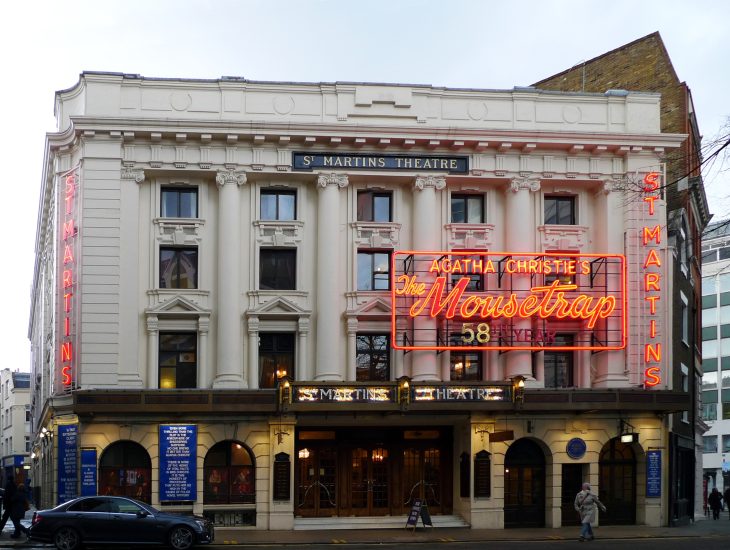
Since that opening, the show has run continuously. It played at the Ambassadors until March of 1974, when it closed at the Ambassadors on Saturday but opened at St. Martin’s Theater, which is larger and was designed by the same designer as the Ambassadors. It even staged a performance on the night of the death of Christie: “Brian McDermott, playing Detective Sergeant Trotter, spoke at the end of the performance to the packed house: ‘Ladies and gentlemen, this afternoon the best-known, best-loved English writer in the world, Dame Agatha Christie died and a few hours ago it seemed that The Mousetrap would close for the first time in its history. Those of us who knew her saw a quiet, shy, sensitive lady, but she also had great courage and determination and we knew she would have wanted the show to go on. As a mark of respect to a great English lady, will you please rise and join in a moment of silence’” (https://themousetrap.com/about/#next).
I have never seen The Mousetrap, but when I was in college, I was in a production of Tom Stoppard’s “The Real Inspector Hound.” “The plot follows two theatre critics named Moon and Birdboot who are watching a ludicrous country house murder mystery, in the style of a whodunit. By chance, they become involved in the action causing a series of events that parallel the play they are watching.
“The play was written between 1961 and 1962, drawing on Stoppard’s experiences as a Bristol theatre critic. It was initially named “The Stand-ins” and later, “The Critics.” It is a parody of the stereotypical parlour mystery in the style of Agatha Christie’s The Mousetrap, as well as of the critics watching the play, with their personal desires and obsessions interwoven into their bombastic and pompous reviews” (https://en.wikipedia.org/wiki/The_Real_Inspector_Hound).
While you almost assuredly know Agatha Christie, at least from the movies made of a few of her novels, like Murder on the Orient Express, you may not be familiar with Tom Stoppard. I was introduced to Stoppard my freshman year of college. The theater department professor directing the winter show asked me if I would be auditioning (I had auditioned in the fall but hadn’t been cast). I said that I hadn’t thought about it. He suggested that I go read the play, which was on 2-hour reserve in the library, and if I liked it, maybe I could audition. The play was Stoppard’s Rosencrantz and Guildenstern Are Dead. I literally laughed out loud while sitting in the library reading.
Christie was a wonderful writer, a true original. Stoppard is also a wonderful writer, and while both “The Real Inspector Hound” and Rosencrantz and Guildenstern Are Dead are, in one or another, a parody of someone else’s work, his persiflage makes them highly entertaining.
Today’s image is of St. Martin’s Theater, in Covent Garden, in London. It was taken by Ewan Munro. “This image, which was originally posted to Flickr, was uploaded to Commons using Flickr upload bot on 23 April 2010, 13:24 by Snowmanradio. On that date, it was confirmed to be licensed under the terms of the license indicated” (https://en.wikipedia.org/wiki/St_Martin%27s_Theatre#/media/File:St_Martin’s_Theatre,_Covent_Garden,_London-2April2010.jpg).
