Word of the Day: Propitiate
Today’s word of the day, courtesy of Words Coach (https://www.wordscoach.com/dictionary), is propitiate. Pronounced / prəˈpɪʃ iˌeɪt /, the transitive verb means “to make favorably inclined; appease; conciliate” (https://www.dictionary.com/browse/propitiate). Samuel Johnson, in his 1755 Dictionary, says that it means “To induce to favour; to gain; to conciliate; to make propitious” (https://johnsonsdictionaryonline.com/views/search.php?term=propitiate).
Merriam-Webster says that it means “to gain or regain the favor or goodwill of : appease” and then goes on to explain, “Propitiate tends to suggest averting the anger or malevolence of a superior being. You might ‘appease’ your hunger, but to speak more colorfully, you could ‘propitiate the gods of hunger.’ The word is related to propitious, an adjective meaning ‘likely to have or produce good results’ or ‘being a good omen’” (https://www.merriam-webster.com/dictionary/propitiate).
The word appears in the English language in the “1580s, a back-formation from propitiation and in part from propitiate (adj.), from Latin propitiatus, past participle of propitiare ‘appease, propitiate’” (https://www.etymonline.com/word/propitiate). We have talked before about what a back-formation is: “Back-formation is the process or result of creating a new word via morphology, typically by removing or substituting actual or supposed affixes from a lexical item, in a way that expands the number of lexemes associated with the corresponding root word” (https://en.wikipedia.org/wiki/Back-formation). An affix is a prefix (a morpheme that changes the form or function of a word and comes before the root word) or suffix (comes after the root word), in English, and in some languages an infix (comes in the middle of the root word).
Propitiation, the word that gives us propitiate, entered the language in the “late 14c., propiciacioun, ‘atonement, expiation,’ from Late Latin propitiationem (nominative propitiatio) ‘an atonement,’ noun of action from past-participle stem of Latin propitiare ‘appease, propitiate,’ from propitius ‘favorable, gracious, kind, well-disposed.’ The current explanation of this (as of de Vaan) is that it represents *propre-tio-, from PIE *propro ‘on and on, ever further’ (source also of Sanskrit pra-pra ‘on and on,’ Greek pro-pro ‘before, on and on’), from root *per- (1) ‘forward,’ hence ‘in front of, toward, near.’ It is thus related to Latin prope ‘near.’
Earliest recorded form of the word in English is propitiatorium ‘the mercy seat, place of atonement’ (c. 1200), translating Greek hilasterion. The meaning ‘that which propitiates or appeases, a propitiatory gift or offering’ is from 1550s” (ibid.).
It was on this date in 1609 that “Galileo Galilei presents his telescope to the Venetian Senate in Venice” (https://www.onthisday.com/events/august/8).
Galileo is, of course, one of the most famous scientists in history. His contributions were many and varied. “Galileo was one of the first modern thinkers to clearly state that the laws of nature are mathematical. In The Assayer, he wrote ‘Philosophy is written in this grand book, the universe … It is written in the language of mathematics, and its characters are triangles, circles, and other geometric figures….’ His work marked another step towards the eventual separation of science from both philosophy and religion; a major development in human thought. He was often willing to change his views in accordance with observation” (https://en.wikipedia.org/wiki/Galileo_Galilei).
In astronomy, “Using his refracting telescope, Galileo observed in late 1609 that the surface of the Moon is not smooth. Early the next year, he observed the four largest moons of Jupiter. Later in 1610, he observed the phases of Venus as well as Saturn, though he thought the planet’s rings were two other planets. In 1612, he observed Neptune and noted its motion, but did not identify it as a planet” (ibid.). And he was just getting started.
“Galileo made a number of contributions to what is now known as engineering, as distinct from pure physics. Between 1595 and 1598, Galileo devised and improved a geometric and military compass suitable for use by gunners and surveyors. This expanded on earlier instruments designed by Niccolò Tartaglia and Guidobaldo del Monte. For gunners, it offered, in addition to a new and safer way of elevating cannons accurately, a way of quickly computing the charge of gunpowder for cannonballs of different sizes and materials” (ibid.).
“In 1593, Galileo constructed a thermometer, using the expansion and contraction of air in a bulb to move water in an attached tube” (ibid.).
“Galileo’s theoretical and experimental work on the motions of bodies, along with the largely independent work of Kepler and René Descartes, was a precursor of the classical mechanics developed by Sir Isaac Newton” (ibid.).
And so much more. But what Galileo is probably best known for is that he was forced to recant his belief in a heliocentric solar system.
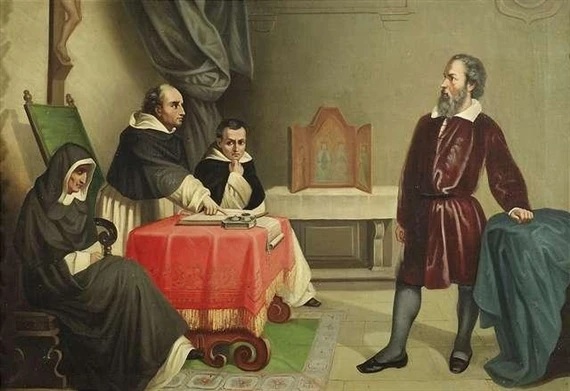
He faced the Inquisition, where he denied that he had ever held Copernican beliefs (the belief that the sun is at the center of the universe and all the planets and other heavenly bodies, including the Earth, revolve around the sun). The denial was clearly false because Galileo had written in defense of heliocentrism. And despite his denial, he was placed under house arrest and he was not allowed to publish anything for the rest of his life. So his attempt to propitiate the leaders of the Church was not quite as successful as he would have liked.
Today’s image is of an oil on canvas painting, Galileo Facing the Roman Inquisition, by the nineteenth century Italian painter Cristiano Banti (https://www.mutualart.com/Artwork/Galileo-facing-the-Roman-Inquisition-in-/DD98B2445D49D88A).