Word of the Day: Riposte
Today’s word of the day, courtesy of the Words Coach (https://www.wordscoach.com/dictionary), is riposte. Pronounced / rɪˈpoʊst /, this noun means “a quick, sharp return in speech or action” or, in fencing, “a quick thrust given after parrying a lunge” (https://www.dictionary.com/browse/riposte).
Merriam-Webster gives the fencing definition as the first definition, and then divides the other definition: “a retaliatory verbal sally” and “a retaliatory maneuver or measure” (https://www.merriam-webster.com/dictionary/riposte). It then adds this: “In the sport of fencing, a riposte is a counterattack made after successfully fending off one’s opponent. English speakers borrowed the name for this particular maneuver from French in the early 1700s, but the French had simply modified the Italian word risposta, which literally means ‘answer.’ Ultimately these words come from the Latin verb respondēre, meaning ‘to respond.’ It seems fitting that riposte has since come full circle to now refer to a quick and witty response performed as a form of retaliation” (ibid.).
Riposte first appears in “1707, in fencing, ‘a quick thrust made after parrying a lunge,’ from French riposte, etymologically, ‘a response,’ by dissimilation from risposte (17c.), from Italian risposta ‘a reply,’ noun use of fem. past participle of rispondere ‘to respond,’ from Latin respondere ‘respond, answer to, promise in return’ (see respond). Sense of ‘sharp retort; quick, sharp reply,’ is attested by 1865, on the notion of ‘a counter-stroke. As a verb, by 1851” (https://www.etymonline.com/search?q=riposte).
According to On This Day, on this date in 1215 “English barons serve an ultimatum on King John which eventually leads to the creation and signing of the Magna Carta” (https://www.onthisday.com/today/events.php).
The English king John (1166-1216; r. 1199-1216) was the youngest son of Henry II and Eleanor of Aquitaine, one of the most famous royal couples in history. I won’t go into a lot of detail about Henry and his sons, but suffice it to say that there was a rebellion, and infidelity, and playing favorites. Henry II died in 1189, and his first choice to succeed him, his oldest son also named Henry, died in 1183 (https://en.wikipedia.org/wiki/Henry_the_Young_King). Henry’s son Geoffrey died in 1186 (https://en.wikipedia.org/wiki/Geoffrey_II,_Duke_of_Brittany). Henry’s oldest son died as a toddler. That left John and his brother Richard.
Richard I was king from 1189 to 1199, although he spent a good bit of his time away from England. His nickname was Richard Cœur de Lion (the Lionheart), and he was leading his own army by the age of 16; he also was involved in the Third Crusade, which is what took him away from England (https://en.wikipedia.org/wiki/Richard_I_of_England). His return from the Holy Land was complicated by a kidnapping.
If you are familiar with the stories of Robin Hood and his merry men, you may remember that the man behind the evil Sheriff of Nottingham was Prince John. That Prince John, who was ruling England in place of his brother Richard, is the same as our King John.
John’s nickname was Lackland (Norman: Jean sans Terre, lit. ”John without land”) because as the youngest son he could not expect to have any inheritance (keep in mind that all the English royalty in the late 12th and early 13th centuries would have spoken Norman French, the same kind of French spoken by William the Conqueror). But this nickname would still be appropriate after he became king of England because he would lose almost all of the land that he inherited on the Continent. Most notably, he lost Normandy to the French king; William had been Duke of Normandy, and Normandy had been part of the English king’s domain ever since (https://en.wikipedia.org/wiki/John,_King_of_England).
One of the problems for a king fighting a war is that it costs money. There was no deficit spending in the early 13th century, so John had to find ways of raising money. The ways included taxation and tariffs, and the people with the money were mostly the nobility, the barons. And the thing is that even after he lost Normandy he kept trying to get it back, and that meant spending even more money. In 1214, he led another campaign into Normandy, one which proved as fruitless as his other enterprises. When he returned to England, he faced considerable discontent (https://www.britannica.com/biography/John-king-of-England/Quarrel-with-the-church).
“After lengthy negotiations in which both sides appealed to the pope, civil war broke out in May 1215. John was compelled to negotiate once more when London went over to the rebels in May, and on June 15 at Runnymede he accepted the baronial terms embodied in a document known as the Articles of the Barons. On June 19, after further revisions of the document, the king and the barons accepted the Magna Carta, which ensured feudal rights and restated English law” (ibid.). Unfortunately, both John and the barons quickly broke the truce that followed upon the signing of the Magna Carta, and the civil war continued. While marching around England, John contracted dysentery, and after a few weeks, he died.
But the legacy of the Magna Carta survives. “By the time of the 1225 reissue, the Magna Carta had become more than a sober statement of the common law; it was a symbol in the battle against oppression. It had been read so many times in shire courts throughout the land that memorable phrases would be invoked in later documents, and whenever liberty seemed in danger, men spoke of the charter as their defense. The influence of the Magna Carta in England—and, later, in its colonies—had come not from the detailed expression of the feudal relationship between lord and subject but from the more-general clauses in which every generation could see its own protection. In England the Petition of Right in 1628 and the Habeas Corpus Act of 1679 looked directly back to clause 39 of the 1215 charter, which read:
No free man shall be arrested or imprisoned or disseised or outlawed or exiled or in any way victimised, neither will we attack him or send anyone to attack him, except by the lawful judgment of his peers or by the law of the land.
“Indeed, this passage would serve as the foundational expression of the concept of due process in Anglo-American jurisprudence. In the 17th century, when England’s North American colonies were shaping their own fundamental laws, the words of the Magna Carta were worked into them. The basic rights embodied in the Constitution of the United States of America (1789) and the Bill of Rights (1791) echo the charter, and the Fourteenth Amendment (1868) can trace its ancestry to the Magna Carta as well” (https://www.britannica.com/topic/Magna-Carta/Reissues-of-1216-1217-and-1225).
“The essential virtue of the Magna Carta, which has made it comparable in historical importance to the Twelve Tables of ancient Rome, lies not in any individual clause or group of clauses but in the solemn circumstances of its first granting and the comprehensive nature of that grant” (ibid.).
“The Magna Carta was pivotal in establishing the idea that the sovereign is subject to the law, a principle that resonated deeply with the framers of the American Constitution. It documented the liberties of “free men,” which later inspired the American Bill of Rights. The Magna Carta’s emphasis on due process and the protection of individual rights became a model for the U.S. Constitution, which enshrines these principles in its amendments. The Fifth and Fourteenth Amendments, for example, ensure that no person is deprived of life, liberty, or property without due process of law, a concept given foundational expression in the Magna Carta. The principle of due process has been a bedrock of American legal thought, generally ensuring fairness and justice in the legal system.
“Beyond specific legal principles, the Magna Carta served as a powerful symbol of liberty and justice. The Magna Carta’s legacy as a document that challenged tyranny and advocated for the rights of individuals inspired the American founders as they crafted a new government based on democratic ideals” (ibid.).
It’s amazing to me that this document is now over 800 years old. Prior to that, and even since then in many places and among many cultures, the notion that individual people have basic rights that no government can deprive them of just didn’t exist. But to us it seems self-evident, to quote Jefferson. If someone ever questions your right to free speech or to property, you can call upon the Magna Carta as your riposte.
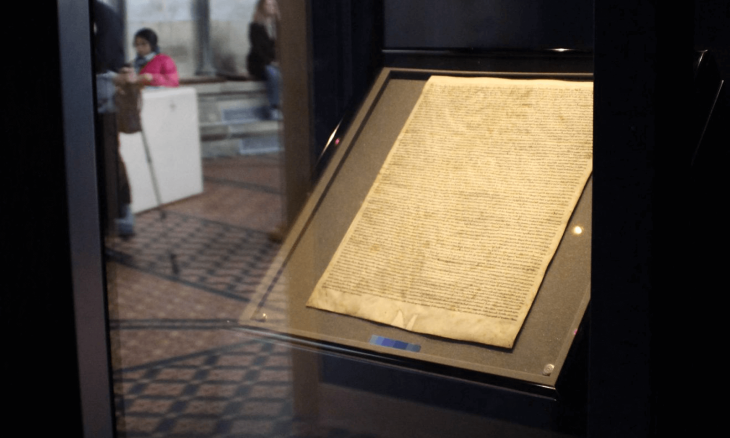
I would love to share a picture of one of the original copies of the Magna Carta with you. I saw it a while back in the Salisbury Cathedral. You can go see it too, but you cannot take pictures of it. But today’s image is of that Magna Carta (https://www.salisburycathedral.org.uk/discover/magna-carta/see-magna-carta/).