Word of the Day: Nimiety
Today’s word of the day, thanks to Words Coach (https://www.wordscoach.com/dictionary), is nimiety. Pronounced / nɪˈmaɪ ɪ ti / (rhymes with piety), this noun means “excess, overabundance” (https://www.dictionary.com/browse/nimiety). Samuel Johnson, in his 1755 Dictionary, defines it as “The state of being too much” and says that it derives from nimietas, which is a term from what he calls School Latin (https://johnsonsdictionaryonline.com/views/search.php?term=nimiety).
The word appears in the English language in the “1560s, from Latin nimietas ‘excessiveness,’ from nimius ‘beyond measure, excessive,’ from nimis (adv.) ‘too much, beyond measure, excessively,’ from *ne-mis- ‘not little,’ from PIE root *ne- ‘not’ + *mi- ‘little,’ from PIE root *mei- (2) ‘small’” (https://www.etymonline.com/search?q=nimiety).
Etymonline.com then provides this for the PIE root *mei-: “Proto-Indo-European root meaning ‘small.’
It might form all or part of: administer; administration; comminute; diminish; meiosis; Menshevik; menu; metier; mince; minestrone; minim; minimum; minister; ministration; ministry; minor; minuend; minuet; minus; minuscule; minute; minutia; Miocene; mis- (2); mite (n.2) ‘little bit;’ mystery (n.2) ‘handicraft, trade, art;’ nimiety.
It might also be the source of: Sanskrit miyate ‘diminishes, declines;’ Greek meion ‘less, smaller;’ Latin minus, minor ‘smaller,’ minuere ‘to diminish, reduce, lessen;’ Old English minsian ‘to diminish;’ Russian men’she ‘less’” (ibid.).
Merriam-Webster says this about nimiety: “There’s no scarcity of English words for too much of a good thing—words like overkill, plethora, superfluity, surfeit, surplus, and preponderance, to name a few. In fact, you might just feel that nimiety itself is a bit superfluous. And it’s true—English speakers have never found much need for it, though it has been part of our language for over 450 years. For reasons long forgot, we borrowed it from Late Latin nimietas, a noun taken, in turn, from the Latin adjective nimius, meaning ‘excessive.’ If nimiety appeals to you but you’d like it in adjective form look no further than its only English relative: nimious, also from nimius, means ‘excessive, extravagant,’ and is even rarer than nimiety” (https://www.merriam-webster.com/dictionary/nimiety).
And I have to admit that I have never, not one single time, heard this word spoken or seen this word in print or on a screen until I looked at the Words Coach website for August 7. It is a totally new word for me. So what’s the attraction.
Among the long list of rhetorical devices one can find on innumerable websites is litotes. Litotes is a “rhetorical figure in which an affirmative is expressed by the negative of its contrary (‘no laughing matter’), from Greek litotes ‘plainness, simplicity,’ from litos ‘smooth, plain,’ also ‘frugal, small, meager,’ and, of style, ‘simple, unadorned,’ from PIE root *(s)lei- ‘slimy, sticky, slippery’ (hence ‘smooth’)” (https://www.etymonline.com/search?q=litotes). That is exactly what we have in the word nimiety, which if calqued would be “not small” or perhaps “not a little”; [“’to calque’ means to borrow a word or phrase from another language while translating its components, so as to create a new word or phrase (lexeme) in the target language. For instance, the English word skyscraper has been calqued in dozens of other languages, combining words for ‘sky’ and ‘scrape’ in each language, as for example skyskrapa in Swedish, Wolkenkratzer in German, arranha-céu in Portuguese, wolkenkrabber in Dutch, rascacielos in Spanish, grattacielo in Italian, gökdelen in Turkish, and matenrō” (摩天楼) in Japanese (https://en.wikipedia.org/wiki/Calque)].
I’m seeing on the internet where some people treat litotes as a synonym for understatement, and that’s not quite true. Litotes is a subset of understatement (how often do you see English professors, retired or not, using set theory?). Understatement can be accomplished without the use of a negative, whereas litotes employs a negative in order to establish the understatement.
We probably need a couple of examples.
T. S. Eliot’s “The Love Song of J. Alfred Prufroch” features a speaker (presumably J. Alfred Prufrock himself) who is trying to motivate himself to leave his room and go visit some people, but he has so little self-esteem that he cannot manage it. It’s a poem well worth reading, Eliot’s first masterpiece. In the poem, the speaker says,
But though I have wept and fasted, wept and prayed,
Though I have seen my head (grown slightly bald) brought in upon a platter,
I am no prophet—and here’s no great matter…. (The Love Song of J. Alfred Prufrock | The Poetry Foundation)
In Act 3, scene 1 of Shakespeare’s Romeo and Juliet, Mercutio and Tybalt duel with swords. Tybalt stabs Mercutio and runs off. Then we have this exchange:
MERCUTIO: I am hurt.
A plague o’ both your houses! I am sped.
Is he gone, and hath nothing?
BENVOLIO: What, art thou hurt?
MERCUTIO: Ay, ay, a scratch, a scratch; marry, ’tis enough.
Where is my page? Go, villain, fetch a surgeon.
ROMEO: Courage, man; the hurt cannot be much.
MERCUTIO: No, ’tis not so deep as a well, nor so wide as a
church-door; but ’tis enough,’twill serve: ask for
me to-morrow, and you shall find me a grave man. (Romeo and Juliet: Entire Play)
So we have two examples of understatement. First, when Mercutio says, “Ay, ay, a scratch, a scratch,” that is understatement because the wound is much more than a scratch, but it is not litotes because it doesn’t employ a negative. Second, Mercutio says, “’tis not so deep as a well, nor so wide as a church door,” that is litotes.
Litcharts identifies a number of common expressions, expressions we might hear any day of the week, that are examples of litotes:
It’s not rocket science. (It’s about as simple as it gets.)
He’s no spring chicken. (He’s getting older.)
It’s not my first rodeo. (I’m very experienced.)
He isn’t the brightest bulb in the box. (He’s somewhat dumb.)
You won’t be sorry you bought this knife set. (You’ll be happy you bought this knife set.)
I don’t deny that it was wrong. (I admit that it was wrong.)
The trip wasn’t a total loss. (The trip was mostly bad with some good elements.)
He doesn’t always have the best sense of direction. (He has a lousy sense of direction.)
Graduating from college was no mean feat. (Graduating from college was a major achievement.)
Parties just aren’t my cup of tea. (I hate parties.)
Clearly, there is a nimiety of examples I could pull from.
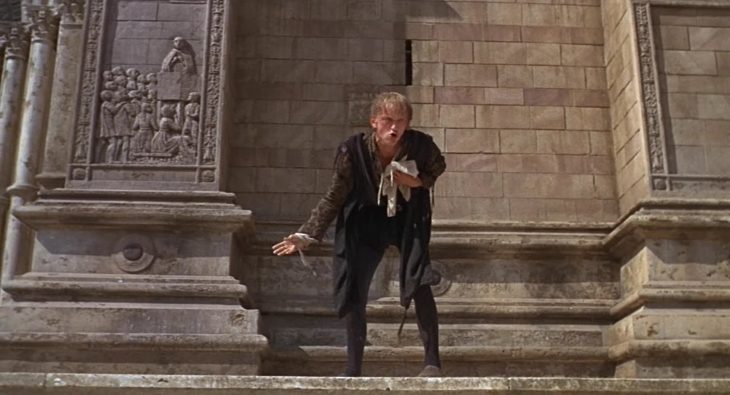
Today’s image is of John McEnery playing Mercutio in the Franco Zefferelli film version of Romeo and Juliet (1968) (https://clip.cafe/clipimg/a-plague-o-both-houses.jpg).
