Word of the Day: Venal
Today’s word of the day, courtesy of the Words Coach (https://www.wordscoach.com/dictionary), is venal. Pronounced / ˈvin l /, this adjective means “willing to sell one’s influence, especially in return for a bribe; open to bribery; mercenary,” “able to be purchased, as by a bribe,” or “associated with or characterized by bribery” (https://www.dictionary.com/browse/venal).
Merriam-Webster says that it means “capable of being bought or obtained for money or other valuable consideration” or “originating in, characterized by, or associated with corrupt bribery” (https://www.merriam-webster.com/dictionary/venal). Then M-W draws a distinction which might be useful to keep in mind:
“What’s the difference between venal and venial?
“If you are given the choice between acts that are venal and those that are venial, go for the venial. Although the two words look and sound alike, they have very different meanings and histories. Venal demonstrates the adage that anything can be had if the price is high enough and the morals are low enough. That word originated with the Latin venum, which simply referred to something that was sold or for sale. Some of those transactions must have been rather shady because by the mid-1600s, venal had gained the sense of corruption it carries today. Venial sins, on the other hand, are pardonable, the kind that show that everyone makes mistakes sometimes. That forgiving term descends from venia, Latin for ‘favor,’ ‘indulgence,’ or ‘pardon’” (ibid.).
The word first appears in English in the “mid-15c., ‘capable of being obtained for a price; that can be corrupted;’ 1660s, ‘offered for sale,’ from French vénal, Old French venel ‘for sale’ (of prostitutes, etc.; 12c.) and directly from Latin venalis ‘for sale, to be sold; capable of being bribed.’
“This is from venum (nominative *venus) ‘for sale,’ reconstructed to be from PIE *wes-no- ‘price,’ from root *wes- (1) ‘to buy, sell,’ source also of Sanskrit vasnah ‘purchase money,’ vasnam ‘reward,’ vasnayati ‘he bargains, haggles;’ Greek onos ‘price paid, purchase,’ oneisthai ‘to buy.’
“Typically with a bad sense of ‘ready to sell one’s services or influence for money and from sordid motives; to be bought basely or meanly’ (https://www.etymonline.com/search?q=venal).
A couple of comments about the pronunciation. You may have noticed that in the IPA spelling, / ˈvin l /, there is no vowel in the second syllable, just the consonant l. That letter is a voiced alveolar lateral approximant. Voiced means that the vocal folds vibrate during the production of the sound (compare b and p, which are made in exactly the same way except that the first is voiced and the second is voiceless). Alveolar means that the speaker places the tip of the tongue on the alveolar ridge, right behind and above the upper front teeth. “A lateral is a consonant in which the airstream proceeds along one or both of the sides of the tongue, but is blocked by the tongue from going through the middle of the mouth” (https://en.wikipedia.org/wiki/Lateral_consonant). “Approximants are speech sounds that involve the articulators approaching each other but not narrowly enough, nor with enough articulatory precision, to create turbulent airflow. Therefore, approximants fall between fricatives, which produce a turbulent airstream, and vowels, which produce no turbulence” (https://en.wikipedia.org/wiki/Approximant). Fricatives include s and f. Approximants are often considered semivowels; they have the features of vowels but also act in certain contexts as consonants. The l in venal functions as a vowel as well as a consonant.
The second thing is the letter v, and this is just a curiosity and has little to do with our word of the day. In English, we pronounce the v as a voice labiodental fricative; that means we put out lower lip against our upper teeth and push air through, creating a turbulent air flow, while vibrating our vocal folds. The voiceless labiodental fricative is the f. In Deutsch, the letter v represents a sound closer to the English f. The Church Latin was similar to the English. But “According to a consensus of Latin scholars, the letter V in ancient Latin was pronounced as [w]. This seems to make sense, because there was no distinguishing between V and U, so the letter V could mark either the vowel [u] or its semivocalic counterpart [w]” (https://latin.stackexchange.com/questions/28/non-typographical-evidence-of-v-being-pronounced-as-w). So the Latin venalis would have begun with a w sound, like “when al iss.” It also means that when Caesar conquered Gaul, what he said would have sounded not like “veni, vidi, vici” (with a ch sound) but rather like “weni, widi, wiki” (the c would have been hard). Say it a few times—it doesn’t sound particularly macho.
On this date in 1497, “Pope Alexander VI excommunicates Italian Dominican friar Girolamo Savonarola for leading the expulsion of the Medici’s from Florence” (https://www.onthisday.com/events/may/13).
Girolamo Savonarola was born in 1452 in Ferrara (those of you familiar with Robert Browning’s “My Last Duchess” will probably recognize the name of that city). He was a kind of Italian puritan even as a youth. “By 1472, he had written an unfinished treatise entitled ‘On Contempt for the World.’ By 1475, he had left his family home to enter the Dominican order at Bologna, and went on to teach Scripture. At one point, Savonarola wrote to his father condemning ‘the blind wickedness of the peoples of Italy’” (https://allthatsinteresting.com/girolamo-savonarola).
“Then, in 1482, Savonarola was sent to the Convent of San Marco in Florence, where he steadily drew attention for his fire-and-brimstone sermons. Girolamo Savonarola drew heavily from Revelations, spoke of a new, imminent Biblical flood, predicted the deaths of Lorenzo de Medici, the de facto leader of Florence, and Pope Innocent VIII, and warned that an invader would soon cross over the Alps and attack Italy” (ibid.). And those prophecies seemed to come true. Lorenzo and the Pope both died in the early 1490s, and the French king invaded Italy in 1494. With the invasion, the de Medicis, who were the ruling family of Florence, skipped town, leaving a power vacuum which Savonarola was happy to fill.
In place of the de Medicis, Savonarola wanted to install a kind of Christian republic, a very puritanical republic that would foreswear the things of this world. “Savonarola disliked jokes, poetry, and sex, denounced nude paintings and humanist ideas, and canceled the city’s popular carnivals and festivals” (ibid.). He created a kind of army of young, poor men, perhaps boys, to help him weed out what he saw as corruption.
“But Savonarola’s most infamous moment came on Feb. 7, 1497, when he threw his infamous ‘Bonfire of the Vanities’. In the Piazza del Signoria, Savonarola had a great pyre erected as his loyal youths went door to door, demanding that Florentines give up objects of ‘vice.’ One remembered that the boys took ‘lascivious pictures… women’s hats, mirrors, wigs, dolls, perfumes, pictures in intarsia, sculptures, cupids, playing cards, dice boards, chess pieces, lutes and other musical instruments, books of diverse poets…’” (ibid.).
Of course there was opposition, most notably in the form of the Roman Catholic Church and Pope Innocent’s replacement, Pope Alexander VI. “As Girolamo Savonarola consolidated power, Church leaders attempted to bring him to heel. They disliked his denunciations of luxury in the Church, and sought to silence him. At first, they attempted to do so by buying Savonarola’s loyalty. But when Pope Alexander VI tried to bribe him by making him a cardinal, Savonarola refused outright. ‘A red hat?’ he purportedly replied. ‘I want a hat of blood’” (ibid.).
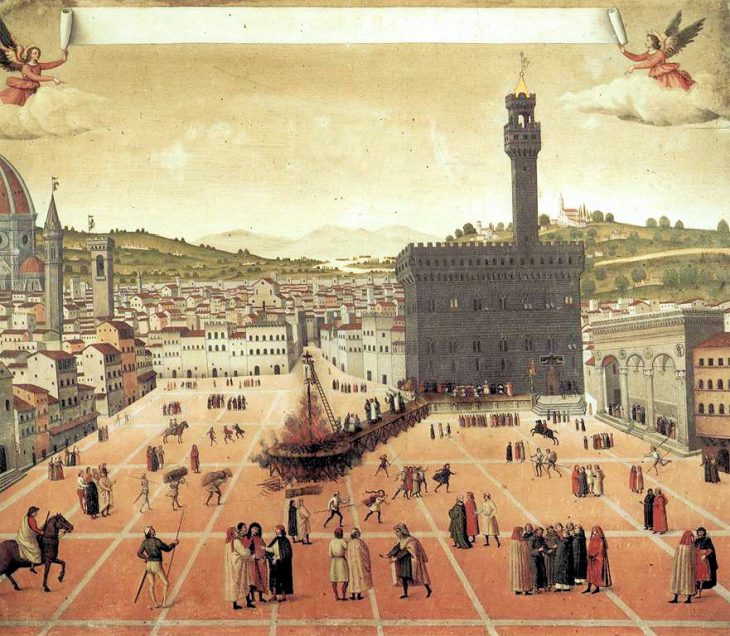
Savonarola and two of his followers were excommunicated and arrested and sentenced to death. And it was a particularly brutal death, which had been preceded by torture. “The three men were condemned to be hanged over a raging fire.
“’We shall have a fine bonfire,’ a papal commissioner, who’d come for the execution, remarked, ‘for I have the sentence of condemnation with me.’
“On May 23, 1498, a large crowd gathered in Piazza della Signoria, where Savonarola had held his “Bonfire of the Vanities.” As a bishop stripped Savonarola and his companions of their religious frocks, he told Savonarola ‘I separate thee from the church militant and from the church triumphant,’ to which the friar replied, ‘That is beyond your power’” (ibid.).
I have to admit that this story leaves me uncertain. I am not a fan of puritans. Savonarola reminds me of the Islamic Republic today. On the other hand, I would guess that Pope Alexander was a fan of the de Medicis and that their money promoted that fandom. I make that guess because it is obvious that Alexander thought that Savonarola could be dissuaded from his actions by appealing to his venal nature. We humans have a tendency to imagine that other people just must share our vices.
But for all his negative qualities, Savonarola was not venal, apparently. Then again, destroying works of art in a Bonfire of the Vanities isn’t exactly venial, at least not in my book.
Today’s image is of the “Hanging and burning of Girolamo Savonarola in Piazza della Signoria in Florence in 1498. 17th-century copy of a contemporary original attributed to Francesco Rosselli. In a contemporary copy from Perugia, the scroll held by angels bears the inscription “ecce quomodo moritur iustus et viri sancti de terra tolluntur“. This is a quote by Savonarolia, its addition amounting to a condemnation of the execution, while the Fiorentine original by Rosselli had the intent of minimizing the impact of the event, representing the audience in small, indifferent and otherwise busy groups” (https://en.wikipedia.org/wiki/File:Hanging_and_burning_of_Girolamo_Savonarola_in_Florence.jpg). Rosselli (1445-c. 1510) was a painter of miniatures and a cartographer. The Latin translates as “Behold how the righteous dieth, and holy men are taken from the earth.”
