Word of the Day: Sycophant
Today’s word of the day, courtesy of the Words Coach (https://www.wordscoach.com/dictionary) is sycophant. Pronounced / ˈsɪk ə ˌfænt / (there are variants, but I’m going with what I think is the preferred pronunciation with a secondary stress on the third syllable), this noun means “a self-seeking, servile flatterer; fawning parasite” (https://www.dictionary.com/browse/sycophant).
It appears in English in the “1530s (in Latin form sycophanta), ‘informer, talebearer, slanderer’ (a sense now obsolete), from French sycophante and directly from Latin sycophanta, from Greek sykophantēs ‘false accuser, slanderer,’ literally ‘one who shows the fig,’ from sykon ‘fig’ (see fig (n.1)) + phainein ‘to show’ (from PIE root *bha- (1) ‘to shine’).
“’Showing the fig’ was a vulgar gesture made typically by sticking the thumb between two fingers. That it was considered obscene and insulting is all that is sure. A split fig was symbolic of a vagina (sykon also meant ‘vulva’). The thumb-poking-between-the-fingers gesture has been a sexual image in various times and places; see fig (n.1).
“The usual modern explanation of the use of the word in reference to certain persons in ancient Greece is that prominent politicians held aloof from scurrilous gestures but privately urged followers to taunt their opponents.
“’The explanation, long current, that it orig. meant an informer against the unlawful exportation of figs cannot be substantiated.’ [OED, 2nd ed. print, 1989]
“That discarded explanation is as old as the word’s use in English, and the phrase already was explained differently in antiquity. The general sense of ‘parasite; mean, servile flatterer’ especially of princes or the great is recorded in English by 1570s” (https://www.etymonline.com/search?q=sycophant).
Merriam-Webster, in the Did You Know? Section, explains a bit differently: “In ancient Greece, sykophantēs meant ‘slanderer.’ It derives from two other Greek words, sykon (meaning ‘fig’) and phainein (meaning ‘to show or reveal’). How did fig revealers become slanderers? One theory has to do with the taxes Greek farmers were required to pay on the figs they brought to market. Apparently, the farmers would sometimes try to avoid making the payments, but squealers—fig revealers—would fink on them, and they would be forced to pay. Another possible source is a sense of the word fig meaning ‘a gesture or sign of contempt’ (as thrusting a thumb between two fingers). In any case, Latin retained the ‘slanderer’ sense when it borrowed a version of sykophantēs, but by the time English speakers in the 16th century borrowed it as sycophant, the squealers had become flatterers” (https://www.merriam-webster.com/dictionary/sycophant).
I have no idea which source is the correct one, but my favorite is the one about politicians hiring people to make their scurrilous gestures for them. I’m pretty sure we are seeing a new version of that online today.
According to On This Day, on this date in 1794, “Jean-Paul Marat’s remains are transferred to the Panthéon in Paris, with the eulogy given by the Marquis de Sade” (https://www.onthisday.com/events/september/21).
Jean-Paul Marat (1743-1793) was a French scientist, doctor, political scientist, and revolutionary. Although he never received medical certification of any kind, he did practice medicine for quite a few years in London and in France. He also wrote an epistolary novel, published in 1770, called “Les Aventures du jeune comte Potowski, set in Poland before the First Partition [of Poland]. The novel already presented resistance to oppressive government as a right of the people” (https://en.wikipedia.org/wiki/Jean-Paul_Marat). “His Chains of Slavery, published in London in 1774, examined the means by which rulers could undermine political liberty. Published during the political agitation surrounding John Wilkes and the British general election of 1774, the book attacked political corruption, restrictions on representation and the use of patronage, standing armies, censorship and other instruments of government power” (ibid.).
In 1788, when King Louis XVI called together the Estates-General, Marat decided that he wanted to be part of the political change coming in France. “On 12 September 1789, Marat began his own newspaper, entitled Publiciste parisien, before changing its name four days later to L’Ami du people (‘The People’s Friend’). He frequently attacked influential individuals and institutions as conspirators against the Revolution, including the Commune, the Constituent Assembly, ministers, and the Châtelet. In January 1790, the district of the Cordeliers, where Marat lived, resisted an attempt by the Châtelet to arrest him. Marat subsequently left Paris for London, returning in May and resumed publication” (ibid.).
“In January 1792, Marat met Maximilien Robespierre for what Robespierre later described as their first and only private meeting. The two disagreed over political tactics: Robespierre criticized Marat’s repeated ‘absurd and violent proposals’, while Marat praised Robespierre’s integrity and patriotism. From 1791, Marat repeatedly referred to him as ‘the incorruptible Robespierre’, helping to popularize the epithet, using it as early as May 1791. He nevertheless concluded that Robespierre lacked ‘the vision and audacity of a statesman’” (ibid.).
Robespierre is, of course, famous for his use of the guillotine during the Reign of Terror, including the execution of King Louis XVI. Robespierre was himself executed in 1794. But Robespierre critiqued the violent rhetoric of Jean-Paul Marat, so that must indicative of exactly how violent Marat was. It is also telling that his eulogy was pronounced by the Marquis de Sade, the man from whom the word sadist is coined (look him up if you want).
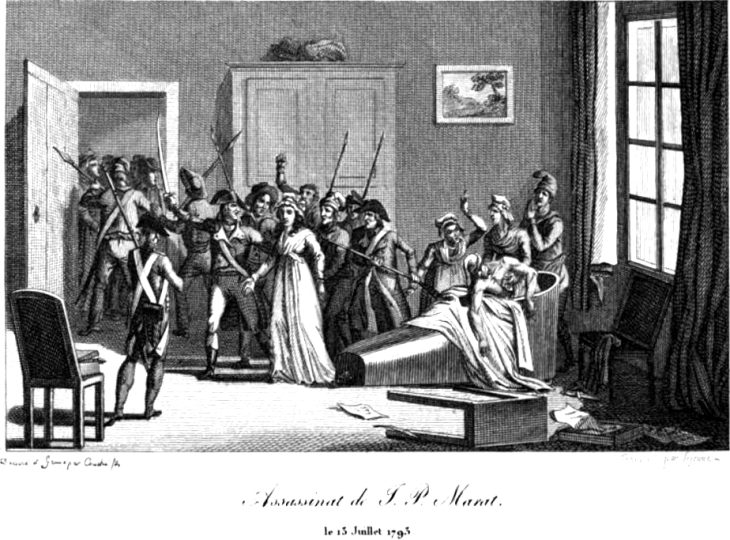
And as is often the case, the proponent of violence was himself the victim of violence. In late May and early June of 1793, Marat was presiding over the National Convention. He ordered the arrest of the leading Girondins, a political group that was not as revolutionary as Marat thought they should be, and some of those leaders were executed. “On Saturday 13 July, Charlotte Corday, a young woman from Caen who sympathized with the Girondins, came to Marat’s home. She had originally intended to kill him at the National Convention, but learned that his illness prevented him from attending its sessions. After being refused admission earlier in the day, she returned in the evening, claiming to have information about Girondin deputies who had taken refuge in Caen after their expulsion from the Convention. She carried with her a note appealing to Marat’s sympathy: ‘I am unhappy; it is enough that I am so to have a right to your protection.’ Marat, whose illness confined him to a medicinal bath for much of the day, eventually ordered that she be admitted and received her there around eight in the evening. Corday named several of the deputies. According to her later testimony, Marat told her that they would soon be guillotined in Paris, words which she said decided his fate. She then drew a kitchen knife concealed in her clothing and stabbed Marat once in the chest. Mortally wounded, he called to Simonne Évrard, ‘Aidez-moi, ma chère amie!’ (‘Help me, my dear friend!’), and died shortly afterwards. News of the assassination quickly drew a large crowd to the Rue des Cordeliers, where cannon were positioned at both ends of the street as Corday was taken away to prison” (ibid.).
The French Revolution began with noble goals, to free the people from the tyranny of a monarchy. But as the Revolution moved along, it became more and more radical and more and more violent. Thousands who were revolutionaries in 1792 were executed as reactionaries by 1793 and 1794. He was celebrated for the next year or so, until his remains were transferred to the Panthéon. But “the Thermidorian Reaction brought a rapid reversal of Marat’s official cult. Le Havre abandoned the name Havre-Marat in January 1795, while busts and other representations of Marat were publicly removed or destroyed. On 2 February 1795, his remains were removed from the Panthéon” (ibid.).
Jean-Paul Marat was caught up in the Revolution and became one of the more radical and violent participants. He may serve as a caution to those who would be revolutionaries today. But at least he wasn’t a sycophant.
Today’s image is a picture of the arrest of Charlotte Corday after she assassinated Jean-Paul Marat (https://en.wikipedia.org/wiki/Jean-Paul_Marat#/media/File:MaratMurder.jpg).
