Word of the Day: Pleonasm
Today’s word of the day, courtesy of the Words Coach (https://www.wordscoach.com/dictionary), is pleonasm. Pronounced / ˈpli əˌnæz əm /, this noun means “the use of more words than are necessary to express an idea” or “a redundant word or expression” (https://www.dictionary.com/browse/pleonasm).
The word appears in English in the “1580s, from Late Latin pleonasmus, from Greek pleonasmos, from pleonazein ‘to be more than enough, to be superfluous,’ in grammatical use, ‘to add superfluously,’ from combining form of pleon ‘more’ (from PIE root *pele- (1) ‘to fill’). Not necessarily a flaw in rhetoric and sometimes used effectively for emphasis. As Fowler writes, ‘The writer who uses [pleonasm] in that way must be judged by whether he does produce his effect & whether the occasion is worthy of it.’
“’The first surplusage the Greekes call Pleonasmus, I call him [too full speech] and is no great fault, as if one should say, I heard it with mine eares, and saw it with mine eyes, as if a man could heare with his heeles, or see with his nose. We our selues ysed this superfluous speech in a verse written of our mistresse, neuertheles, not much to be misliked, for euen a vice sometime being seasonably vsed, hath a pretie grace.’ [George Puttenham, ‘The Arte of English Poesie,’ 1589]” (https://www.etymonline.com/search?q=pleonasm).
George Puttenham’s The Arte of English Poesie “is the most systematic and comprehensive treatise of the time on its subject. It is ‘contrived into three books: the first of poets and poesies, the second of proportion, the third of ornament.’ Puttenham’s book covers a general history of the art of poetry, and a discussion of the various forms of poetry; the second treats of prosody, dealing in turn with the measures in use in English verse, the caesura, punctuation, rhyme, accent, cadence, proportion in figure, which the author illustrates by geometrical diagrams, and the proposed innovations of English quantitative verse; the section on ornament deals with style, the distinctions between written and spoken language, the figures of speech; and the author closes with lengthy observations on good manners. He deprecates the use of archaisms, and although he allows that the purer Saxon speech is spoken beyond the Trent, he advises the English writer to take as his model the usual speech of the court, of London and the home counties” (https://en.wikipedia.org/wiki/George_Puttenham). While the actual authorship of The Arte of English Poesie is uncertain, Puttenham is generally given credit for it, and what is not uncertain is the influence it had on both poetry and books of poetics that came later.
That was a digression, perhaps employing more words than necessary, so now we’ll get back to our word.
In its Did You Know? section, Merriam-Webster says, “Pleonasm, which stems (via Late Latin) from the Greek verb pleonazein, meaning ‘to be excessive,’ is a fancy word for ‘redundancy.’ It’s related to our words plus and plenty, and ultimately it goes back to the Greek word for ‘more,’ which is pleōn. Pleonasm is commonly considered a fault of style, but it can also serve a useful function. ‘Extra’ words can sometimes be helpful to a speaker or writer in getting a message across, adding emphasis, or simply adding an appealing sound and rhythm to a phrase—as, for example, with the pleonasm ‘I saw it with my own eyes!’” (https://www.merriam-webster.com/dictionary/pleonasm). M-W also lists its first use as occurring in 1610, but that cannot be correct if Puttenham used it in a book in 1598.
On this date in 1889, Wilkie Collins died following a stroke.
Collins is best known for his novels The Woman in White and The Moonstone. Born in 1824, Collins was born into a religious, middle-class family. He was initially taught at home, but he went to a variety of schools, including one in Italy while his family was there for two years. “From 1838 to 1840, he attended the Reverend Cole’s private boarding school in Highbury, where he was bullied. One boy forced Collins to tell him a story every night before allowing him to go to sleep. ‘It was this brute who first awakened in me, his poor little victim, a power of which but for him I might never have been aware…. When I left school I continued story telling for my own pleasure,’ Collins later said” (https://en.wikipedia.org/wiki/Wilkie_Collins).
“An instrumental event in his career was an introduction in March 1851 to Charles Dickens by their friend in common, the painter Augustus Egg. They became lifelong friends and collaborators. In May of that year, Collins acted with Dickens in Edward Bulwer-Lytton’s play Not So Bad As We Seem. Among the audience were Queen Victoria and Prince Albert. Collins’s story “A Terribly Strange Bed”, his first contribution to Dickens’s journal Household Words, was published in April 1852” (ibid.). Collins later went to work on Household Words, and after that on Dickens’s magazine All the Year Round.
The 1860s were Collins’s most productive decade. He published The Woman in White serially in All the Year Around starting in 1859 and finishing in 1860. It was then published in book form and sold very well. Collins would late say that it was his best novel (ibid.). It was called a “sensation novel at the time, but today it is generally considered to be a mystery. “The story can be seen as an early example of detective fiction with many of the sleuthing techniques of protagonist Walter Hartright being employed by later private detectives. The use of multiple narrators (including nearly all the principal characters) draws on Collins’s legal training, and as he points out in his preamble: ‘the story here presented will be told by more than one pen, as the story of an offence against the laws is told in Court by more than one witness’” (https://en.wikipedia.org/wiki/The_Woman_in_White_(novel)).
In 1868 Collins published The Moonstone, also in All the Year Round. It’s an epistolary novel, meaning that it is presented as a series of letters. The detective in the book is one Sargeant Cuff, so in a sense The Moonstone is an early example of a police procedural. “The book is regarded by some as the forerunner of the modern mystery novel and the suspense novel. T. S. Eliot called it ‘the first, the longest, and the best of modern English detective novels in a genre invented by Collins and not by Poe,’ and Dorothy L. Sayers praised it as ‘probably the very finest detective story ever written’. G. K. Chesterton calls it ‘probably the best detective tale in the world’. Graham Greene argues that The Sign of Four [the second of the Sherlock Holmes novels written by Arthur Conan Doyle] is derived ‘a little too closely’ from it” (https://en.wikipedia.org/wiki/The_Moonstone).
In The Moonstone, “Gabriel Betteredge is a venerable man and the Verinders’ head servant. He bases his personal philosophy around the book Robinson Crusoe, and frequently uses quotes from it to apply to different situations. He narrates the first section of the novel, and assists Sergeant Cuff in his investigations” (https://en.wikipedia.org/wiki/The_Moonstone). He is kind of a precursor to Doyle’s Doctor Watson, the man who often serves as a narrator to the Holmes stories, as well as being an assistant to Sherlock Holmes. Here is a quote from The Moonstone, specifically from Betteredge:
“You are not to take it, if you please, as the saying of an ignorant man, when I express my opinion that such a book as ROBINSON CRUSOE never was written, and never will be written again. I have tried that book for years—generally in combination with a pipe of tobacco—and I have found it my friend in need in all the necessities of this mortal life. When my spirits are bad—ROBINSON CRUSOE. When I want advice—ROBINSON CRUSOE. In past times when my wife plagued me; in present times when I have had a drop too much—ROBINSON CRUSOE. I have worn out six stout ROBINSON CRUSOES with hard work in my service. On my lady’s last birthday she gave me a seventh. I took a drop too much on the strength of it; and ROBINSON CRUSOE put me right again. Price four shillings and sixpence, bound in blue, with a picture into the bargain” (https://www.goodreads.com/work/quotes/1044477-the-moonstone).
There’s a funny thing about novels in the nineteenth century that were initially published serially in magazines, just as Collins’s novels were. In many cases, the authors were paid by the word. But Collins was not being paid by the word, which makes one wonder why we see such pleonasm in his work. Maybe it’s just the character.
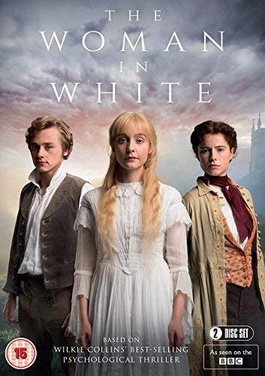
In 2018, the BBC produced a five-episode television drama (they called in a “psychological thriller”) based on Wilkie Collins’s The Woman in White (https://en.wikipedia.org/wiki/The_Woman_in_White_(2018_TV_series)). Today’s illustration is from the marketing for that TV series.