Word of the Day: Ostensible
Today’s word of the day, thanks to Words Coach (https://www.wordscoach.com/dictionary/ostensible), is ostensible. Ostensible is an adjective that means “intended for display, open to view” or more commonly “being such in appearance, plausible rather than demonstrably true or real” (https://www.merriam-webster.com/dictionary/ostensible).
M-W goes on to explain, ” British philosopher and economist Jeremy Bentham once wrote to Indian religious leader Ram Mohan Roy asking him to ‘send me two letters—one confidential, another ostensible.’ By ostensible he meant that, unlike the confidential letter, the latter was intended to be shown to people other than Bentham himself. This sense of ostensible shows clearly the influence of the word’s Latin ancestor, the verb ostendere, meaning ‘to hold out for inspection,’ ‘to show,’ ‘to make clear by one’s actions,’ and ‘to demonstrate.’ Ostensible is still used today as it is in Bentham’s letter, but it is much more likely to suggest a discrepancy between a declared or implied aim or reason (i.e., the aim or reason that someone displays or ‘shows’ to others) and the true one. For example, someone might give ‘seeing an old friend’ as their ostensible reason for planning a trip when in reality they are planning on spending most of their time relaxing on the beach” (ibid.).
Etymonline.com says that the word first appears in English in “1730, ‘capable of being shown, that can be shown or seen, presentable,’ from French ostensible, from Latin ostens-, past-participle stem of ostendere ‘to show, expose to view; to stretch out, spread before; exhibit, display,’ from assimilated form of ob ‘in front of’ (see ob-) + tendere ‘to stretch’ (from PIE root *ten- ‘to stretch’). Meaning ‘apparent, professed, put forth or held out as real’ is from 1771.
“Ostensible is, literally, that may be or is held out as true, real, actual, or intended, but may or may not be so: thus, a person’s ostensible motive for some action is the motive that appears to the observer, and is held out to him as the real motive, which it may or may not be. [Century Dictionary, 1895]” (https://www.etymonline.com/search?q=ostensible).
The pronunciation is / ɒˈstɛn sə bəl /, with the emphasis on the second syllable. One could dispute the schwa in the third syllable, that it is, perhaps, more often an ɪ, but the schwa certainly fits the general rule, that vowels in unstressed syllables tend toward schwa. And assimilation is the process by which a sound will change to ease the pronunciation of a word. So the ob- prefix would be much more difficult to say right before tensible, so the b gradually morphed into an s, and this assimilation has happened frequently enough in the history of the English language that we recognize it as a pattern.
On this date in 1816, according to On This Day, “10″ of snowfall in New England, part of a ‘year without a summer’ which followed the eruption of Mount Tambora in Indonesia” (https://www.onthisday.com/events/june/6).
The New England Historical Society has a lengthy article about this on its website; it’s called 1816: The Year without a Summer; Also Known as Eighteen Hundred and Froze to Death” (https://newenglandhistoricalsociety.com/1816-year-without-a-summer/). According to the article, “The year 1816 was known as ‘The Year Without a Summer’ in New England because six inches of snow fell in June and every month of the year had a hard frost. Temperatures dropped to as low as 40 degrees in July and August as far south as Connecticut.”
“There were warm days in the spring of 1816, but they were followed by cold snaps. In Salem, Mass., for example, it was 74 degrees on April 24. Within 30 hours the temperature dropped to 21 degrees.
“Thomas Robbins, the East Windsor, Conn., bibliophile, noticed the late spring. He wrote in his diary, ‘the vegetation does not seem to advance at all.’
“On May 12, strong winds and freezing temperatures from Canada killed the buds on fruit trees. Inch-thick ice formed on ponds and streams from Maine to Upstate New York. By the end of May, corn plants froze in central Maine.
“Then on June 6, 1816, six inches of snow fell on New England. Clockmaker Chauncey Jerome wrote in his autobiography that he walked to work that day in Plymouth, Conn., wearing heavy woolen clothes, an overcoat and mittens.”
Okay, 6” and 10” are not the same, but who’s counting?
But here’s the part of the article that really caught my attention: “And to this day, scientists don’t agree on what caused the bizarre weather in The Year Without a Summer.”
Wikipedia says, “Evidence suggests that the anomaly was predominantly a volcanic winter event caused by the massive 1815 eruption of Mount Tambora in April in modern-day Indonesia (commonly referred to as the Dutch East Indies at the time). This eruption was the largest in at least 1,300 years (after the hypothesized eruption causing the volcanic winter of 536); its effect on the climate may have been exacerbated by the 1814 eruption of Mayon in the Philippines. The significant amount of volcanic ash and gases released into the atmosphere blocked sunlight, leading to global cooling” (https://en.wikipedia.org/wiki/Year_Without_a_Summer).
But the wiki also says, “The Earth had already been in a centuries-long period of cooling that began in the 14th century. Known today as the Little Ice Age, it had already caused considerable agricultural distress in Europe. The eruption of Tambora occurred near the end of the Little Ice Age, exacerbating the background global cooling of the period.
“This period also occurred during the Dalton Minimum, a period of relatively low solar activity from 1790 to 1830. May 1816 had the lowest Wolf number (0.1) to date since records on solar activity began. It is not yet known, however, if and how changes in solar activity affect Earth’s climate, and this correlation does not prove that lower solar activity produces global cooling.”
So scientists really are uncertain about the causes of the Year without a Summer. The recent news about the drastic increase in the ice in Antarctica reaffirms the uncertainty. There is so much we don’t know, not only about climate but also about the history of our language. Perhaps when we are talking about effects in the linguistic or the natural world we should talk about ostensible causes.
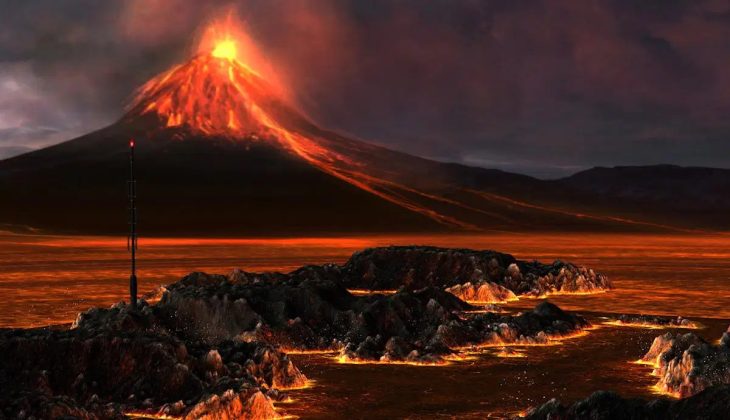
Today’s image is of the eruption of Mount Tambora (https://www.thecollector.com/eruption-mt-tambora/): “Mount Tambora is a volcano on the Indonesian island of Sumbawa. In 1815, Indonesia was still a part of the Dutch East Indies and was known for its Tambora coffee variety, produced on the slopes of the volcano. When the volcano began erupting on April 5, 1815, the devastation was immediate and widespread.”