Word of the Day: Plethora
Today’s word of the day, courtesy again of Merriam-Webster, is plethora. According to the dictionary, “Plethora refers to a very large amount or number of something. Plethora is most often used in the phrase ‘a plethora of’” (https://www.merriam-webster.com/word-of-the-day).
According to the etymology website, the word enters the English language in the “1540s, a medical word for ‘excess of body fluid, overfullness of blood,’ from Late Latin plethora, from Greek plēthōrē ‘fullness,’ from plēthein ‘be full’ (from PIE root *pele- (1) ‘to fill’). Figurative meaning ‘too-muchness, overfullness’ in any respect is recorded by 1700 (https://www.etymonline.com/search?q=plethora).
I’m sure lots of things have happened on the fifth day of May throughout history, but I’m going to ignore the date today and talk about a famous athlete.
On October 23, 1940, Edson Arantes do Nascimento was born in Três Corações, in the state of Minas Gerais, in Brazil. According to the wiki, he “in poverty in Bauru in the state of São Paulo” (https://en.wikipedia.org/wiki/Pel%C3%A9). His father taught him to play association football, what we Americans call soccer.[i] And he actually became pretty good even though his family couldn’t afford a ball. He played with a stuffed sock or a piece of fruit.
According to the wiki, “He was originally nicknamed ‘Dico’ by his family. He received the nickname ‘Pelé’ during his school days, it is claimed, after mispronouncing the name of his favourite player, Vasco da Gama goalkeeper Bilé. In his autobiography released in 2006, Pelé stated he had no idea what the name means, nor did his old friends, and the word has no meaning in Portuguese. He would later learn it means ‘miracle’ (פֶּלֶא) in Hebrew.” Other possible translations of the Hebrew word פֶּלֶא are “wonder,” “marvel,” and “prodigy,” which seems particularly apt.
Pele played amateur football and futsal (indoor football) when he was young, but at 15 he began his professional career, playing his first senior match on September 7, 1956, and scoring his first professional goal. He would go on to score many more for Santos, the club he was with in Brazil for 19 years. He did come out of retirement, briefly, to play for the New York Cosmos in the North American Soccer League.
His international career began the next year, and he scored a goal in his first game on July 7, 1957, a game Brazil lost to Argentina, 2-1. He was just 16 and remains the youngest player ever to score a goal in an international match. He played for Brazil in the 1958 World Cup, held in Sweden, and became the youngest player ever to play in the World Cup, the youngest to score a goal, and the youngest to score a hat trick (three goals in one game), which he did in the semi-final against France. He then scored two more goals in the World Cup final against the host team, helping Brazil to win its first World Cup title. Brazil would win two more, 1962 and 1970, before Pele would retire.
It’s hard to know how many goals Pele actually scored in his career. The official FIFA tally is 757, but the Guiness Book of World Records has the total at 1,279, far more than Cristiano Ronaldo or Lionel Messi. And of course it is hard to compare athletes from different generations, though people constantly try to do so. Let’s just say that Pele was one of the greatest footballers (soccer players) to ever don (put on) his boots (soccer shoes or cleats) and step onto the pitch (field).
By the way, the PIE root word for plethora is, as you may have noticed, *pele-, meaning “to fill.” That also seems apt for the footballer who filled the goal perhaps more than any player ever has or ever will. Then again, records are made to be broken.
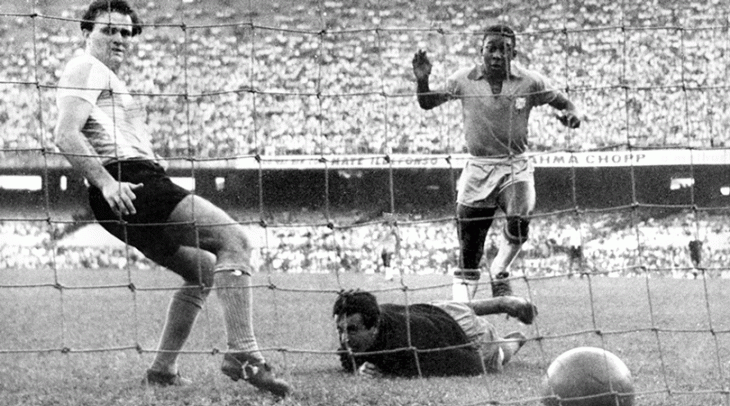
Today’s image is “A young Pele scores his first-ever goal for Brazil in a 1957 Copa Roca match against Argentina at the Maracana in Rio de Janeiro. Picture courtesy CBF,” from The Telegraph Online (https://www.telegraphindia.com/sports/football/peles-memorable-goals/cid/1906908#goog_rewarded
[i] There are two types of football in England. One kind developed at a school called Rugby; the other goes back to ancient times. In the 1800s, an association was formed to govern the latter sport. So to distinguish between the two kinds of football, one was called Rugby football and the other Association football. Rugby football has become known as simply rugby. But the other kind picked up a nickname, a shortening of the word association, which was soccer. For a long time in the UK, soccer was used to refer to Association football as frequently as football. But then the sport started to become popular in the United States. But the US already had their own kind of football, sometimes referred to as gridiron football, and to most Americans, that was just football, so the British football was called by its other name, soccer. When the Yanks started to call it soccer exclusively, the Brits began to use soccer less and less until now the name is somewhat a bone of contention. As Oscar Wilde wrote in The Canterville Ghost (1887): “We have really everything in common with America nowadays except, of course, language” (https://english.stackexchange.com/questions/74737/what-is-the-origin-of-the-phrase-two-nations-divided-by-a-common-language).