Word of the Day: Fanfaronade
Today’s word of the day, thanks to the Words Coach (https://www.wordscoach.com/dictionary) is fanfaronade. Pronounced / ˈfæn fər əˈneɪd /, with stresses on both the first and last syllable, this noun means “bragging; bravado; bluster” (https://www.dictionary.com/browse/fanfaronade).
In its Did You Know section, Merriam-Webster says, “You Can Brag About Your Knowledge of Fanfaronade
“If we tell you that fanfaronade is what fanfarons do, you’ll easily guess that fanfaron means ‘braggart.’ Both ‘fanfaron’ (a fairly uncommon word found in unabridged dictionaries) and ‘fanfaronade’ derive from ‘fanfarrón,’ a Spanish word for a boaster that probably developed in imitation of the verbal claptrap blared by blowhards. ‘Fanfarrón’ gave Spanish speakers fanfarronada, which the French borrowed with the spelling ‘fanfaronnade’; English speakers further modified the French term into ‘fanfaronade’ in the mid-1600s. Some etymologists believe English speakers borrowed ‘fanfaron’ directly from Spanish, but others think that word also passed through French before reaching our language. It isn’t clear whether ‘fanfaron’ and ‘fanfaronade’ are directly related to the similar ‘fanfare’ or if that term arose as yet another transliteration of the sound of a showy or pompous display” (https://www.merriam-webster.com/dictionary/fanfaronade).
Etymonline.com does not have an entry for fanfaronade, but it does have an entry for fanfare. It appears in English “c. 1600, ‘a flourish sounded on a trumpet or bugle,’ from French fanfare ‘a sounding of trumpets’ (16c.), from fanfarer ‘blow a fanfare’ (16c.), perhaps echoic, or perhaps borrowed (with Spanish fanfarron ‘braggart,’ and Italian fanfano ‘babbler’) from Arabic farfar ‘chatterer,’ of imitative origin. French fanfaron also came into English 1670s with a sense ‘boastful’” (https://www.etymonline.com/search?q=fanfaron). So it does connect fanfaronade with fanfare, and it appears that fanfare entered the language first. Of course, in the 16th century, the English were reading literature from the French and the Spanish, so it’s not surprising that a Spanish word would come into English through French or perhaps directly. And there was a strong Arabic influence in Spanish from the hundreds of years of the Kingdom of Granada.
According to On This Day, on this date in 1869, “In the first US college football game, players use their hands, feet, heads, or sides to advance the ball, but they cannot run with it; Rutgers College beats New Jersey (now Princeton) 6-4” (https://www.onthisday.com/events/november/6).
Rutgers College and the College of New Jersey were just 20 miles apart, so they had a bit of a rivalry. In 1866, they played a baseball game, and New Jersey won, 40-2. So Rutgers challenged New Jersey (later to become Princeton University) to a series of three football matches.
“The match was played under modified rules of the London Football Association, which emphasized kicking and batting a round soccer-style ball with feet, heads, or bodies but prohibited carrying it in hands, blending elements of soccer and early rugby. Each team fielded 25 players, divided into roles such as “bulldogs” for advancing the ball, ‘fielders’ for defense, and two goalkeepers, with the objective of scoring 10 goals to win while alternating field directions after each score” (https://grokipedia.com/page/1869_Princeton_vs._Rutgers_football_game).
“This contest marked the birth of American college football, introducing innovative tactics like the ‘flying wedge’ formation and setting the stage for the sport’s rapid evolution from soccer-rugby hybrids to the modern game within a decade. Princeton, seeking revenge, hosted a rematch one week later on November 13, 1869, and won 8–0 under similar rules, though the teams negotiated variations for each encounter. The series of early games between the institutions helped standardize intercollegiate competition, influencing the formation of rules committees and the shift toward rugby-influenced play at eastern universities by the 1870s. Today, the 1869 game is commemorated as a foundational event, with Rutgers claiming the inaugural victory and Princeton retroactively awarding itself a national championship for the era” (ibid.).
Here are the rules they played under:
- Grounds must be 360 feet (110 m) long and 225 feet (69 m) wide.
- Goals must be 8 paces.
- Each side shall number 25 players.
- No throwing or running with the ball; if either it is a foul and the ball then must be thrown perpendicularly in the air by the side causing the foul.
- No holding the ball or free kicks allowed.
- A ball passing beyond the limit on the side of the goal shall be kicked on from the boundary by the side who has that goal.
- A ball passing the limit on the side of the field shall be kicked on horizontally to the boundary by the side which kicked it out.
- No tripping or holding of players.
- The winner of the first toss has the choice of position; the winner of the second toss has the first kick-off.
- There shall be four judges and two referees. (https://en.wikipedia.org/wiki/1869_Princeton_vs._Rutgers_football_game)
“According to a retrospective story, the winning Rutgers students immediately ran Princeton’s players out of town, forcing them to hastily return home ‘in their carriages.’ This suggests that the game also birthed the first passionate college football rivalry. However, a contemporary account published in The Targum describes the Princeton team traveling by train, not by carriage, and refers to an ‘amicable’ postgame gathering followed by the Princeton team leaving ‘in good high spirits, but thirsting to beat us next time, if they can’” (ibid.).
There was supposed to be a third game, but it was cancelled by the faculty of the two institutions. They felt that academics should be more important than football. That is probably the last time in recorded history that such a sentiment was acted upon. One wonders, though, if that first victory prompted a fanfaronade by the Rutgers students.
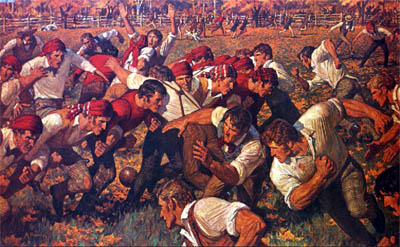
Today’s image is of Arnold Friburg’s commissioned painting The First Game. Oil on canvas, the painting was commission in 1968 by the Chevrolet division of General Motors to commemorate the centennial of that first football game. “In The First Game, Friberg extolled the fight and physical strength of the game. His painting shows how bruised players collide each other. Some of them even have blood stains in their uniforms. Rutgers players wear a headscarf that resembles a piracy-style. The ball is small and round, like an association football. The field is covered by dry leaves, as usual in November, when the game was played. Spectators are seen at background, some are sitting on a fence, and others run along the players.
“Spectators depicted include a Rutgers professor who is reported to have waved his umbrella at the participants while yelling, ‘You will come to no Christian end!’ Friberg included the man with the umbrella in the painting as a tribute” (https://en.wikipedia.org/wiki/The_First_Game).