Word of the Day: Inchoate
Today’s word of the day, thanks to the Words Coach (https://www.wordscoach.com/dictionary), is inchoate. Pronounced / ɪnˈkoʊ ɪt / or / ɪnˈkoʊ eɪt /, this adjective means “not yet completed or fully developed; rudimentary,” “just begun; incipient,” or “not organized; lacking order” (https://www.dictionary.com/browse/inchoate).
In its Did You Know section, Merriam-Webster says, “When should you use inchoate?
Inchoate is most often used to describe something that is not, or not yet, completely formed or developed. It’s a formal word that’s sure to add pizzazz to any conversation—but only if you start working on pronouncing it correctly. The first two letters of inchoate do what you’d expect—exactly what the word in does. However, the choate in inchoate does not share the first sound of chair, nor does it rhyme with oat. Instead, it shares the first sound of cat, and rhymes with poet. Inchoate came to English in the 16th century from the Latin adjective incohātus, meaning ‘only begun, unfinished, imperfect,’ which in turn comes from a form of the verb incohāre, meaning ‘to start work on’” (https://www.merriam-webster.com/dictionary/inchoate).
The word first appears in English in the “1530s, from Latin inchoatus, past participle of inchoare, alteration of incohare ‘commence, begin,’ probably originally ‘to hitch up,’ traditionally derived from in- ‘in’ + a verb from cohum ‘strap (fastened to the oxen’s yoke),’ a word of obscure origin. De Vaan says that as incohere ‘is a frequent verb, … its meaning can easily have derived from “to yoke a plough to a team of oxen”…, in other words, “to start work.” Thus, there might be a core of truth in the ancient connection of cohum with a yoke’” (https://www.etymonline.com/word/inchoate).
Given that the word is inchoate, you might be wondering if it was preceded by an adjective meaning the opposite, i.e., without the “in.” So here is the scoop in choate: “’finished, complete,’ a mistaken or humorous back-formation from inchoate (q.v.) as though that word contained in- ‘not.’ It is pointed to in an 1878 letter from Oliver Wendell Holmes lamenting barbarisms in legal case writing (he said he found choate in a California report), and it is used in a South Carolina Supreme Court case from 1871 (Massey vs. Duren) as the opposite of inchoate. But non-legal use seems to have been mostly jocular:
‘Companion Gouley is entirely correct ; for this particular U.D. is not only not inchoate, but he is so terribly choate that, not content with being finished himself, he proceeds with great zeal and unction to finish everybody else. [“Proceedings of the Grand Chapter of the Royal Arch Masons of Canada,” 1874]’” (ibid.).
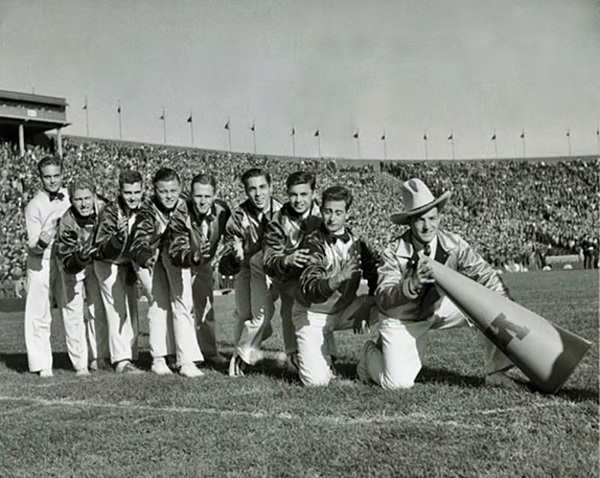
According to On This Day, on this date in 1898 “Cheerleading begins in the United States as Johnny Campbell leads the crowd cheering on the football team at the University of Minnesota” (https://www.onthisday.com/events/november/2).
“During the 1800’s crowds at sporting events began to cheer on their teams, increasingly in unison…. Minnesota saw this trend evolve with Thomas Peebles, an alumnus, organizing cheers by the fans. Students were invited to cheer on players at practice, and organized groups of student fans in the stands would cheer on the football team. Then Campbell took it to a new and familiar level by directing the cheers of the fans from outside the stands” (https://www.historyandheadlines.com/history-november-2-1898-first-official-cheerleaders-sports-become-interesting/).
“By 1903 the first cheerleading fraternity was established (Gamma Sigma), and of course the first cheerleader squad at Minnesota consisted of 6 male students. Obviously, that state of affairs had to change! Not until 1923 were females permitted to participate in cheerleading at UM, and other schools slowly caught on to this popular idea. World War II and the military draft greatly accelerated the number of female cheerleading units as college men were drafted for war. By 1975 it was estimated 95% of American school cheerleaders were female. As of 2005, the estimate in America is 97% female dominated cheerleading, although at the college level about half are still male” (ibid.).
In the 1950s, some professional teams began to employ cheerleaders, particularly the Dallas Cowboys, whose cheerleaders have become celebrities in their own right. Cheerleading also moved down to younger levels, including high schools, middle schools, and even peewee sports. “Organized competitions are common at many levels as well, and students can earn scholarships similar to other athletes. Various types of related activities such as dance groups and the like have evolved from cheerleading” (ibid.).
So I must confess that my senior year in high school I dated a cheerleader, and I had a number of good friends who were cheerleaders (all female). I was not, however, the captain of the football team; I was co-captain of the soccer team, but in the 1970s that didn’t carry a lot of prestige.
But I also have to say that I have never been a big fan of cheerleading. I never quite saw the point, and I still don’t see the point. Perhaps prior to Johnny Campbell felt that the cheering of the Minnesota crowds was inchoate and need to be organized.
Today’s image is of Johnny Campbell and his group of cheerleaders (https://www.onthisday.com/events/november/2).