Word of the Day: Nomothetic
Today’s word of the day, courtesy of the Words Coach (https://www.wordscoach.com/dictionary), is nomothetic. Pronounced / ˌnɒm əˈθɛt ɪk /, with the primary stress on the third syllable and a secondary stress on the first syllable, this adjective means “giving or establishing laws,” “founded upon or derived from law,” or, in psychology, “pertaining to or involving the study or formulation of general or universal laws (opposed to idiographic)” (https://www.dictionary.com/browse/nomothetic).
In its Did You Know section, Merriam-Webster says, “Nomothetic is often contrasted with idiographic, a word meaning ‘relating to or dealing with something concrete, individual, or unique.’ Where idiographic points to the specific and unique, nomothetic points to the general and consistent. The immediate Greek parent of nomothetic is a word meaning ‘of legislation’; the word has its roots in nomos, meaning ‘law,’ and –thetēs, meaning ‘one who establishes’” (https://www.merriam-webster.com/dictionary/nomothetic).
It appears in English in the “1650s, from Latinized form of Greek nomothetikos ‘relating to legislation, legislative,’ from nomothetes ‘lawgiving,’ from nomos ‘usage, custom, law’ (from PIE root *nem- ‘assign, allot; take’) + thetes ‘one who puts, places, or establishes’” (https://www.etymonline.com/search?q=nomothetic).
According to On This Day, on this date in 835 “Pope Gregory IV decrees All Saints Day a holy day of obligation for the Catholic religion” (https://www.onthisday.com/events/november/1).
The word saint appears in English in the “early 12c. as an adjective, seinte, ‘holy, divinely inspired, worthy of worship,’ used before proper names (Sainte Marian Magdalene, etc.), from Old French saint, seinte ‘holy, pious, devout,’ from Latin sanctus ‘holy, consecrated,’ past participle of sancire ‘consecrate’ (see sacred). It displaced or altered Old English sanct, which is directly from Latin sanctus” (https://www.etymonline.com/search?q=saint).
There are at least two different kinds of saints in the Christian tradition. The first can be anybody. A person who is baptized becomes a member of the body of Christ. Then, when a person dies and goes to heaven, one is considered a saint. Beyond these ideas, a person can be considered a saint if they are really good or do really benevolent things.
The second requires canonization by the Church.
“To become a canonized saint—someone whom the Church publicly declares ‘worthy of universal veneration’—there are three stages.
“The first stage involves an examination of the life of a candidate for sainthood. Phase one of the examination is at the diocesan or eparchial level. The bishop of the diocese or eparchy in which the person died begins the investigation into the life of the candidate five years after the person’s death (unless the pope gives a dispensation), gathering information from witnesses establishing the candidate’s martyrdom or attesting to the virtues the candidate bore witness to in his life.
“Phase two of the examination is carried out by the Vatican’s Congregation for the Causes of Saints, the beginning of which consists of a team of nine theologians examining the prepared Positio, which is a document the Congregation prepares summarizing the evidence gathered in phase one. If the majority of the assigned theologians agree that the evidence supports the martyrdom or the virtuous life of the candidate, then the Positio is handed over for examination to bishops and cardinals who are members of the Congregation. If they approve, then the entire cause is given to the pope for approval. If approved, the pope authorizes a decree declaring the candidate to be either a venerable (in the case that the person has lived a virtuous life) or a blessed (in the case that the person was martyred).
Stage two of the canonization process is what’s called beatification. A decree of beatification grants permission for limited public veneration, usually restricted to within the boundaries of “a diocese, eparchy, region, or religious community in which the blessed lived.”iii One miracle attributed to the candidate’s intercession is required for beatification unless the candidate is a martyr. When a candidate is beatified, he receives the title Blessed.
“Stage three is the actual canonization. The condition for this stage is an additional miracle attributable to the intercession of the blessed. But it must be attributed to the blessed’s intercession after his beatification. With canonization, the individual is able to be publicly venerated throughout the universal Church, and he receives the formal title Saint.
“This formal process wasn’t always the way things happened. For the first five centuries in the Church, instead of an official Vatican organ, it was the vox populi (voice of the people) that determined who was considered a saint” (https://shop.catholic.com/blog/how-does-someone-become-a-saint-/).
A person who achieves the first stage of the canonization process is called “Venerable,” as in the Venerable Bede. A person who achieves the second stage is called “Blessed,” such as Charles of Austria, the last Austro-Hungarian emperor, who was beatified by Pope John Paul in 2004. In order to be beatified by the Pope, a person must have performed one miracle or have been martyred. A person who achieves the final stage of the canonization process is canonized and declared a saint, such as Saint Francis of Assisi.
In the early church, the Church remembered martyrs by declaring their death date a day set aside. “The usual steps involved with formal canonization by the pope began in the tenth century, with Pope John XV’s canonization of St. Ulric on January 31, 993 being the first recorded canonization. The rules and regulations governing the canonization of saints would be adjusted over the centuries, including adjustments made in the 1917 and 1983 Codes of Canon Law” (ibid.).
“The earliest feast days of saints were those of martyrs, venerated as having shown for Christ the greatest form of love, in accordance with the teaching: ‘Greater love has no one than this, that someone lay down his life for his friends.’ Saint Martin of Tours is said to be the first or at least one of the first non-martyrs to be venerated as a saint. The title ‘confessor’ was used for such saints, who had confessed their faith in Christ by their lives rather than by their deaths. Martyrs are regarded as dying in the service of the Lord, and confessors are people who died natural deaths. A broader range of titles came into later use, such as Virgin, Pastor, Bishop, Monk, Priest, Founder, Abbot, Apostle, and Doctor of the Church.
“As the number of recognized saints increased during Late Antiquity and the first half of the Middle Ages, eventually every day of the year had at least one saint who was commemorated on that date. To deal with this increase, some saints were moved to alternate days in some traditions or completely removed, with the result that some saints have different feast days in different calendars” (https://en.wikipedia.org/wiki/Calendar_of_saints).
In addition to the Roman Catholic Church, November 1 is recognized as All Saints’ Day by the Lutheran Church, the Anglican Church, and some Methodist Churches. Eastern Orthodox Churches recognize an All Saints’ Day, but theirs take place on the first Sunday after Pentecost. Pentecost, also called Whitsunday or simply Whitsun occurs seven weeks after Easter and remembers an event in the Book of Acts when the Holy Spirit descended upon the disciples, giving them the ability to speak in tongues (https://en.wikipedia.org/wiki/Pentecost). The first Sunday after Pentecost in the Lutheran Church, the Roman Catholic Church, and the Anglican Church is called Holy Trinity Sunday.
So on this day, in certain Christian traditions, we remember those who have passed before us, and doing so is nomothetic, thanks to Pope Gregory. I would say those that have passed and gone on to heaven, but I’m not really the one to judge. There are some, like my dad, about whom I am quite confident, but there are others that I wouldn’t bet on. But as I told my students over the years, that decision is above my pay grade.
Oh, and in the English language, before the word saint was used, such people were referred to as hallowed (‘holy’), as in the King James version of the Lord’s Prayer: “Our father, which art in heaven, hallowed by thy name.” Thus today would be All Hallows Day. And, of course, last night would be All Hallows Eve, or Hallowe’en.
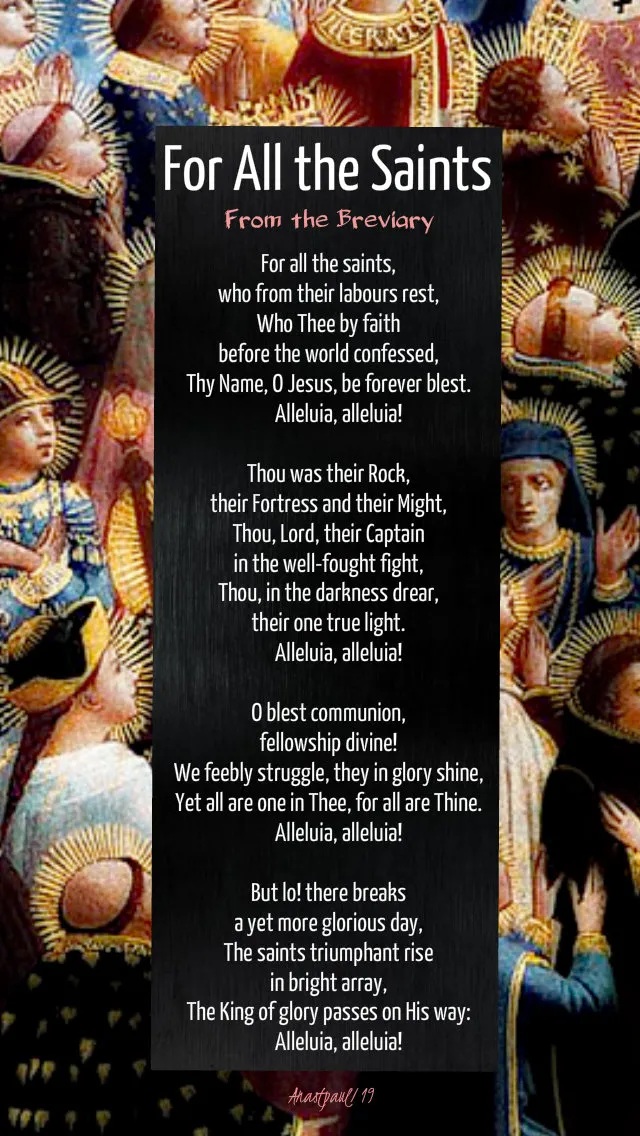
The image today comes from somebody else’s blog, and it’s listed as a breviary prayer (i.e., from a book of prayers), but I know it as a hymn that we usually sang on All Saints’ Day (https://anniesthoughs.wordpress.com/2026/11/01/all-saints-day-2/#jp-carousel-28408). I would sing it for you, but you wouldn’t hear it. But here’s a YouTube recorded version from the Worcester Cathedral Choir, from 1982: https://www.youtube.com/watch?v=ffM1jNA6BuU&list=RDffM1jNA6BuU&start_radio=1