Word of the Day: Jack-o’-lantern
Today’s word of the day, courtesy of the Words Coach (https://www.wordscoach.com/dictionary), is jack-o’-lantern. Pronounced / ˈdʒæk əˌlæn tərn /, this noun refers to “a hollowed pumpkin with openings cut to represent human eyes, nose, and mouth and in which a candle or other light may be placed, traditionally made for display at Halloween,” or “any phenomenon of light, as a corona discharge or an ignis fatuus,” or “a poisonous luminescent orange fungus, Omphalotus olearius, often found in clusters at the base of hardwood tree stumps” (https://www.dictionary.com/browse/jack-o-lantern?q=jack-o%27-lantern). A couple of side notes. First, ignis fatuus is Latin, and translated word by word it means “foolish fire.” But if you check Merriam-Webster, it says, “a light that sometimes appears in the night over marshy ground and is often attributable to the combustion of gas from decomposed organic matter” or “a deceptive goal or hope” (https://www.merriam-webster.com/dictionary/ignis%20fatuus). Second, the Dictionary.com entry does not italicize ignis fatuus, though it does italicize Omphalotus olearius. The rule is that you italicize foreign words, making one wonder what the state of ignis fatuus is.
It appears in English “As Jack with the lanthorn, 1650s, shortened jack-o-lantern, jack-a-lantern, jackolantern by 1750. A name for the ignis fatuus. See jack (n.1) + lantern. Earlier sometimes Will (1590s) or Meg (1650s) instead of Jack (see will-o’-the-wisp).
“The extension to lanterns of carved pumpkin is attested by 1828 in American English (as Jack-o-lanthorn)” (https://www.etymonline.com/search?q=jack-o-lantern).
As for the name Jack, it became “a generic name for a person or in personifications, by late 14c. based on similar use of French Jacques, which, being an extremely popular given name in France, became the generic name there for a common young man (compare Jacquerie). English jack in this sense is the masc. proper name Jack applied familiarly or contemptuously, often in reference to a young man of the lower classes. Later Jack was used especially of sailors (by 1650s); Jack-tar ‘common sailor’ is attested by 1781; Jack-ashore drinking and in high spirits and recklessly spending, is attested by 1840 as a book title” (https://www.etymonline.com/word/Jack#etymonline_v_1616). You find the name used, particularly of lower-characters, in folk tales such as “Jack and the Beanstalk” and in nursery rhymes, like “Jack Sprat” and “Jack and Jill.” In Deutsch folk tales, the name is Hans, which is a diminutive of Johannes, which is the Latin form of John, of which Jack is a diminutive.
As to lanthorn, it goes back as far as the 16th century, and it “was folk etymology based on the common use of horn as a translucent cover” (https://www.etymonline.com/word/lantern).
Today is my dad’s birthday. He was born on this date in 1923 in Philadelphia, and grew up in a part of Philly called Olney. My grandfather was a policeman before marrying my grandmother, and after the marriage, he became the owner of a hardware store because his wife feared for his life. So my dad grew up in the Great Depression the son of a hardware store owner.
He told me that when he was in high school he would usher at the Philadelphia Academy of Music. He was a lifelong lover of classical music. He also told me, several times, how, whenever Italian operas were performed at the Academy of Music, Italian-Americans would come from South Philly and fill the balcony, where he generally ushered, and they would sing along with the arias.
He also told me, several times, a story o=of the time when Eugene Ormandy (I think, though it might have been Toscanini or Stokowski) scheduled a performance of Haydn’s Symphony No. 94 in G Major, also known as the Surprise Symphony. But when he began the performance, not all members of the orchestra were in place. Some filtered in as the performance went along, tuned up their instruments, and then joined in. At the end of the symphony, or maybe it was at the end of the first movement, Ormandy turned, looked at the audience, and said, “That is what you look like to us.” I suppose there was a problem with late arrivers.
My grandparents didn’t have a lot of money, so my dad had to earn a scholarship to go to Muhlenberg, which is in Allentown, PA. The school offered scholarships to students based upon taking a test. My dad told me that he was not an outstanding student in high school, but he prayed before taking the test, and told God that, were he to earn that scholarship, he would go into the ministry. He did, and he did.
He served as pastor of several Lutheran congregations during his career. He was at Salem Lutheran in Bethlehem, PA, for 29 years. That’s where I grew up. The church was sold some years ago and turned into apartments or condos or some such thing, but at least they didn’t tear the building down. His last parish was in Wilkes-Barre, PA, and that is where he died in 1987, at just 63 years old. The official date of his death is August 18, but he really died on August 16; he just wasn’t found until the 18th. The way I see it, he finished celebrating communion at the 11 service at Messiah Lutheran, walked the few steps to the parsonage where he was living, went upstairs to take a nap, had a massive stroke, and died. He died, as it were, with his boots on.
I talked to my dad long-distance several times a week, and it was the not hearing from him that made me think something was wrong. I called a couple of his pastor friends, and on that Tuesday, they broke into the parsonage to find him. I flew up to PA that same day, got a ride from the airport, and began to take care of things. I met a lot of people whom I’ve never seen again. They were nice, but it didn’t help.
That first night, after everyone had left, I was alone in the parsonage, I thought. I was in an upstairs bedroom where my dad had his Kaypro II computer, going through his files looking for anything that might be of help. While I was sitting there, a shadow passed by the door. I was aware of it out of the corner of my eye, so I’m not really sure what it was. Just a sense. An impression. I got up from my seat, called out, “Anybody there?” I went looking. I was sure that there was a shadow.
I don’t believe in ghosts or the supernatural. I don’t believe in witchcraft or demons or anything magical. And yet…. I can explain almost anything to people, at least anything that doesn’t require an advanced degree in some scientific field. I firmly believe that unexplained phenomena, like the ignis fatuus, are ultimately explainable in scientific or naturalistic terms, given time and leisure to explore. And yet….
My rational mind has no more fear of ghosts than of a jack-o’-lantern. And yet….
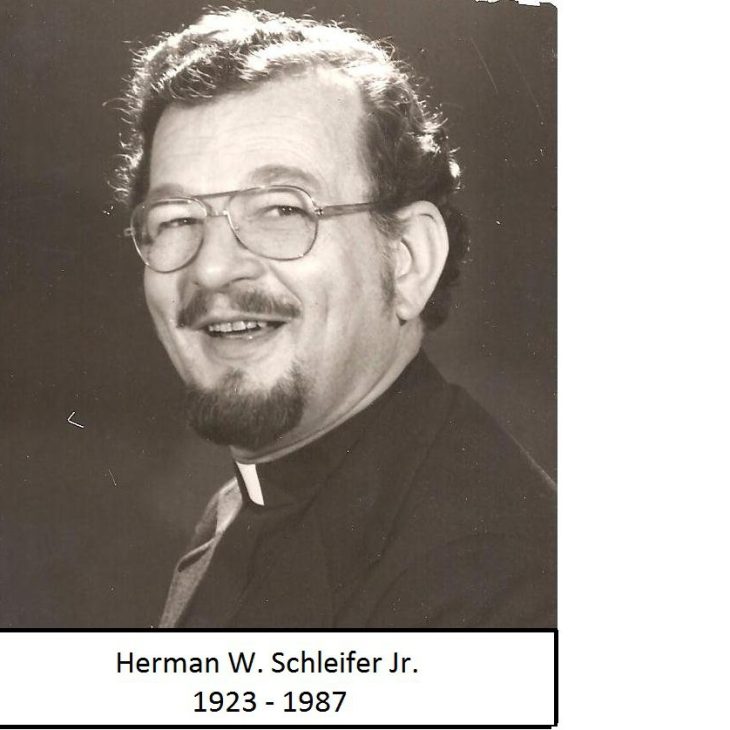
Today’s image is of my dad, a photo from my personal files. Happy birthday, Dad. I miss you.