Word of the Day: Wizened
Today’s word of the day, courtesy of the Words Coach (https://www.wordscoach.com/dictionary) is wizened. Pronounced / ˈwɪz ənd / (notice that the vowel in the first syllable is what we used to call a short i), this adjective means “withered; shriveled” (https://www.dictionary.com/browse/wizened).
According to Merriam-Webster, wizened is the past participle of the verb wizen, which means “to become dry, shrunken, and wrinkled often as a result of aging or of failing vitality” (https://www.merriam-webster.com/dictionary/wizened), but I have to say that I have never heard or seen the word used except in the adjective form, and almost exclusively in relation to people, and almost always old people.
Nevertheless, Etymonline.com also has its entry as wizen, a verb: “’become dry or shriveled,’ Middle English wisenen, from Old English wisnian, weosnian ‘to wither, dry up, waste away,’ from Proto-Germanic *wisnon (source also of Old Norse visna ‘to wither,’ Old High German wesanen ‘to dry up, shrivel, wither;’ German verwesen ‘to decay, rot’)” (https://www.etymonline.com/search?q=wizened).
According to On This Day, on this date in 1555 “Freedom of religion in Augsburg” (https://www.onthisday.com/events/september/25). I can see why it says that, but it is actually quite misleading.
What actually happened in Augsburg on the 25th of September of 1555 was the signing of the Peace of Augsburg or the Augsburg Settlement. Prior to 1517, the Roman Catholic Church was the only legal church in Western Europe. There had been reform efforts, and there were groups that split off from the Church, but those groups were subject to punishment by clerical and secular authorities. Then Martin Luther nailed the 95 Theses to the church door in Wittenburg, disputing the efficacy of indulgences. This act is considered the beginning of the Protestant Reformation, although Luther himself would have objected to calling his efforts Protestant. The Pope excommunicated Luther along with his many followers, most of whom were in what we today call Deutschland.
As seems quite usual for the Middle Ages in Europe, fighting ensued. The Deutsch areas of Europe were part of the Holy Roman Empire, which was, of course, ruled by a Roman Catholic. The emperor, Charles V, was challenged by a group of Deutsch principalities and cities that in 1531 had united to form what we call the Schmalkaldic League. This League did not really openly challenge the Empire, but they did spread the idea of Lutheranism, and the Augsburg Confession, through Deutsch areas.
What followed were two Schmalkaldic Wars, one from 1546-1547, which was won by Charles V’s forces because of the incompetence and lack of unity among the leaders of the League, and another in 1552, which was won by the League. In fact, the League “forced Charles to flee across the Alps to avoid capture; the heir Ferdinand (King of the Romans) signed the Peace of Passau, which granted some freedoms to Protestants and ended all of Charles’ hopes of religious unity within his empire. Three years later, the Peace of Augsburg granted Lutheranism official status within the Holy Roman Empire and let princes choose the official religion within the domains that they controlled, according to the principle of Cuius regio, eius religio” (https://en.wikipedia.org/wiki/Schmalkaldic_League). The Latin means, “whose region, his religion,” or a region of the Holy Roman Empire that is ruled by a Lutheran can follow the Augsburg Confession, or be Lutheran in its religious practices, whereas a region that is ruled by a Roman Catholic can follow Roman Catholic practices.
That may sound a lot like “religious freedom,” but it excluded other Christian movements that were taking shape during that century, such as Calvinism, Zwingliism, and Anabaptism. Those groups were still subject to punishment by the civil or religious authorities. But I suppose it was a start. Perhaps the negotiators were wise, if not wizened.
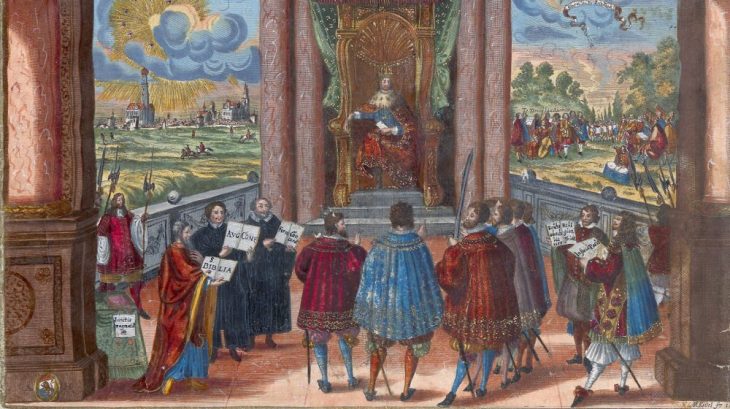
Today’s illustration is of the Augsburg Assembly that led to the Peace of Augsburg: “Augsburg Peace Painting, illustrator: Melchior Küssel (Source: Staats- und Stadtbibliothek Augsburg).” I found it at https://www.deutschlandmuseum.de/en/history/calendar/1555-09-25-the-peace-of-augsburg/).