Word of the Day: Desideratum
Today’s word of the day, courtesy of the Words Coach (https://www.wordscoach.com/dictionary) is desideratum. Pronounced / dɪˌsɪd əˈreɪ təm, -ˈrɑ-, -ˌzɪd- / (the ˈrɑ- would be an alternative to the ˈreɪ, and the -ˌzɪd would be an alternative to the ˌsɪd, and I have only heard it pronounced with both of those alternatives: / dɪ ˌzɪd ə ˈrɑ təm /), it means “something wanted or needed” (https://www.dictionary.com/browse/desideratum). Merriam-Webster defines it as “something desired as essential” (https://www.merriam-webster.com/dictionary/desideratum).
In its “Did You Know” section about this word, M-W says, “We’d like to introduce you to some close cousins of the common word desire. All trace their roots to the Latin sīder-, or sīdus, which has historically been understood to mean ‘heavenly body,’ but which may also have an older, non-celestial meaning of ‘mark, target, goal.’ Whether etymologically starry or grounded, dēsīderāre, meaning ‘to long for,’ was born when Latin de- was prefixed to sīder-. Dēsīderāre begat Anglo-French desirer, which in turn brought forth English desire, desirous, and desirable in the 13th and 14th centuries, with desideration following in the 15th. Then, in the 17th century, English acquired desiderate (‘to wish for’) and desideratum (desiderata in the plural), all of which can lay claim to direct ancestry from desiderare” (ibid.).
Etymonline.com has a full entry for desiderata. The word appears in English in the “1650s, plural of desideratum, Latin, literally ‘something for which desire is felt,’ noun use of neuter past participle of desiderare ‘to long for’ (see desire (v.)).
“A Latin word in English; other offshoots of the Latin verb were nativized in Middle English: desiderable ‘wished for, desired’ (mid-14c.), also ‘worthy of being admired;’ desideracioun ‘longing, yearning’ (late 15c.); desiderantly ‘with ardent desire’ (c. 1500). Also compare obsolete desiderate ‘feel a desire or longing for’ (1640s)” (https://www.etymonline.com/word/desideratum). The change of the form of the Latin derivative is, to me, quite interesting.
Max Ehrmann was an American lawyer, writer, and poet who lived 1872-1945. You may have never heard of him, and that kind of makes sense. Although his bibliography is kind of extensive, almost nobody reads what Ehrmann wrote. Except for one thing.
In 1927 he got a copyright to a poem that he had been working on for the previous six years. In the copyright application, he didn’t even have a title for it; he used the opening line of the poem as a title (https://en.wikipedia.org/wiki/Desiderata). He finally published the poem; the “April 5, 1933, issue of Michigan Tradesman magazine published the full, original text on its cover, crediting Ehrmann as its author. In 1933, he distributed the poem in the form of a Christmas card, now officially titled ‘Desiderata’” (ibid.).
It’s also a prose poem: “poetry written in prose form instead of verse form while otherwise deferring to poetic devices to make meaning” (https://en.wikipedia.org/wiki/Prose_poetry).
According to the poem’s wiki, a psychiatrist passed out over 1000 copies of the poem to his patients, unattributed. Later, a minister distributed over 200 copies to his parishioners, again unattributed. In 1948, Ehrmann’s wife published the poem in The Poems of Max Ehrmann, properly attributed, obviously. But where I and many in my generation became familiar with the poem was on posters on our dorm room walls. In the later 60s and 70s, it was a popular piece of pop philosophy. In 1971, an actor and announced named Les Crane won a Grammy for a recording (https://en.wikipedia.org/wiki/Desiderata).
The poem was popular enough to even generate a satire called Deteriorata, “written by Tony Hendra for National Lampoon magazine, and was recorded for the album Radio Dinner. Narrator Norman Rose read the parody poem and Melissa Manchester was the background vocalist, both closely tracking the format of Crane’s original” (https://en.wikipedia.org/wiki/Deteriorata).
I have to admit that reading again 50 years later it seems a little kitschy, but I’m going to share it anyway since it is in the public domain.
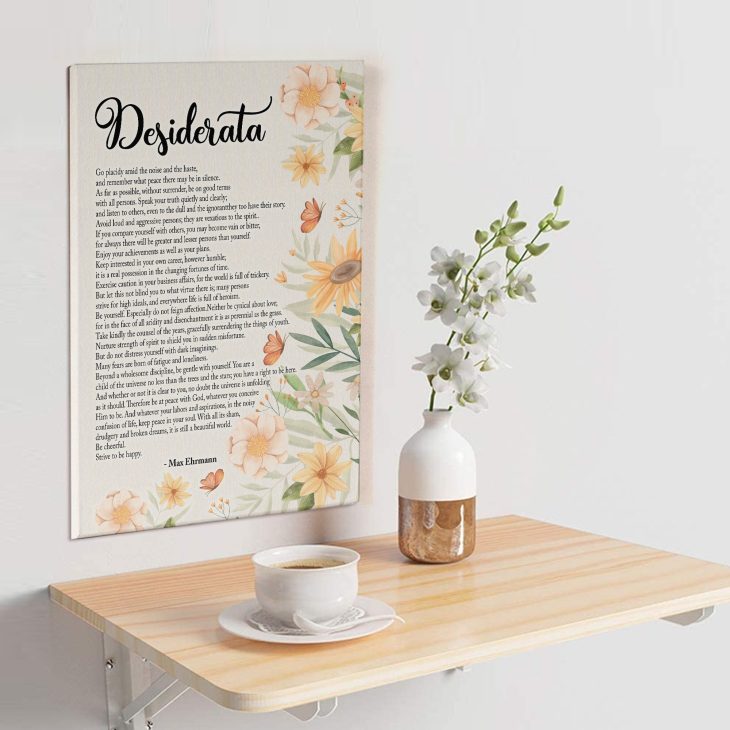
Go placidly amid the noise and the haste, and remember what peace there may be in silence. As far as possible, without surrender, be on good terms with all persons.
Speak your truth quietly and clearly; and listen to others, even to the dull and the ignorant; they too have their story.
Avoid loud and aggressive persons; they are vexatious to the spirit. If you compare yourself with others, you may become vain or bitter, for always there will be greater and lesser persons than yourself.
Enjoy your achievements as well as your plans. Keep interested in your own career, however humble; it is a real possession in the changing fortunes of time.
Exercise caution in your business affairs, for the world is full of trickery. But let this not blind you to what virtue there is; many persons strive for high ideals, and everywhere life is full of heroism.
Be yourself. Especially do not feign affection. Neither be cynical about love; for in the face of all aridity and disenchantment, it is as perennial as the grass.
Take kindly the counsel of the years, gracefully surrendering the things of youth.
Nurture strength of spirit to shield you in sudden misfortune. But do not distress yourself with dark imaginings. Many fears are born of fatigue and loneliness.
Beyond a wholesome discipline, be gentle with yourself. You are a child of the universe no less than the trees and the stars; you have a right to be here.
And whether or not it is clear to you, no doubt the universe is unfolding as it should. Therefore be at peace with God, whatever you conceive Him to be. And whatever your labors and aspirations, in the noisy confusion of life, keep peace in your soul. With all its sham, drudgery and broken dreams, it is still a beautiful world. Be cheerful. Strive to be happy.
And a little research tells me that you can buy your own poster of Ehrmann’s poem from Walmart, Amazon, Etsy, and probably other sources. Today’s image is one you can buy from Etsy (https://www.etsy.com/au/listing/1267467035/desiderata-poem-canvas-floral-poster).