Word of the Day: Vitreous
Today’s word of the day, courtesy of the Words Coach (https://www.wordscoach.com/dictionary) is vitreous. Pronounced / ˈvɪ tri əs / (the s is the voiceless /s/, not the voiced /z/), the adjective means “of the nature of or resembling glass, as in transparency, brittleness, hardness, glossiness, etc.,” “of or relating to glass,” or “obtained from or containing glass” (https://www.dictionary.com/browse/vitreous?priorityFeature=culture-article).
Merriam-Webster adds two other definitions: “characterized by low porosity and usually translucence due to the presence of a glassy phase” and “of, relating to, or constituting the vitreous humor” (https://www.merriam-webster.com/dictionary/vitreous). The latter has nothing to do with comedy: “the clear colorless transparent jelly that fills the eyeball posterior to the lens” (https://www.merriam-webster.com/dictionary/vitreous%20humor).
The word appears in English in the “late 14c., ‘glass-like, translucent,’ with substitution of -ous, from Latin vitreus, vitrius ‘of glass, glassy,’ from vitrum ‘glass,’ which perhaps was so called for its bluish color: Latin vitrium also meant ‘woad,’ a plant used in dyeing blue.
“De Vaan supports instead the derivation from PIE *ued-ro- ‘water-like’ from PIE *unda-, from *wed-, the root for ‘water; wet.’ He writes, ‘The plant and its dye will have been denominated after the colour of glass (in antiquity, a transparent green with a yellowish to blueish paleness).’
“By 1640s as ‘of, pertaining to, or obtained from glass; consisting of glass.’ In figurative use also in reference to heaviness or brittleness but also sometimes to viscosity, as of molten glass. Vitric ‘of the nature of or pertaining to glass’ is by 1915. Vitreous humor for the transparent substance in the eyeball is attested from 1660s” (https://www.etymonline.com/search?q=vitreous).
On this date in 1902, “Italian tenor Enrico Caruso makes his Covent Garden debut opposite Nellie Melba in Giuseppe Verdi’s opera ‘Rigoletto’ in London” (https://www.onthisday.com/events/may/14).
Enrico Caruso was a name when I was growing up. What I mean is that he was famous even among people, like me, who never heard him sing (I was born in 1956, and Caruso died in 1921, so yeah). But had you asked the young me who the greatest opera singer of all time was, I would have said Caruso because that was the name. If you look up the greatest tenors of all time, Caruso’s name will be on the list. In this case, (https://www.classical-music.com/features/artists/20-greatest-tenors-all-time), he’s number 2, just after Placido Domingo and ahead of Luciano Pavarotti, both of whom I have heard on television. Even now, while I enjoy opera, I am not steeped in the history of opera, and I don’t know any of the 17 names that follow, though #19 is Wolfgang Windgassen, a German tenor who once left a performance of Beethoven’s Fidelio with an upset stomach (ibid.).
Here’s an aside: my family has been caught up recently in watching episodes of The Charismatic Voice on YouTube, where Elizabeth Zharoff discusses the voices of singers, mostly popular singers although she did do a piece on Pavarotti. She sometimes talks about vocal production, which is interesting from a linguistic perspective. If you like singing, you might find her YouTube channel interesting.
Caruso performed all over the world, particularly in Europe, South America, and North America. He also recorded numerous records. In April of 1902, a month before his debut at Covent Garden, he signed a contract with the “British Gramophone Company to make his first series of recordings in Milan, for a fee of 100 pounds sterling. These ten records swiftly became best-sellers. Among other things, they helped spread 29-year-old Caruso’s fame throughout the English-speaking world” (https://en.wikipedia.org/wiki/Enrico_Caruso).
The wiki has a whole section on Caruso’s recording career. “Enrico Caruso died in 1921, before the advent of electrical recording technology in 1925. His entire recorded output was made using the acoustic process, which required the performer to sing into a metal horn or funnel; the sound was relayed directly onto a wax master disc, using a stylus. This antiquated process captured a limited range of the overtones and nuances present in a singing voice. Caruso’s 12-inch disc records were limited to a maximum playing time of approximately four and one-half minutes; consequently, most of the operatic selections that he recorded were limited to that duration or those which could be edited to fit this time constraint. Occasionally, longer excerpts were issued on two or more record sides” (ibid.).
“Caruso is generally acknowledged as the record industry’s first major recording star. He possessed a phonogenic voice which was “manly and powerful, yet sweet and lyrical”, to quote the singer/author John Potter (see bibliography below). Caruso and the disc phonograph (known in the United Kingdom as the gramophone) did much to promote each other during the first two decades of the 20th century. During his lifetime, Caruso earned more in royalties from the sales of his recordings than he did from his operatic appearances. From 1902 to 1921, Caruso’s record royalties amounted to more than two million dollars (nearly $36 million in 2025)” (ibid.). Now, that’s a lot of money, at least for most of us.
So here is the part of the story that is most intriguing to me. Caruso did not grow up in a wealthy family studying music from the best teachers and attending a conservatory. “Marcellino Caruso, the tenor’s father, was a mechanic and foundry worker. Initially, Marcellino thought his son should adopt the same trade, and at the age of 11, the boy was apprenticed to a mechanical engineer who constructed and maintained public water fountains. Whenever visiting Naples in future years, Caruso liked to point out a certain fountain that he had helped to install. Caruso later worked alongside his father at the Meuricoffre factory in Naples. At his mother’s insistence, he also attended school for a time, receiving a basic education under the tutelage of a local priest. He learned to write in a strikingly handsome script and studied technical draftsmanship. At this time, he sang in a church choir, and his voice showed enough promise for him to contemplate a possible career in music” (ibid.).
Life was probably not easy for the Caruso family. Marcellino and Anna, Caruso’s mother, had seven children, but only three survived infancy. “Caruso was encouraged in his early musical ambitions by his mother, who died in 1888. To help support his family, he worked as a street singer in Naples and performed at cafes and soirées. In 1894, his progress as a paid entertainer was interrupted, however, by 45 days of compulsory military service, which was completed for him by his brother, Giovanni. Caruso resumed his vocal studies upon being discharged from the army” (ibid.). But he did make it to the stage, and he did become an international star.
If you’re surprised that a working-class kid in Naples would become an opera star, here’s one more little story. My father, the Rev. Dr. Herman W. Schleifer, Jr., grew up in Philadelphia, the son of working-class parents. But he loved classical music. When he was in high school, he ushered for performances at the Academy of Music, usually in the third balcony. The Academy of Music is an opera house as well as a concert hall (the oldest opera house in the USA still used for its original purpose), and occasionally operas would be performed there. When the performance was of an Italian opera (Verdi, Puccini, etc.), the third balcony would fill up with working-class Italians from South Philly. My father, who loved opera, said that the only problem was that the men would sing along with the arias. Opera as sing along. I’m not sure how I would have handled such a thing, but I love the concept.
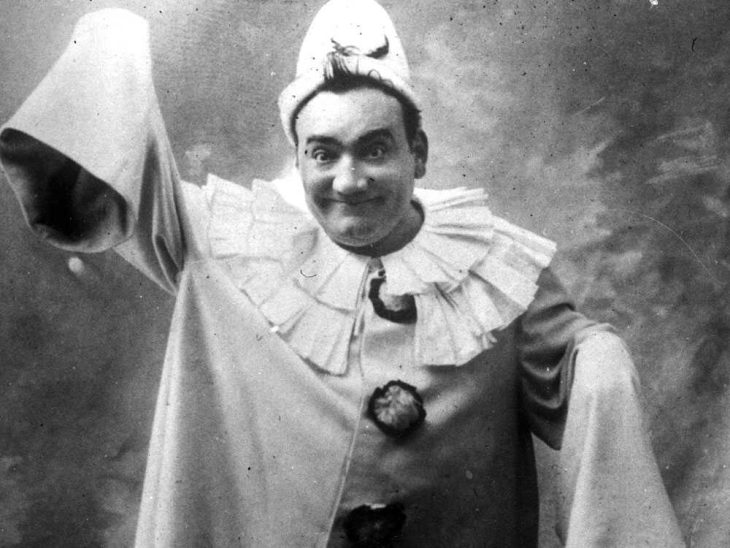
Today’s image is of Enrico Caruso in costume for the role of Canio in Pagliacci by Ruggero Leoncavallo (https://www.npr.org/2010/05/17/126833090/enrico-caruso-and-confessions-of-an-operaholic).