Word of the Day: Rubicund
Today’s word of the day, courtesy of the Words Coach (https://www.wordscoach.com/dictionary) is rubicund. It’s pronounced / ˈru bɪˌkʌnd /, with a secondary stress on the third syllable, which is why the vowel is /ʌ/ (“commonly referred to as a ‘wedge’, ‘caret’ or ‘hat’” [https://en.wikipedia.org/wiki/Open-mid_back_unrounded_vowel]) instead of a schwa (/ə/), which is used only in unstressed syllables. It means “red or reddish; ruddy” (https://www.dictionary.com/browse/rubicund).
It appears in English in the “early 15c. (Chauliac), ‘reddish, flushed,’ especially of the face, especially as a result of indulgence in appetites, from Old French rubicund (14c.) and directly from Latin rubicundus, from rubere ‘to be red,’ from ruber ‘red’ (from PIE root *reudh- ‘red, ruddy’) (https://www.etymonline.com/search?q=rubicund).
Etymonline.com goes on to give the etymology of *reudh-: “Proto-Indo-European root meaning ‘red, ruddy.’ The only color for which a definite common PIE root word has been found. The initial -e- in the Greek word is because Greek tends to avoid beginning words with -r-.
“It might form all or part of: bilirubin; corroborate; Eritrea; erysipelas; erythema; erythro-; Radnor; red; redskin; roan; robust; rooibos; Rotwelsch; rouge; roux; rowan; rubella; rubicund; rubric; ruby; ruddock; ruddy; rufous; Rufus; russet; rust.
“It might also be the source of: Latin ruber, also dialectal rufus ‘light red,’ mostly of hair; Greek erythros; Sanskrit rudhira-; Avestan raoidita-; Old Church Slavonic rudru, Polish rumiany, Russian rumjanyj ‘flushed, red,’ of complexions, etc.; Lithuanian raudas; Old Irish ruad, Welsh rhudd, Breton ruz ‘red’” (ibid.).
As an aside, I taught English composition and literature for four years as a graduate student TA, a couple of years as an instructor at an R1, and twenty-eight years as a professor at a small private college. I saw quite a few changes over those years. One change involved a sensitivity to the feelings of students that resulted in criticism of using the infamous red pen. Red, we were told, was aggressive and unforgiving, and it made the students feel bad. We were encouraged to use a friendlier color, like green or a light blue.
Another change is that we were encouraged to use a more seemingly objective form of grading, one that involved stated objectives with an indication of how many points each one of those objectives was worth. The form of this objective measure was a kind of graph, with statements about expectations and goals. This graphic form is referred to as a rubric. As you may have noted above, rubric comes from that Proto-Indo-European root mean red. So we were told not to use the red pen, but instead substitute something else that was red.
William the Conqueror, famous for the conquest of England in 1066, had four sons: Robert Curthose, Richard, William (c. 1057-1100), and Henry. Richard died relatively young. When William died, he left Normandy to Robert and England to William. William reigned from 1087, upon the death of his father, until 1100, when he died in a hunting accident. At that point, Henry became Henry I and reigned from 1100 until 1135. William II died without ever having married or even taking a mistress, and with no offspring.
But he is not usually referred to in histories of England as William II. He is called William Rufus, “Rufus being Latin for ‘the Red’), perhaps because of his ruddy appearance or, more likely, because he had red hair” (https://en.wikipedia.org/wiki/William_II_of_England).
Erik Thorvaldsson (950-1003) “was a Norse explorer, described in medieval and Icelandic saga sources as having founded the first European settlement in Greenland” (https://en.wikipedia.org/wiki/Erik_the_Red). “According to Icelandic sagas, Erik was born in the Jæren district of Rogaland, Norway, the son of Thorvald Asvaldsson. When Thorvald was banished from Norway, the family sailed west to Iceland. During Erik’s life in Iceland, he married Þjódhild Jorundsdottir and had four children, including Icelandic explorer Leif Erikson. Around the year of 982, Erik was exiled from Iceland for three years, during which time he explored Greenland, eventually culminating in his founding of the first successful European settlement on the island. Erik died there around 1003 CE during a winter epidemic” (ibid.).
“Erik’s son Leif Erikson became the first Norseman to explore the land of Vinland—part of North America, presumably near modern-day Newfoundland—and invited his father on the voyage. However, according to the sagas, Erik fell off his horse on the way to the ship and took this as a bad sign, leaving his son to continue without him. Erik later died in an epidemic that killed many of the colonists in the winter after his son’s departure” (ibid.). He may have lived longer than 53 years had he only sailed with his son. And, of course, perhaps due to the color of his hair and beard, he is known today as Eric the Red.
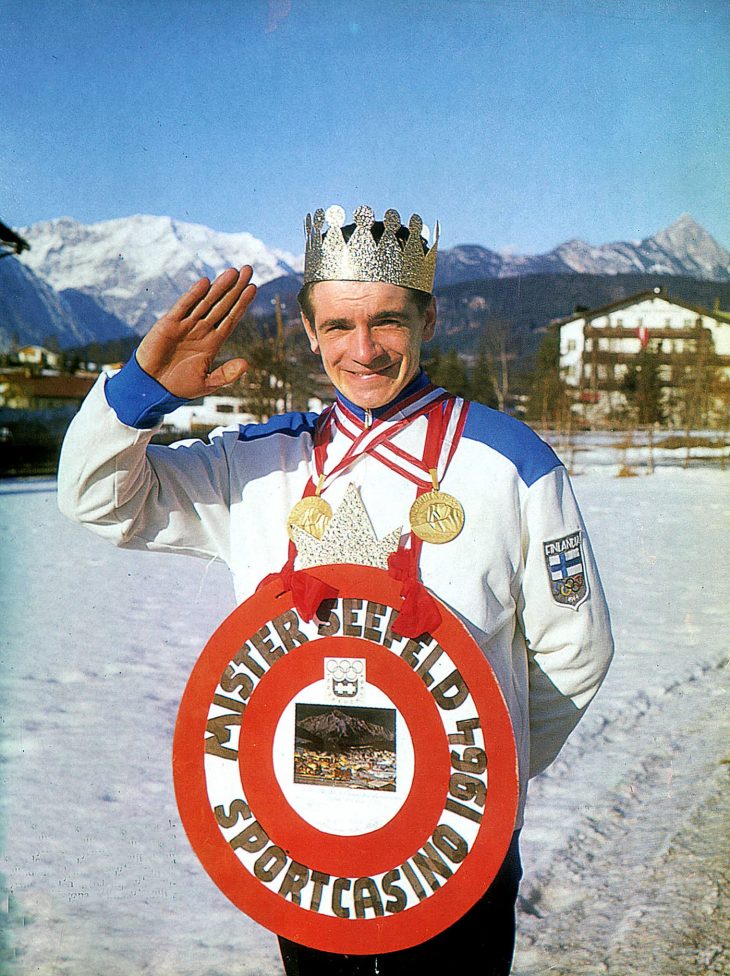
Then again, perhaps Erik actually did have a ruddy complexion rather than, or perhaps in addition to, red hair. Scandinavian people are generally thought to be fair skinned, but I can think of at least one example of a man from Finland who was famous for his ruddy complexion.
Eero Mäntyranta grew up in Finland and, like many people from that part of the world, took to skiing early on. He won his first race when he was just seven years old. “As a twenty-year old, he made the Olympic squad that traveled to Squaw Valley, California for the 1960 Winter Games, snagging a gold medal in the 4x10km cross-country ski event.
“Four years later at Innsbruck, Austria, Mantyranta was one of the Games’ stars, taking two more golds in the 15 and 30-km races, as well as a silver medal in the 4x10km relay. And in his third Olympics, Mantyranta tool home a silver and two bronze medals” (https://theolympians.co/2018/01/22/eero-mantyranta-the-ruddy-cheeks-and-the-genetic-advantange-of-a-cross-country-skiing-legend-from-finland/).
“Mäntyranta had primary familial and congenital polycythemia (PFCP) causing an increase in red blood cell mass and hemoglobin due to a mutation in the erythropoietin receptor (EPOR) gene, which was identified following a DNA study that found the mutation in a high proportion of members of his extended family, as reported in 1993. The elevated hematocrit caused by the condition increases the ability of the blood to transport oxygen; the EPOR mutation is speculated to have contributed to Mäntyranta’s remarkable endurance” (https://en.wikipedia.org/wiki/Eero_M%C3%A4ntyranta). But the condition gave him not only “remarkable endurance” but also a complexion that might best be described as rubicund.
Today’s image is of Eero Mäntyranta from Lapin Kansa “a news outlet operating across Lapland that publishes a daily stream of news via its app and website” (https://www.lapinkansa.fi/eero-mantyranta-aloitti-lappilaisen-palkitsemisper/6180931).