Word of the Day: Poignant
Today’s word of the day, thanks to the Words Coach (https://www.wordscoach.com/dictionary), is poignant. Pronounced / ˈpɔɪn jənt /, this adjective means “keenly distressing to the feelings,” “keen or strong in mental appeal,” “affecting or moving the emotions,” or “pungent to the smell” (https://www.dictionary.com/browse/poignant).
Merriam-Webster, in its Did You Know section, says, “Poignant comes to English from French, and before that from Latin—specifically, the Latin verb pungere, meaning ‘to prick or sting.’ Several other common English words derive from pungere, including pungent, which can refer to, among other things, a sharp odor. The influence of pungere can also be seen in puncture, as well as punctual, which originally meant simply ‘of or relating to a point.’ Even compunction and expunge come from this pointedly relevant Latin word” (https://www.merriam-webster.com/dictionary/poignant).
It appears in English in the “late 14c., poinaunt, ‘painful to physical or mental feeling’ (of sauce, spice, wine as well as things that affect the feelings), from Old French poignant ‘sharp, pointed’ (13c.), present participle of poindre ‘to prick, sting,’ from Latin pungere ‘to prick, pierce, sting,’ figuratively, ‘to vex, grieve, trouble, afflict’ (from suffixed form of PIE root *peuk- “to prick”) (https://www.etymonline.com/word/poignant). In addition, “The sense of ‘sharp to the taste’ is now obsolete. The word contains an etymological double-reverse. Latin pungere is from the same root as Latin pugnus ‘fist,’ and represents a Latin metathesis of -n- and -g- that was reversed in French” (ibid.). Metathesis is the “the transposition of letters, syllables, or sounds in a word, as in the pronunciation for comfortable or for ask” (https://www.dictionary.com/browse/metathesis).
The etymology website also explains in detail about that Proto-IndoEuropean root: “It might form all or part of: appoint; appointment; bung; compunction; contrapuntal; expugn; expunge; impugn; interpunction; oppugn; pink; poignant; point; pointe; pointillism; poniard; pounce; pugilism; pugilist; pugnacious; pugnacity; punch (n.1) ‘pointed tool for making holes or embossing;’ punch ‘a quick blow with the fist;’ punch (v.) ‘to hit with the fist;’ puncheon (n.2) ‘pointed tool for punching or piercing; punctilio; punctilious; punctual; punctuate; punctuation; puncture; pungent; punty; pygmy; repugn; repugnance; repugnant.
“It might also be the source of: Greek pyx ‘with clenched fist,’ pygme ‘fist, boxing,’ pyktes ‘boxer;’ Latin pugnare ‘to fight,’ especially with the fists, pungere ‘to pierce, prick’” (https://www.etymonline.com/word/poignant).
On this date in 1526, Jews were expelled from Pressburg (Bratislava), Hungary (https://www.onthisday.com/events/november/9 ). “Jews were expelled and accepted back several times in history of Bratislava, but after the Battle of Mohács in 1526 they were expelled permanently as part of the general expulsion from the Kingdom of Hungary. The synagogue was torn down and a monastery was built in its place. Many Bratislava Jews fled into neighboring Austria but a few remained in an area called Schlossgrund, outside of the walled city. Most of them left in 1572 on the orders of Maximilian II, Holy Roman Emperor” (https://en.wikipedia.org/wiki/History_of_the_Jews_in_Bratislava).
Actually, on this date in 1526 the Jews were expelled from all of Hungary “after being falsely accused of aiding the Turks in the war against Hungary. This is an example of the Jews being caught up in the cross currents of European Religious Wars. Most of Hungary had come under the control of the Turks…. The Hungarians were all that stood between the Turks and the Germanic Holy Roman Empire. But Charles V, the Emperor was not supplying aide for reasons of his own, so the Jews ended up being scapegoats for the newly enthroned Hungarian King’s inability to dislodge the Turks” (https://ourcog.org/this-day-november-9-in-jewish-history-by-mitchell-a-and-kathryn-levin/).
Also on this date, in 1720, the “Rabbi Yehuda Hasid synagogue [was] set afire” (https://www.onthisday.com/events/november/9). “Rabbi Yehuda Hasid and a small group of a few hundred followers arrived in Eretz Israel. The rabbi purchased the courtyard in the Old City for the synagogue, and construction of the facility was started after his death but was never completed. Due to the non-payment of a loan taken by Jews from Arabs for the construction of the synagogue, Arabs burned down the site, desecrating its 40 Torah scrolls. The destruction wrought at the time became the root of the name of the “Hurva” (ruin) synagogue, and building recommenced in the late 1830s, by Perushim followers of the Vilna Gaon. After its completion in 1864, the Hurva loomed as a cultural and religious symbol in Eretz Israel and Jerusalem. The Hurva retained its status as Jerusalem’s leading synagogue, and public gatherings and celebrations were held in it. Among other events, a prayer gathering to mark the coronation of King George V was held at the Hurva. Two days after the Jewish Quarter fell to Jordanian legionnaires during the 1948 war; the Jordanians blew up the Hurva. The Jordanian commander on the scene reported to his superiors: “For the first time in 1,000 years, there’s not a single Jew left in the Jewish Quarter, and not a single building that hasn’t been damaged. This will make the return of Jews here impossible.” After the 1967 Six-Day War, the Hurva became a memorial to the fall of the Jewish Quarter in 1948” (https://ourcog.org/this-day-november-9-in-jewish-history-by-mitchell-a-and-kathryn-levin/).
Also on this day, “US General Ulysses S. Grant issues orders to bar Jews from serving under him” (https://www.onthisday.com/events/november/9). And actually, it was bigger than that. “Major Gen. Ulysses S. Grant, then in command of a military district made up areas of Tennessee, Kentucky and Mississippi, told a subordinate to ‘refuse all [travel] permits to come south of Jackson, Mississippi, for the present. The Israelites,’ he added, ‘especially should be kept out.’
“On the following day, Grant instructed his chief of staff, Gen. Joseph Webster, to order ‘all the conductors on the [railroad] that no Jews are to be permitted to travel on the railroad southward from any point. They may go north and be encouraged in it, but they are such an intolerable nuisance that the [district] must be purged of them.’ In a letter to Gen. William Tecumseh Sherman, Grant wrote that his policy was occasioned ‘in consequence of the total disregard and evasion of orders by Jews’” (https://www.politico.com/story/2017/11/09/grant-bars-jews-from-war-zone-nov-9-1862-244654).
On this date in 1938, “Kristallnacht begins: pogrom against Jews in Germany and Austria – first large-scale physical act of anti-Jewish violence, begins” (https://www.onthisday.com/events/november/9). “Kristallnacht was a nationwide, violent anti-Jewish riot that took place throughout Nazi Germany on November 9 and 10, 1938. During Kristallnacht, groups of Nazis and other Germans targeted Jewish places of worship, stores and businesses, homes, and people. The perpetrators included Nazi Party officials and members of Nazi Party organizations, especially the SA, SS, and Hitler Youth. German civilians unaffiliated with these Nazi organizations also participated. Many took the opportunity to steal items from vandalized Jewish homes and businesses, and to publicly humiliate their Jewish neighbors.
“Top Nazi leaders coordinated and instigated the Kristallnacht riot. However, they intended for it to look like an unplanned outburst of popular anger against Jews. They portrayed the violence as a spontaneous response to a Jewish teenager’s assassination of a minor German diplomat. But the violence was not spontaneous. Nazi officials used the incident as an excuse to launch the riot” (https://encyclopedia.ushmm.org/content/en/article/kristallnacht).
“During Kristallnacht, groups of Nazis destroyed more than 1,400 synagogues throughout Germany and its annexed territories. They also destroyed other Jewish religious and communal buildings, including prayer houses in Jewish cemeteries. In most cases, local Nazis set fire to the synagogues. Sometimes they used explosives to destroy the buildings. Local firefighters stood by. They had received orders only to prevent flames from spreading to nearby buildings” (ibid.).
“As part of the wanton destruction of Jewish houses of worship, Nazis also desecrated religious texts and other sacred Jewish objects and clothing, such as prayer shawls. Throughout Germany and the annexed territories, groups of Nazis destroyed holy Torah scrolls by throwing them onto the ground, tearing them, burning them, or tossing them into rivers” (ibid.).
“Across Germany and its annexed territories, groups of Nazis vandalized thousands of Jewish-owned stores and businesses. They shattered the glass storefront windows, destroyed shop wares, and painted graffiti. Even though the regime had instructed people not to loot, theft was common. This was a culmination of almost five years of Nazi propaganda, boycotts, and threats” (ibid.).
But it was clearly more than just the culmination of five years of Nazi propaganda. It was the culmination of centuries of discrimination against Jews. And that discrimination continues today and is actually getting worse. On November 8 of 2026, “the activist group Philly Bike On Your Left, working alongside two other anti-Israel organizations, [promoted] a bicycle demonstration … aimed at businesses whose owners are Jewish or perceived to support Israel…. Organizers advertised the demonstration as an effort to ‘show these zio business owners that we see them for the disgusting humans they are.’ Another message declared, ‘No business for zionists! These zionist establishments must go! Not in our city!’” (https://www.theyeshivaworld.com/news/israel-news/2619307/chilling-antisemitsm-anti-israel-activists-target-jewish-owned-philadelphia-businesses-on-anniversary-of-kristallnacht.html).
In a world with a population over 8 billion people, the Jewish minority represents 0.2% of that population, with under 16 million people, a number almost one million less than the Jewish population at its peak, before the Nazis tried to kill them all. One would think that, in a nation that tries its best to protect all kinds of minorities, the Jews would be protected as well. It is poignant that such protection no longer exists in certain parts of the country. Maybe one day tolerance and peace will rule.
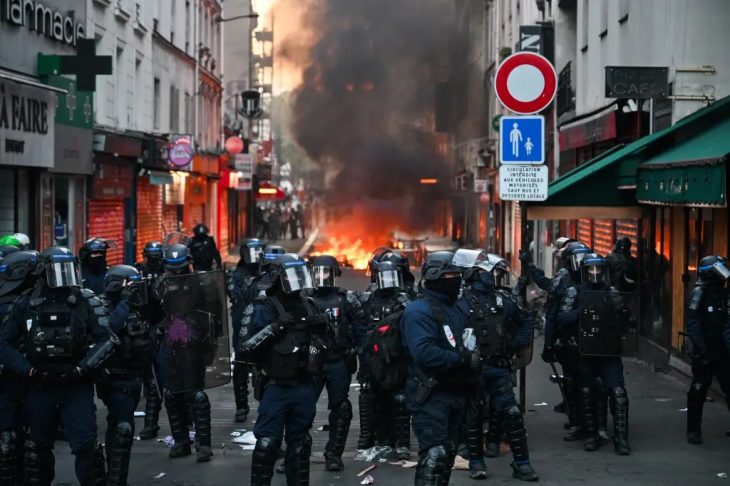
Today’s image is of Marseilles, France, which saw riots specifically targeting Jewish businesses. “In France’s second-largest city of Marseille, which boasts one of the largest Jewish populations of any city in Europe, rioters vandalized dozens of shops — stealing a range of products ranging from high-end Hermes items to slices of bread, according to local reports” (https://nypost.com/2026/10/18/world-news/synagogue-ransacked-jewish-businesses-hit-during-french-riots/).