Word of the Day: Felicity
Today’s word of the day, somewhat thanks to the Words Coach (https://www.wordscoach.com/dictionary; the word there was actually felicitous, but that is derived from felicity), is felicity. Pronounced / fɪˈlɪs ɪ ti /, it means “the state of being happy, especially in a high degree; bliss,” “an instance of this,” “a source of happiness,” “a skillful faculty,” “an instance or display of this,” or “Archaic. good fortune” (https://www.dictionary.com/browse/felicity). Merriam-Webster adds “an apt expression” (https://www.merriam-webster.com/dictionary/felicity).
The word first appears in English in the “late 14c., ‘happiness; that which is a source of happiness,’ from Old French felicite ‘happiness’ (14c.), from Latin felicitatem (nominative felicitas) ‘happiness, fertility,’ from felix (genitive felicis) ‘happy, fortunate, fruitful, fertile’ (from suffixed form of PIE *dhe(i)- ‘to suck,’ with derivatives meaning ‘to suckle, produce, yield’).
“A relic of Rome’s origins as an agricultural community: that which brings happiness is that which produces crops. Compare pauper (see poor (adj.)) ‘poor, not wealthy,’ literally ‘producing little.’ The meaning ‘skillful adroitness, admirable propriety’ is attested from c. 1600” (https://www.etymonline.com/word/felicity).
Pat “Sullivan was an Australian-born animator who started his career as a cartoonist before setting up his own animation studio in 1916” (https://www.nfsa.gov.au/stories/articles/100-years-felix-cat). One of the studio’s first productions was called “Feline Follies.” The production featured a black and white cat with big eyes and a wide grin. His name was Felix.
“There is still much debate over who originally created Felix the Cat. Many animation scholars attribute the character to Otto Messmer, one of Sullivan’s animators. However, Sullivan’s supporters claim Felix evolved from an earlier character of his who appeared in a short film titled The Tale of Thomas Kat (1917), two years before Feline Follies” (ibid.).
Felix was probably the first animated movie star. He appeared during the silent film error almost a decade before Walt Disney’s Steamboat Willie, the precursor of Mickey Mouse. But Felix went through a difficult time after the introduction of talkies because his creators didn’t want to make the transition. Eventually, of course, it happened.
The early version of Felix the Cat got involved in a wide variety of adult-type situations. He worked in a butcher shop. He went to war after proposing to his girlfriend; “although he returns a war hero, he comes home to find Kitty has forgotten him and married another cat. The films ends with Felix having the last laugh, feeling he ‘dodged a bullet’ after seeing Kitty’s litter of kittens causing chaos” (ibid.).
“Felix Revolts (1923) shows our hero fighting back against a council ban on cats, organising a strike which allows the rats in the town to run wild and wreak havoc on the townsfolk. The underlying social and political commentary in this film is an honest reflection of the post-First World War era of worker unrest and the rise of unions” (ibid.).
The early Felix looked like a normal cat, but “By the mid-to-late 1920s, Felix had transformed and become more cartoonish–with a large head, big eyes and rounder tummy…. The cartoons have mellowed over the years with his high-pitched voice, wide smile and bag of tricks making him into more of a children’s character, but he still lays claim to a diverse and devoted worldwide fan base” (ibid.).
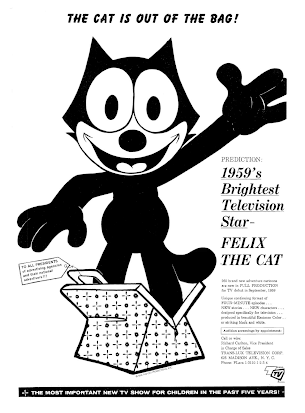
In the 1950s, the old silent cartoons were bought by a group that added soundtracks. Then, in 1958, another group started producing new Felix cartoons. The new versions “gave Felix a more domesticated and pedestrian personality geared more toward children and introduced now-familiar elements such as Felix’s Magic Bag of Tricks, a satchel that could assume the shape and characteristics of anything Felix wanted.” Revisions and updates of Felix happened throughout the end of the 20th century, although Felix never became as popular as he had been in the early days. He was certainly not as well known as Mickey Mouse, Bugs Bunny, or Donald Duck. “According to Don Oriolo’s Felix the Cat blog, as of September 2008 there were plans in development for a new television series. Oriolo’s biography page also mentioned a 52-episode cartoon series then-in the works titled Felix the Cat, which was slated to use computer graphics” (https://en.wikipedia.org/wiki/Felix_the_Cat#cite_note-94).
I grew up watching Felix the Cat cartoons, along with a host of others, like Bugs Bunny, Rocky and Bullwinkle, and Mr Peabody. Felix was not my favorite cartoon, but I clearly remember watching it, and I especially remember the theme song:
Felix the Cat, the wonderful, wonderful cat.
Whenever he get’s into a fix,
He reaches into his magic bag of tricks.
Felix the Cat, the wonderful, wonderful, cat.
You’ll laugh so much your sides will ache.
Your heart will go pitter pat.
Watching Felix the wonderful cat.
https://lyricstranslate.com/en/felix-cat-ost-felix-cat-theme-song-lyrics
Of course, what I didn’t know as a kid was the Felix meant happy and lucky, though he certainly was both. And he was a source of felicity to many, many kids.
Today’s image is an ad that came out with the late 50s revival of Felix (https://tralfaz.blogspot.com/2022/09/a-cat-greek-god-and-robot.html).