Word of the Day: Kvell
Today’s word of the day, thanks to the Words Coach (https://www.wordscoach.com/dictionary) is kvell. Pronounced / kvɛl /, just as it is spelled, this slang verb means “to be extraordinarily pleased; especially, to be bursting with pride, as over one’s family” (https://www.dictionary.com/browse/kvell). Dictionary.com goes on to say, “An Americanism first recorded in 1965–70; from Yiddish kveln ‘be delighted’; compare Middle High German, German quellen ‘well up, gush’” (ibid.).
Merriam-Webster, in its Did You Know section, says, “Kvell comes from Yiddish kveln, meaning ‘to be delighted,’ which, in turn, comes from the Middle High German word quellen, meaning ‘to well, gush, or swell.’ Yiddish has been a wellspring of creativity for English, giving us such delightful words as meister (‘one who is knowledgeable about something’), maven (‘expert’), and shtick (‘one’s special activity’), just to name a few. The date for the appearance of kvell in the English language is tricky to pinpoint exactly. The earliest known printed evidence for the word in an English source is found in a 1952 handbook of Jewish words and expressions” (https://www.merriam-webster.com/dictionary/kvell).
Chabad.org says, “Although kvell is extremely popular among English-speaking Yiddish dabblers, most Yiddish speakers would probably describe the same sensation as to shep nachas (pronounced SHEP NOKH-is). Shep means ‘draw’ (like drawing water from a well). Nachas is Hebrew for ‘calm’ and ‘serenity,’ but its Yiddish iteration implies the glow that comes from the success of the people you care about.
“Thus, when your friend updates you on her prodigious son’s success (‘He is now married and has a houseful of sweet children’), you can tell her to shep nachas, to lap up bucket-loads of satisfaction from those super-cute grandkids” (https://www.chabad.org/library/article_cdo/aid/4075768/jewish/What-Does-Kvell-Mean.htm).
“Yiddish is the language of the Ashkenazim, central and eastern European Jews and their descendants. Written in the Hebrew alphabet, it became one of the world’s most widespread languages, appearing in most countries with a Jewish population by the 19th century. Along with Hebrew and Aramaic, it is one of the three major literary languages of Jewish history” (https://www.britannica.com/topic/Yiddish-language). The Ashkenazim or Ashkenazi Jews are a subset of the Jewish people who migrated from the Holy Land to what is now Eastern Europe. The origin of the Ashkenazim is Ashkenaz, a son of Gomer in the Bible, and a great grandson of Noah. They suffered significant persecution in Europe throughout the Middles Ages and up through the middle of the twentieth century until many of them emigrated to what today is Israel and to the United States. The US has the largest population of Ashkenazim.
“The earliest dated Yiddish documents are from the 12th century CE, but scholars have dated the origin of the language to the 9th century, when the Ashkenazim emerged as a unique cultural entity in central Europe. Yiddish first arose through an intricate fusion of two linguistic stocks: a Semitic component (containing postclassical Hebrew and Aramaic that the first settlers brought with them to Europe from the Middle East) and a grammatically and lexically more potent Germanic component (gleaned from a number of High German and Middle German dialects). In addition, a sprinkling of words from Romance languages also seems to have appeared in Yiddish from early on. From its birthplace on German-speaking soil, Yiddish spread to nearly all of eastern Europe, where the language acquired a Slavic component” (ibid.).
“Millions of Yiddish speakers were victims of the Nazi Holocaust. The number of speakers was further reduced by the official suppression of the language in the Soviet Union, by the antagonism of early Israeli authorities zealously guarding modern Hebrew, and by massive voluntary shifts to other primary languages in Western countries. The language nevertheless continues to flourish among the ultra-Orthodox Hasidim in numerous countries and among secular students of Yiddish at leading universities” (ibid.).
One of the great Yiddish writers is Isaac Bashevis Singer, who won the Nobel Prize for Literature in 1978. “Singer always wrote and published in Yiddish. His novels were serialized in newspapers, which also published his short stories. He edited his novels and stories for publication in English, which was used as the basis for translation into other languages. Some of Singer’s stories and novels have not been translated….
“Singer believed in the power of his native language and thought that there was still a large audience, including in New York, who longed to read in Yiddish. In an interview in Encounter (February 1979), he said that although the Jews of Poland had died, ‘something—call it spirit or whatever—is still somewhere in the universe. This is a mystical kind of feeling, but I feel there is truth in it.’
“Some of his colleagues and readers were shocked by the breadth and frankness of his treatment of human nature. He wrote about lesbian desire in “Zeitl and Rickel” (“Tseytl un Rikl”),published in The Seance and Other Stories; a young woman who disguises herself as a man to study Talmud in ‘Yentl the Yeshiva Boy’, published in Short Friday; and rabbis corrupted by demons in ‘Zeidlus the Pope’, also published in Short Friday. In novels and stories that refer to events in his own life, he portrays himself unflatteringly, with some degree of accuracy, as an artist who is self-centered yet has a keen eye for the sufferings and tribulations of others (https://en.wikipedia.org/wiki/Isaac_Bashevis_Singer).
Chabad.org has a list of the “Top 20 Yiddish Words You Should Know” (https://www.chabad.org/library/article_cdo/aid/7284554/jewish/Top-20-Yiddish-Words-You-Should-Know.htm). Here are a few: Mentsch (a person, particularly “a decent, upstanding, respectable person”; Schmutz (dirt); Nosh (to snack); Schmoose (to chat); Mishmash (a mixture); and, of course, Kvell.
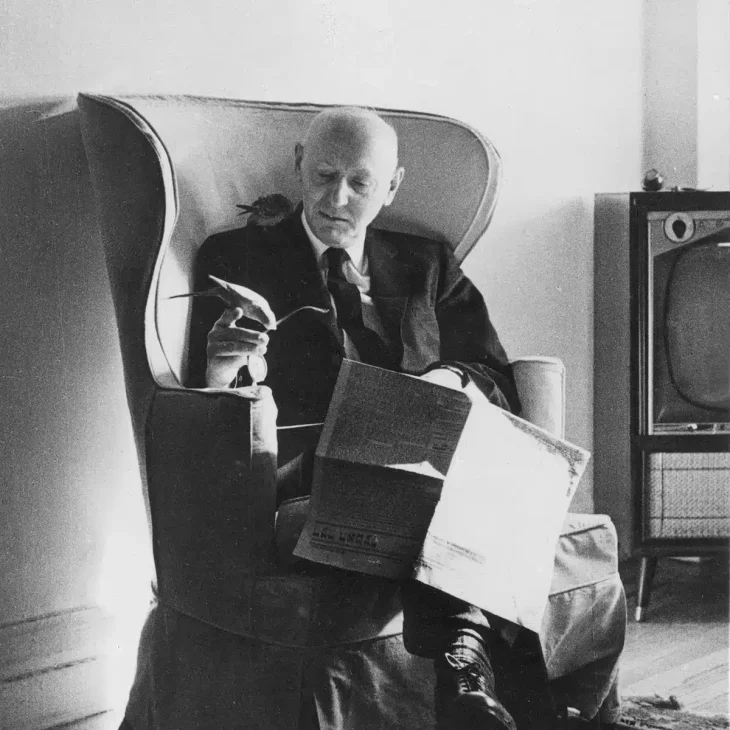
Today’s image is ok Isaac Bashevis Singer (https://sketchblog.lu/isaac-bashevis-singer-zum-todestag-21-11-1902-24-7-1991/).