Word of the Day: Rarefy
Today’s word of the day, thanks to some extent to the Words Coach (https://www.wordscoach.com/dictionary), is rarefy. Pronounced / ˈrɛər əˌfaɪ /, it means “to make rare or rarer; make less dense” or “to make more refined, spiritual, or exalted” (https://www.dictionary.com/browse/rarefy).
This verb first appears in English in the “late 14c., rarefien, ‘make thin, reduce the density of,’ from Old French rarefier (14c.) and directly from Medieval Latin rarificare, from Latin rarefacere ‘make thin, make rare,’ from rarus ‘rare, thin’ (see rare (adj.1)) + facere ‘to make’ (from PIE root *dhe- ‘to set, put’). Intransitive sense of ‘become less dense’ is from 1650s” (https://www.etymonline.com/word/rarefy). On another page on the Etymonline website, we find that rarify is “common but incorrect spelling of rarefy,” which is especially interesting since the classical Latin spelling is rarefacere, but the Medieval Latin has the i, rarifacere.
On this date in 1593, “Playwright Thomas Kyd’s accusations of heresy lead to an arrest warrant for Christopher Marlowe” (https://www.onthisday.com/events/may/18).
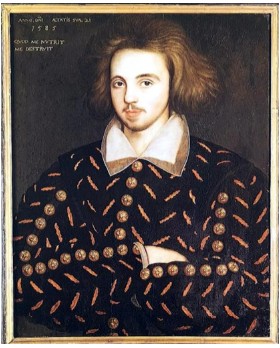
Christopher “Kit” Marlowe (1564-1593) was a poet, playwright, and translator and a contemporary of William Shakespeare. His best known plays are Doctor Faustus, Tamburlaine, The Jew of Malta, and Edward II. All of them are, in a way, predecessors of Shakespeare plays, except for perhaps Doctor Faustus, which is unique. But Edward II is an early history play, similar to Shakespeare’s history plays, especially Richard II. His most famous poems are “Hero and Leander” and “The Passionate Shepherd to His Love,” which receives a response in “The Nymph’s Reply to the Shepherd” by Sir Walter Raleigh (although I understand that writing a response to the Passionate Shepherd was somewhat of a school exercise).
According to the Marlowe Society, “Marlowe was a child of the English Renaissance and the Reformation, which was also that troubled period called by the great scholar Dame Frances Yates, “the false dawn of the Enlightenment”, which was doomed to suppression and delay. He shared his birth year, 1564, with Galileo (and with Shakespeare, but that fact is never mentioned by the Shakespearean academic authors). It was a dangerous time in which to express an eager interest in the new scientific discoveries that were exciting the minds of intellectuals all over Europe. In England Sir Walter Raleigh and the young (9th) Earl of Northumberland, Henry Percy (also born in 1564), led a group of intellectuals, a select band of advanced thinking noblemen, courtiers and educated commoners, including mathematicians, astronomers, voyagers who had explored the New World, geographers, philosophers and poets. They formed an esoteric club nicknamed “The School of Night” which met secretly to discuss this forbidden knowledge, always ‘behind closed doors’. Marlowe became a member of this close circle, who were called Free-Thinkers and were all stigmatised as “Atheists” in order to blacken them in the eyes of the ignorant” (https://www.marlowe-society.org/christopher-marlowe/life/the-free-thinkers/).
In addition to his being a writer, Marlowe may also have been a spy. The Marlowe Society says, “Lord Burghley, Queen Elizabeth’s chief minister who, together with her Secretary of State, Sir Francis Walsingham, was said to rule the land with the Queen as the Head of all, was also Chancellor of the University of Cambridge. As such he used the University as his recruiting ground to enlist bright, patriotic young men to serve as secret agents. Evidently Marlowe was picked out for this service, which was vitally important, in this age of Catholic versus Protestant political intrigue, an age of political assassinations, directed against the Heads of States” (https://www.marlowe-society.org/christopher-marlowe/life/government-agent/). Walsingham in particular was known as Elizabeth’s spy master.
Marlowe was just 29 when he died: “On 30 May 1593 a murder was said to have been committed in a room that had been hired for a private meeting in a respectable house in Deptford, owned by Dame Eleanor Bull. It was not a tavern as is often alleged. Dame Bull had Court connections. Her sister, Blanche, was the god-daughter of Blanche Parry, who had been the much loved nanny of the infant Elizabeth and was a ‘cousin’ of Lord Burghley’s. Now widowed, Dame Bull hired out rooms and served meals. It was likely that her home was a safe house for Government Agents” (https://www.marlowe-society.org/christopher-marlowe/life/death-in-deptford/).
Charles Nicholl published The Reckoning: The Murder of Christopher Marlowe in 1995. Here is what the Amazon blurb says: “Here, in a tour de force of scholarship and ingenuity, Charles Nicholl penetrates four centuries of obscurity to reveal not only a complex and unsettling story of entrapment and betrayal, chimerical plot and sordid felonies, but also a fascinating vision of the underside of the Elizabethan world” (https://www.amazon.com/Reckoning-Murder-Christopher-Marlowe/dp/0226580245). The book reads almost like a modern thriller.
The saddest part of the story is that Marlowe was truly a great writer, and his death at 29 was a great loss for English literature. So in remembrance of Kit Marlowe, here is “The Passionate Shepherd to His Love”:
Come live with me and be my love,
And we will all the pleasures prove,
That Valleys, groves, hills, and fields,
Woods, or steepy mountain yields.
And we will sit upon the Rocks,
Seeing the Shepherds feed their flocks,
By shallow Rivers to whose falls
Melodious birds sing Madrigals.
And I will make thee beds of Roses
And a thousand fragrant posies,
A cap of flowers, and a kirtle
Embroidered all with leaves of Myrtle;
A gown made of the finest wool
Which from our pretty Lambs we pull;
Fair lined slippers for the cold,
With buckles of the purest gold;
A belt of straw and Ivy buds,
With Coral clasps and Amber studs:
And if these pleasures may thee move,
Come live with me, and be my love.
The Shepherds’ Swains shall dance and sing
For thy delight each May-morning:
If these delights thy mind may move,
Then live with me, and be my love.
Today’s image is a “Purported portrait of Marlowe. This painting was discovered at Marlowe’s old rooms during renovations at Cambridge in 1952. Is it really Marlowe? Check out the story at The Marlowe Studies” (https://www.faust.com/books/authors/christopher-marlowe/).