Word of the Day: Pejorative
Paul Schleifer
At www.dictionary.com, you’ll find the following definition for pejorative: “having a disparaging, derogatory, or belittling effect or force.” The example given, “the pejorative affix -ling in princeling,” is kind of fun. The site also gives a noun pejorative “a pejorative form or word,” but I would think that that is a substantive adjective, an adjective which stands without its noun, as in Jesus’s “For the poor you have with you always; but you do not always have Me” (Matthew 26:11), where “the poor” means “the poor people,” but people is understood.
According to both etymonline and the OED, the word entered the English language in the late 19th century from the French péjoratif. According to www.etymonline.com, “from Late Latin peiorat-, past participle stem of peiorare ‘make worse,’ from Latin peior ‘worse,’ perhaps originally ‘stumbling,’ from PIE *ped-yos-, suffixed (comparative) form of *ped- ‘to walk, stumble, impair,’ from root *ped- ‘foot.’ As a noun from 1882. English had a verb pejorate ‘to worsen’ from 1640s.” It is interesting that you will not find the verb pejorate in the dictionary today, but you may find, depending on the dictionary, pejoration, which is a noun created from pejorate with the derivational suffix –ion. Even as I compose this using MicroSoft Word, pejorative and pejoration have no red squiggly line beneath them, but pejorate does.
Today is May 5, or Cinco de Mayo, a day celebrated by Americans as if it were the Independence Day of Mexico, when in fact Mexico’s Independence Day is in September. Cinco de Mayo is a celebration day in Mexico, just not of its independence. So what happened on May 5?
From 1858 to 1861, a civil war took place in Mexico between liberals who wanted a separation of church and state and conservative Roman Catholics who believed the government and the Roman Catholic Church should be connected. One of the results of this civil war was to bankrupt the Mexican treasury. President Benito Juárez declared a moratorium on the repayment of debts owed to foreign countries, and the British, Spanish, and French did not take kindly to the declaration. All three countries sent ships to Mexico to try to persuade the Mexican government to reconsider the moratorium. The British and Spanish negotiated with Juárez and left, but the French, whose leader at the time was Napoleon III, decided that the moment was ripe to re-establish a colonialist foothold in the New World.
On May 5 of 1862, a well-armed and equipped French force of about 8,000 men met a poorly armed Mexican force of half that size. And against all odds, the Mexicans won the battle. Some people have argued that the Battle of Puebla was significant for several reasons. One, it is claimed that since the Battle of Puebla, no country in the Americas has been invaded by a European military force. Two, one historian claims that had the French won the Battle of Puebla, they would have gone on to join the side of the Confederacy in the U.S. Civil War.
However, what followed Cinco de Mayo was a larger French invasion force, about 30,000 men, who just a year after Puebla defeated the Mexican army, took over Mexico City, and installed Emperor Maximilian I, the only ruler of the Second Mexican Empire. Maximilian, the younger brother of Austrian Emperor Francis Joseph I, was offered the Mexican throne by Napoleon III, and he accepted. This new Mexican Empire was recognized as the legitimate world powers as Britain and Spain. It was not, however, recognized by the United States. The U.S. continued to recognize Juárez as the legitimate president of Mexico.
And then, in 1865, the U.S. Civil War ended, and the U.S. was able to begin actively supporting the liberal Mexicans in their struggle against the French puppet. Furthermore, Napoleon III began to lose interest in the Mexican project, particularly since the Prussians were threatening war. Juárez’s forces, who had been fighting a guerrilla campaign against the French, became more aggressive and eventually defeated the forces of Maximilian I, retaking Mexico City, and capturing and executing Maximilian. His reign ended just three years after it had started.
Now, I’m not going to say that Mexican independence from France was won by the United States, but I think it is reasonable to assert that the U.S. recognition of Juárez’s government after the fall of Mexico City in 1863 may have been crucial in Juárez’s ability to continuing the resistance against France. And this support of the Mexican government came less than two decades after the conclusion of the Mexican-American War.
In other words, despite all the pejorative language about Mexico that we have heard from our current president, the importance of U.S.-Mexico relations goes way back. Personally, I think it would be great if, on this Cinco de Mayo, we concentrated on improving relationships with Mexico and Mexicans by doing more than just drinking cerveza.
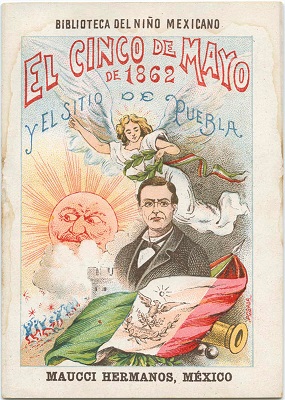
The image is of a poster: El cinco de Mayo de 1862 y el sitio de Puebla (May 5, 1862 and the siege of Puebla), by Heriberto Frias (1870-1925), 1901. The image is made available through the DeGolyer Library, Southern Methodist University.