Word of the Day: Lethargy
Today’s word of the day, courtesy of the Dictionary Project (https://www.dictionaryproject.org/), is lethargy. Pronounced / ˈlɛθ ər dʒi /, this noun means “the quality or state of being drowsy and dull, listless and unenergetic, or indifferent and lazy; apathetic or sluggish inactivity” (https://www.dictionary.com/browse/lethargy).
The Merriam-Webster page has a section called Choose the Right Synonym, and it says the following:
“lethargy, languor, lassitude, stupor, torpor mean physical or mental inertness;
“lethargy implies such drowsiness or aversion to activity as is induced by disease, injury, or drugs: ‘months of lethargy followed my accident’;
“languor suggests inertia induced by an enervating climate or illness or love; ‘languor induced by a tropical vacation’;
“lassitude stresses listlessness or indifference resulting from fatigue or poor health: ‘a depression marked by lassitude’;
“stupor implies a deadening of the mind and senses by shock, narcotics, or intoxicants: ‘lapsed into an alcoholic stupor’;
“torpor implies a state of suspended animation as of hibernating animals but may suggest merely extreme sluggishness: “a once alert mind now in a torpor.’”
The word first appears in English in the “late 14c., litarge, ‘state of prolonged torpor or inactivity, inertness of body or mind,’ from Medieval Latin litargia, from Late Latin lethargia, from Greek lēthargia ‘forgetfulness,’ from lēthargos ‘forgetful,’ apparently etymologically ‘inactive through forgetfulness,’ from lēthē ‘a forgetting, forgetfulness’ (see Lethe) + argos ‘idle’ (see argon). The form with -th- is from 1590s in English. The Medieval Latin word also is the source of Old French litargie (Modern French léthargie), Spanish and Italian letargia” (https://www.etymonline.com/search?q=lethargy).
On this date in 1940, according to the On This Day website, “British and Allied forces begin the evacuation of Dunkirk (Operation Dynamo) during World War II” (https://www.onthisday.com/events/may/27).
The wiki on the Miracle at Dunkirk, or Operation Dynamo, says that the operation lasted from May 26 to June 4 (https://en.wikipedia.org/wiki/Dunkirk_evacuation). It came at the end of what is known as the Battle of France. Britain and France had declared war on Deutschland in September of 1939, in response to Deutsch invasion of Poland. Initially the French tried to invade Deutschland, but they were unsuccessful. The following spring, the Deutsch responded with an invasion of their own. “On 10 May 1940, Wehrmacht armies invaded Belgium, Luxembourg, the Netherlands and parts of France.
“In Fall Gelb (Case Yellow), German armoured units advanced through the Ardennes, crossed the Meuse and raced down the Somme valley, cutting off and surrounding the Allied units that had advanced into Belgium to meet the German armies there. British, Belgian and French forces were pushed back to the sea by the Germans where the British and French navies evacuated the encircled elements of the British Expeditionary Force (BEF) and the French and Belgian armies from Dunkirk in Operation Dynamo” (https://en.wikipedia.org/wiki/Battle_of_France).
You have probably heard of this famous evacuation. Over 300,000 soldiers were evacuated over the course of a little over a week. All kinds of boats were used for the evacuation, not just military vessels. It may be the most famous retreat of all time. But there’s a feature to the story that most of us have probably not heard of, unless of course you are fond of military history.
So here’s what Paul Harvey used to call the rest of the story:
“The Battle of France began on May 10, 1940, when German forces invaded neutral Holland and Belgium, and British and French forces moved forward to meet them. A German armored spearhead soon blasted through the Ardennes Forest in Luxembourg and southern Belgium, shattered weak French defenses and outflanked the Anglo-French armies in Belgium. Ten days later, on the evening of May 20, German forces reached the English Channel, cutting off the BEF from the rest of France.
“Britain’s Imperial General Staff at first underestimated the scope of the disaster and ordered General Lord Gort, commander of the BEF, to attack into the teeth of the German army. Rejecting these orders, Gort decided instead on May 23 to pull back and establish a defensive perimeter. Three days later the War Office in London ordered the BEF’s evacuation. By then the Germans had squeezed British and French forces into such a tight perimeter that their chances for evacuation depended entirely on holding the tiny French port of Dunkirk.
“Just 12 miles away tanks of Guderian’s 1st Panzer Division had reached the Aa Canal, the last real obstacle before Dunkirk. Standing on a hill, Guderian could see the town walls. By the morning of the 25th his men had thrown pontoon bridges across the canal, allowing a few tanks to cross. Just as the advance was ready to resume, however, an order arrived from Army Group A, under General Gerd von Rundstedt: The tanks must halt at the Aa Canal” (https://historynet.com/decisions-hitlers-halt-order/).
Wait. What?
That’s right. Just as the Deutsch army was ready to cross the Aa Canal and destroy the Allied army, with its 338,000 or more soldiers, General von Rundstedt ordered the tanks to stop. And the next day, Adolf Hitler himself confirmed the order. Why?
“The halt order left Guderian ‘speechless,’ and it has sparked debate ever since. Some writers speculated—falsely—that Hitler had given the order out of a misguided sense of mercy, hoping the British were ready to make peace. German generals, in interviews and memoirs, chalked it up as yet another example of Hitler’s outrageous military stupidity, which had prevented them from winning the war” (ibid.).
Some speculate that some of the Deutsch generals were afraid of an allied counter-attack. Some blame the Halt Order on Field Marshal Hermann Göring, who wanted the Luftwaffe to have the honor of destroying the Allied army. Some think Hitler was swayed by the losses of the Panzer tanks, which was reportedly pretty high. But whatever the reason, the Miracle at Dunkirk would not have happened were it not for that Halt Order.
And one thing I’m pretty certain of regarding the Halt Order: it wasn’t issued out of lethargy.
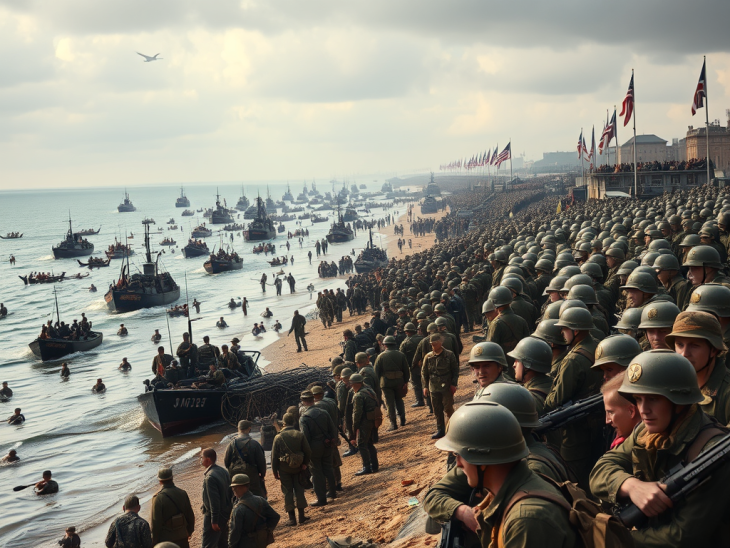
Today’s image is of the Miracle at Dunkirk (https://zentara.blog/2025/07/02/the-miracle-of-dunkirk-10-facts-about-wwiis-amazing-evacuation/).