Word of the Day: Copacetic
Today’s word of the day, courtesy of the Words Coach (https://www.wordscoach.com/dictionary), is copacetic. Pronounced / ˌkoʊ pəˈsɛt ɪk /, with the primary stress on the third syllable, this adjective means “fine; completely satisfactory” and is listed as slang (https://www.dictionary.com/browse/copacetic).
In the Did You Know section, Merriam-Webster says, “If you’re living the life of Riley, strolling along easy street, or wallowing in hog heaven, your circumstances may be described as copacetic. A word of obscure origin, copacetic has for over a century satisfied those who’ve had a hankering to describe that which is hunky-dory or otherwise completely satisfactory. (If “of obscure origin” leaves you feeling less than copacetic, the note here will undoubtedly remedy that.) Life isn’t always beer and skittles, but when you do find yourself walking that primrose path, just remember: it’s all copacetic” (https://www.merriam-webster.com/dictionary/copacetic).
Etymonline.com identifies the first record of the word in “1919, but it may have origins in 19c. U.S. Southern Black speech. Origin unknown; suspects include Latin, Yiddish (Hebrew kol b’seder), Italian, Louisiana French (coupe-sétique), and Native American. Among the linguists, none of these is considered especially convincing. The popularization, and sometimes the invention, of the word often is attributed to U.S. entertainer Bill ‘Bojangles’ Robinson (1878-1949)” (https://www.etymonline.com/search?q=copacetic).
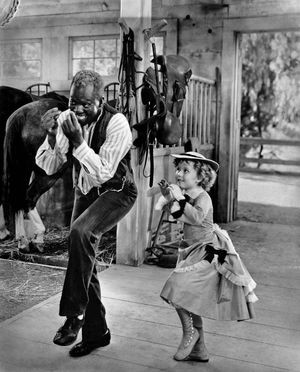
“Bill Robinson (born May 25, 1878, Richmond, Virginia, U.S.—died November 25, 1949, New York, New York) was an American dancer of Broadway and Hollywood, best known for his dancing roles with Shirley Temple in films of the 1930s.
“Robinson’s parents having died when he was a child, he was raised by a grandmother and received little formal schooling. He began dancing for pennies at the age of eight, when he had also begun to work as a stableboy. He eventually made a swing of a vaudeville circuit and in 1908 entered a business association with Marty Forkins, actors’ agent, who helped him to fame.
“Robinson went on to become a star of black musical comedies, later a top vaudeville star, and finally a star of motion pictures, appearing in 14 films, notably The Little Colonel (1935), In Old Kentucky (1935), The Littlest Rebel (1935), Rebecca of Sunnybrook Farm (1938), and Just Around the Corner (1938). He also appeared in the wartime all-black musical film Stormy Weather (1943)” (https://www.britannica.com/biography/Bill-Robinson).
Now if you’re like me, and you hear the name “Bojangles,” you automatically think of the song by Jerry Jeff Walker. Or perhaps, if you’re younger than I am, you think automatically of the fast-food chain, but that doesn’t really matter for the blog. But if you know anything about Jerry Jeff Walker, you know that he couldn’t possibly have written “Mr. Bojangles” about Bill Robinson. Well, maybe you wouldn’t know that if you don’t know the story.
“Walker said he was inspired to write the song after an encounter with a street performer in a New Orleans jail. While in jail for public intoxication in 1965, he met a homeless man who called himself ‘Mr. Bojangles’ to conceal his true identity from the police. Mr. Bojangles had been arrested as part of a police sweep of indigent people that was carried out following a high-profile murder. The two men and others in the cell chatted about all manner of things, but when Mr. Bojangles told a story about his performing dog who was killed by a car, the mood in the room turned heavy. Someone else in the cell asked for something to lighten the mood, and Mr. Bojangles obliged with a tap dance. The homeless ‘Mr. Bojangles’, who was white, had taken his pseudonym from Bill ‘Bojangles’ Robinson (https://en.wikipedia.org/wiki/Mr._Bojangles_(song)).
The song was made popular by the Nitty Gritty Dirt Band in 1969. Other performers who covered the song include Bob Dylan, Harry Belafonte, Neil Diamond, John Denver, and Sammy Davis, Jr. But my favorite version of the song, one which tells the story from a slightly different perspective, is by Dave Bromberg (https://www.youtube.com/watch?v=muG8kDYbZ5Q). Take a listen. It’s copacetic.
Today’s image is from the movie “The Little Colonel [with]Bill (‘Bojangles’) Robinson and Shirley Temple egging each other on in … (1935)” (https://www.britannica.com/biography/Bill-Robinson).