Word of the Day: Comity
Today’s word of the day, courtesy of the Words Coach (https://www.wordscoach.com/dictionary), is comity. Pronounced / ˈkɒm ɪ ti /, it means “mutual courtesy; civility” (https://www.dictionary.com/browse/comity).
Merriam-Webster has more options: “friendly social atmosphere : social harmony,” “a loose widespread community based on common social institutions,” “the informal and voluntary recognition by courts of one jurisdiction of the laws and judicial decisions of another,” or “avoidance of proselytizing members of another religious denomination” (https://www.merriam-webster.com/dictionary/comity). The in the Did You Know section, it says, “’Our country soweth also in the field of our breasts many precious seeds, as … honest behavior, affability, comity,’ wrote English clergyman Thomas Becon in 1543. Becon’s use is an early documented appearance of comity—a word derived from Latin cōmitās, meaning ‘friendliness, courtesy, or graciousness.’ Comity is largely used in political and judicial contexts. Since 1804, comity of nations has referred to countries bound by a courteous relationship based on mutual recognition of executive, legislative, and judicial acts. And, in legal contexts, comity refers to the recognition by courts of one jurisdiction of the laws and judicial decisions of another” (ibid.).
The word first appears in English in the “early 15c., ‘association,’ from French comité, from Latin comitas ‘courtesy, friendliness, kindness, affability,’ from comis ‘courteous, friendly, kind,’ perhaps from PIE *ko(m)smi-, literally ‘smiling with,’ from *kom- ‘together’ + root *smei- ‘to laugh, smile’ (see smile (v.)).
Meaning ‘courtesy, civility’ in English is from 1540s. Phrase comity of nations attested from 1812: ‘The obligation recognized by civilized nations to respect each other’s laws and usages as far as their separate interests allow’” (https://www.etymonline.com/search?q=comity).
On this date in 1864, “Russia declares an end to the Russo-Circassian War, forcing many Circassians into exile, commemorated today as the Circassian Day of Mourning” (https://www.onthisday.com/events/may/21).
I have to admit that, until today, I had never heard of Circassia. Apparently it was “a country and a historical region in Eastern Europe. It spanned the western coastal portions of the North Caucasus, along the northeastern shore of the Black Sea” (https://en.wikipedia.org/wiki/Circassia). “Legally and internationally, the Treaty of Belgrade, which was signed between Austria and the Ottoman Empire in 1739, provided for the recognition of the independence of Eastern Circassia. Both the Russian Empire and the Ottoman Empire recognized it under witness from the other great powers of the time. The Congress of Vienna also stipulated the recognition of the independence of Circassia. In 1837, Circassian leaders sent letters to a number of European states requesting diplomatic recognition. Following this, the United Kingdom recognized Circassia. However, following the outbreak of the Russo-Circassian War, the Russian Empire did not recognize Circassia as an independent nation and instead treated it as Russian land under rebel occupation, despite having no control or ownership over the region. Russian generals often referred to the Circassians as “mountaineers”, “bandits”, and “mountain scum” rather than by their ethnonym (ibid.).
“Circassians themselves don’t use the term ‘Circassia’, and refer to their country as Адыгэ Хэку (Adıgə Xəku) or Адыгей (Adıgey).
“Another historical name for the country was Zichia (or Zyx; the tribe living there was called Zygii), who was described by the ancient Greek intellectual Strabo as a nation to the north of Colchis” (ibid.).
“Every year on May 21st, Circassians all over the world mark the Day of Mourning and Remembrance for the Circassian Genocide. In the Circassian homeland in the Caucasus, in the Republic of Adygea, in the Republic of Kabardino-Balkaria, in the Republic of Karachay-Circassia, this day is marked with conferences and processions with the participation of the governments of the republics. In the Krasnodar Territory – in the city of Krasnodar and in the Shapsug region on the Black Sea coast, as well as in the Stavropol Territory, Circassian organizations there also mark this day with conferences and processions.
“In the Circassian diaspora in Turkey, Syria, Jordan, Israel, European countries, the United States, Canada, Australia and other countries of the world, this day is also marked with conferences and processions of mourning and remembrance” (http://www.adyglife.com/2026/05/may-21st-circassian-nation-mark-day-of.html).
“May 21 marks the end of the Russo-Caucasian War of 1763-1864, following which 90 percent of the Circassian people were expelled from their historical homeland of Circassia into the Ottoman Empire. According to various historians, before the conquest of Circassia by the Russian Empire, over 2 million people lived in Circassia. After the conquest, less than 50,000 people remained in their homeland. The Republic of Kabardino-Balkaria recognized the Circassian genocide in 1992. The Republic of Adygea recognized it in 1996. Georgia in 2011 and Ukraine in 2025 officially recognized the Circassian genocide” (ibid.).
I wonder if Ukraine recognized the Circassian genocide because of what has been happening to them, at the hands of Russia, in the last few years. In any case, I feel kind of bad for the Circassian or Adyghe people. I do not understand why some people feel the need to conquer other people. If there really were such a thing as the comity of nations, people would leave other people alone.
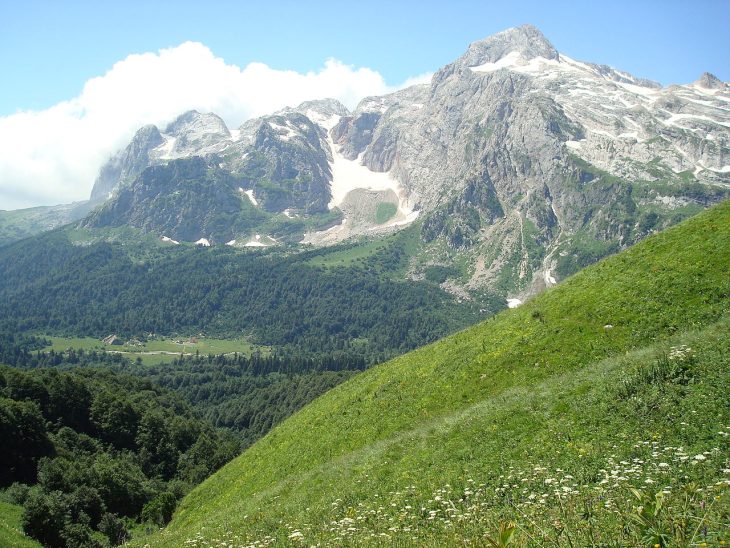
Today’s image is of “Гора Фишт. Кавказский государственный природный биосферный заповедник, западный отдел” (“Mount Fisht. Caucasian State Nature Biosphere Reserve, Western Section”), a photo by Sergei Kazantsev (https://en.wikipedia.org/wiki/Adygea#/media/File:%D0%A4%D0%B8%D1%88%D1%822.jpg). Perhaps the Adyghe say, “Next year in Matrega.”
