Word of the Day: Acquiesce
Today’s word of the day, thanks to the Words Coach (https://www.wordscoach.com/dictionary), is acquiesce. Pronounced / ˌæk wiˈɛs /, with the primary stress on the third syllable and a secondary stress on the first syllable, acquiesce means “to assent tacitly; submit or comply silently or without protest; agree; consent” (https://www.dictionary.com/browse/acquiesce). Merriam-Webster defines it as “to accept, agree, or comply usually by staying silent or by not arguing —often used with to or in” (https://www.merriam-webster.com/dictionary/acquiesce).
M-W adds this: “If you’re looking to give your speech a gentle, formal flair, don’t give acquiesce the silent treatment. Essentially meaning ‘to comply quietly,’ acquiesce has as its ultimate source the Latin verb quiēscere, ‘to be quiet.’ (Quiet itself is also a close relation.) Quiēscere can also mean ‘to repose,’ ‘to fall asleep,’ or ‘to rest,’ and when acquiesce arrived in English via French in the early 1600s, it did so with two senses: the familiar ‘to agree or comply’ and the now-obsolete ‘to rest satisfied’” (ibid.).
The first sense was the one that it came with. It first appears in English in the “1610s, ‘remain at rest’ (a sense now obsolete); 1650s as ‘agree tacitly, concur,’ from French acquiescer ‘to yield or agree to; be at rest,’ (14c.), from Latin acquiescere/adquiescere ‘become quiet, remain at rest, rest, repose,’ thus ‘be satisfied with, be content,’ from ad “to” (see ad-) + quiescere ‘become quiet,’ from quies (genitive quietis) ‘rest, quiet’ (from PIE root *kweie– ‘to rest, be quiet’)” (https://www.etymonline.com/search?q=acquiesce).
If you’re wondering how the ad– becomes an ac-, it’s a phonological change that we call assimilation. The wiki says, “assimilation is a sound change in which some phonemes (typically consonants or vowels) change to become more similar to other nearby sounds. This process is common across languages and can happen within a word or between words. For example, in English ‘handbag’ (/ˈhændbæɡ/), the [n] often shifts to [m] in rapid speech, becoming /ˈhæmbæɡ/, because [m] and [b] are both bilabial (produced with both lips), and their places of articulation are similar” (https://en.wikipedia.org/wiki/Assimilation_(phonology)).
On this date in 1917, “After the sinking of 3 more American merchant ships, US President Woodrow Wilson meets with cabinet, who agree that war is inevitable” (https://www.onthisday.com/events/march/20). On April 2, Wilson called an “extraordinary” session of Congress and addressed both the House and the Senate. That day the Senate passed a declaration of war against Deutschland, and the House confirmed that declaration just four days later (https://en.wikipedia.org/wiki/United_States_declaration_of_war_on_Germany_(1917)).
When I was in school, I was told that while Woodrow Wilson and a majority of Americans favored neutrality in the Great War, the sinking of the Lusitania by a Deutsch U-boat changed the perspective of Americans and took the USA into the war. But that’s not really true. The sinking of the Lusitania occurred in May of 1915, almost two full years before the US entered the war. So what happened in between?
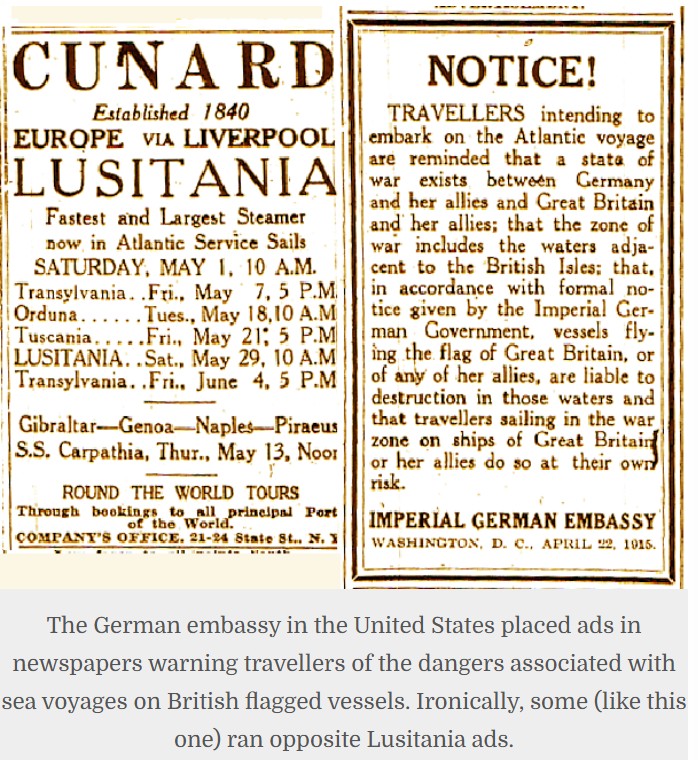
First of all, let’s be clear about what happened with the Lusitania: while it was a passenger liner, the USA was shipping munitions to Great Britain in the cargo hold. The Deutsch claimed that the submarine which struck the passenger liner surfaced and gave warning, giving the crew time to load the passengers into lifeboats. But the passengers were not loaded into lifeboats, and over 1100 people died, including 128 Americans.
After that incident, the Germans promised to reduce attacks on merchant vessels and passenger liners, but further incidents happened. In August of 1915, the Arabic was sunk, leading to another diplomatic incident, and then the Sussex was struck and damaged in May of 1916. That led to the Sussex pledge, a promise from Deutschland that it would stop attacks on passenger vessels.
Second, and more important to the total story, is that Deutschland was not sinking passenger boats for no particular reason.
“The United Kingdom, with its overwhelming sea power, established a naval blockade of Germany immediately on the outbreak of war in August 1914. This was strengthened or weakened in a number of steps.
“1. 20 August 1914, a Maritime Order in Council declared that Conditional Contraband would be treated as Absolute Contraband.
“2. 21 September 1914, the Contraband Proclamation reassigned many goods from the ‘not to be declared contraband’ list to the Conditional Contraband list.
“3. 29 October 1914, due to American protests, a new Maritime Order in Council repealed the 20 August order, but put the onus on the owners of the goods to prove there was not a military destination.
“4. 2 November 1914, accusing Germany of illegally placing naval mines, Britain declared the North Sea a ‘military area’. This meant that to ensure ‘commerce of all countries will be able to reach its destination in safety’, traffic through the area was recommended to follow specific lanes (to avoid German mines and British mines, ostensibly placed to protect against German warships), forcing them to submit to British inspection.
“5. 11 March 1915, a Maritime Order in Council announced that the British would ‘seize all ships carrying goods of presumed enemy destination, ownership, or origin’. This was in retaliation for the February 1915 German ‘war zone’ announcement” (https://en.wikipedia.org/wiki/Blockade_of_Germany_(1914%E2%80%931919)).
In other words, the British, when the war commenced, immediately blockaded Deutschland, including preventing food from getting to the Deutsch. The British used not only naval ships but also mines. Mines are really dangerous weapons to use in war because they do not discriminate. Mines blow up whatever ship trips the mine, whether it is a military vessel or a passenger liner. And the British mines did sink Deutsch ships.
In 1917, after the US joined the war, the British and US Navies, began the North Sea Mine Barrage. They mined a large portion of the North Sea, from the Orkney Islands to Norway (https://www.abmc.gov/news-events/news/allied-north-sea-mine-barrage-world-war-i/). It is arguable that such a massive minefield was in violation of the Hague Convention VIII of 1907, which “outlines rules for the use of naval mines, emphasizing the need to avoid indiscriminate harm to civilians” (https://www.genevacall.org/news/naval-mines-and-international-humanitarian-law/). After the war, the Deutsch government announced that over 750,000 Deutsch people had died from starvation during the war (ibid.).
Senator Robert La Follette argued, on April 4, 1917, after the Senate vote had already taken place, “You cannot distinguish between the principles which allowed England to mine a large area of the Atlantic Ocean and the North Sea in order to shut in Germany, and the principle on which Germany by her submarines seeks to destroy all shipping which enters the war zone which she has laid out around the British Isles.
“The English mines are intended to destroy without warning every ship that enters the war zone she has proscribed, killing or drowning every passenger that cannot find some means of escape. It is neither more nor less than that which Germany tries to do with her submarines in her war zone. We acquiesced in England’s action without protest. It is proposed that we now go to war with Germany for identically the same action upon her part” (https://en.wikipedia.org/wiki/United_States_declaration_of_war_on_Germany_(1917)).
It is pointless to debate a war that happened over a century ago, but it is not pointless to consider how our governments do sometimes acquiesce to the actions of other governments.
Today’s image is of the Deutsch embassy’s warning to potential passengers of the Lusitania (https://militaryhistorynow.com/2016/09/14/lusitania-down-survivor-recalls-ocean-liners-terrifying-final-minutes/).