Word of the Day: Juvenescent
Today’s word of the day, thanks to Dictionary.com (https://www.dictionary.com/word-of-the-day), is juvenescent. Pronounced / ˌdʒu vəˈnɛs ənt /, with the primary stress on the third syllable and a second stress on the first syllable, juvenescent is an adjective that means “being or becoming youthful; young,” “young in appearance,” or “having the power to make young or youthful” (https://www.dictionary.com/browse/juvenescent).
It first appears in English in “1759, ‘becoming young, growing young in appearance,’ from Latin iuvenescentem (nominative iuvenescens), present participle of iuvenescere ‘to grow into youth, grow young again, regain youth,’ from iuvenis ‘young man’ (see young (adj.)). Its use in a sense of ‘immature, undeveloped’ (by 1875) is etymologically incorrect” (https://www.etymonline.com/word/juvenescent).
The Latin is cognate to the English word young, which goes back to “Middle English yong, from Old English geong ‘being in the early stage of life, not old; youthful, being in the early stages of adulthood; recent, new, fresh, vernal;’ from Proto-Germanic *junga-, reconstructed to be from a suffixed form of PIE root *yeu- ‘vital force, youthful vigor.’
“Cognates include Sanskrit yuvan- ‘young; young man;’ Avestan yuuanem, yunam ‘youth,’ yoista- ‘youngest;’ Latin juvenis ‘young,’ iunior ‘younger, more young;’ Lithuanian jaunas, Old Church Slavonic junu, Russian junyj ‘young,’ Old Irish oac, Welsh ieuanc ‘young.’ Germanic cognates include Old Saxon and Old Frisian jung, Old Norse ungr, Middle Dutch jonc, Dutch jong, Old High German and German jung, Gothic juggs” (ibid.).
Today is going to be short because I’m on vacation, but I like the word juvenescent, so I decided to go ahead.
I’m in Williamsburg, VA, with my daughter and two grandchildren. They are on Spring Break at their school, so we decided to come to Williamsburg to go to the historic town and go to Busch Gardens amusement park. We arrived this morning spent several hours at Busch Gardens. The kids, including the daughter, rode several rollercoasters. I didn’t. It’s not that I am afraid of heights, though I am. It’s that I have artificial knees, and my range of motion is somewhat limited. I literally cannot bend my legs enough to sit properly in one of those roller coaster cars. So I waited.
And while I was waiting (along with my wife), we read about the particular roller coaster they were on. There was a little plaque. It’s called the Loch Ness Monster though it actually has nothing to do with Scotland. It opened in 1978, at which time it was, if I remember correctly, the tallest roller coaster in the world. There are many much taller ones in the world now.
So where did the idea come from? Here is a brief history of the roller coaster courtesy of the National Roller Coaster Museum: “The oldest roller coasters descended from the so-called ‘Russian Mountains,’. These were specially constructed hills of ice located especially around Saint Petersburg, Russia. Built in the 17th century, the slides became popular with the Russian upper class. Catherine II of Russia was such a fan of these attractions that she had a few of these slides built on her own property. There is some dispute as to when wheels were added to carts for year-round operation. Some historians say the first real roller coaster was built under the orders of James the 3rd. The roller coaster was built in the Gardens of Oreinbaum in St. Petersburg in the year 1784. Other historians believe that the first roller coaster was built by the French. Les Montagnes Russes à Belleville (The Russian Mountains of Belleville). This roller coaster was said to be constructed in Paris in 1812. The Promenades Aeriennes both featured wheeled cars securely locked to the track, guide rails to keep them on course, and higher speeds. Although the groundwork for the invention of the roller coaster was laid in Europe, the ride as we know it today developed in the United States. La Marcus Thompson is often credited as the ‘father of the roller coaster’ building a switchback railway at Coney Island in 1884. While there is no doubt that he built Coney’s Switchback Railway, it doesn’t mean that he invented, or built the first — rather, he was the best at promoting and improving it” (https://rollercoastermuseum.org/blog/history-roller-coaster-2).
It has been quite a journey from ice mountains to the incredible roller coasters we have today. Just watching my daughter and grandkids getting off one of those rides is a juvenescent experience.
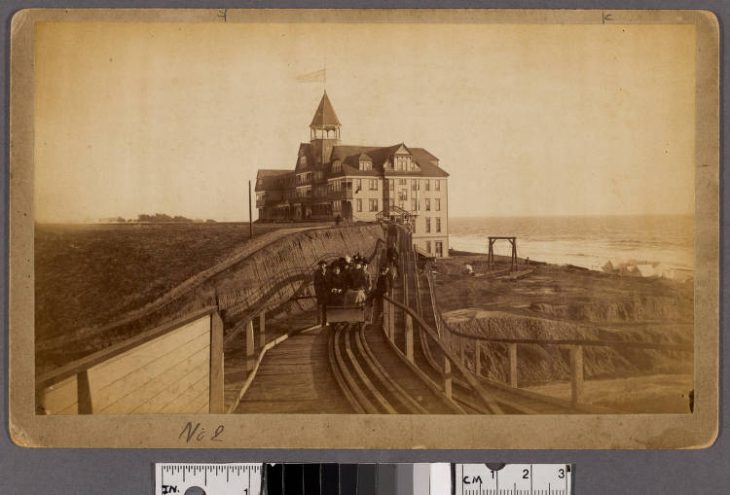
Today’s image is of “passengers riding the Thompson Gravity Switchback Railroad at the Arcadia Hotel near the beach in Santa Monica, California, with the Ocean Avenue face of the hotel visible” (https://hdl.huntington.org/digital/collection/p15150coll2/id/19483). This little roller coaster “was outside the luxurious-for-the-time Arcadia Hotel in Santa Monica and carried passengers 500 feet from a Southern Pacific station across a ravine to the hotel” (https://martinturnbull.com/photo-blog/2018/09/27/a-thompson-gravity-switchback-railway-in-front-of-the-arcadia-hotel-santa-monica-1890-2/), so it was functional as well as fun.