Word of the Day: Proscribe
Today’s word of the day, courtesy of the Words Coach (https://www.wordscoach.com/dictionary), is proscribe. Pronounced / proʊˈskraɪb /, with the stress on the second syllable, this transitive verb means “to denounce or condemn (a thing) as dangerous or harmful; prohibit,” or “to put outside the protection of the law; outlaw,” or “to banish or exile,” or “to announce the name of (a person) as condemned to death and subject to confiscation of property” (https://www.dictionary.com/browse/proscribe).
The word first appears in the English language in the “early 15c., proscriben, ‘write before or in front, prefix,’ from Latin proscribere ‘publish in writing’ (literally ‘write in front of’), including ‘publish as having forfeited one’s property; condemn, outlaw before the world,’ from pro ‘before’ (see pro-) + scribere ‘to write’ (from PIE root *skribh- ‘to cut’).
“From mid-15c. as ‘to exile, put out of the protection of the law’ (implied in proscribed). By 1550s as ‘publish the name of as condemned to death and liable to confiscation of property.’ The meaning ‘denounce and prohibit (something) as wrong or dangerous’ is recorded by 1620s” (https://www.etymonline.com/search?q=proscribe). So proscribe underwent semantic shift over time, meaning one thing when it entered the language and something a good bit narrower after some time.
Merriam-Webster elaborates: “Signs, signs, everywhere, signs: some prescribe (‘do this’) and others proscribe (‘don’t do that’). Don’t take it as a bad sign if you have difficulty telling prescribe and proscribe apart, however; you’ve got plenty of company, and a good excuse. Proscribe and prescribe both come from Latin words that combine a prefix meaning ‘before’ with the verb scribere, meaning ‘to write.’ Yet the two words have very distinct, often nearly opposite meanings, hints of which emerge upon a closer look at their origins. Prescribe comes from praescribere, meaning ‘to dictate, order’—clear enough for a word used when making rules and giving orders. Proscribe has a more complex history: proscribere means both ‘to publish’ and, more specifically, ‘to publish the name of someone who is condemned to death and whose property is now forfeited to the state.’ This narrower meaning is the one proscribe carried into English when it was first used in the 15th century. By the early 17th century, the word had expanded from merely signaling condemnation to actual condemning or prohibiting” (https://www.merriam-webster.com/dictionary/proscribe).
That Proto-IndoEuropean root, *skrībh-, means “‘to cut, separate, sift;’ an extended form of root *sker- (1) ‘to cut.’
“It might form all or part of: ascribe; ascription; circumscribe; conscript; conscription; describe; description; festschrift; inscribe; inscription; manuscript; postscript; prescribe; prescription; proscribe; sans-serif; scribble; scribe; script; scriptorium; scripture; scrivener; serif; shrift; shrive; subscribe; superscribe; superscript; transcribe; scarification; scarify.
It might also be the source of: Greek skariphasthai ‘to scratch an outline, sketch;’ Latin scribere ‘to write’ (to carve marks in wood, stone, clay, etc.); Lettish skripat ‘scratch, write;’ Old Norse hrifa ‘scratch’” (https://www.etymonline.com/word/*skribh-). It is interesting that a word that originally meant “to cut” changed over time to mean “to write.” Oh, and festschrift is a loanword from Deutsch, meaning “festival writing” or a collection of writings in honor of someone. You can tell it’s a Deutsch loanword because, unlike shrift or shrive, it begins with sch.
This date in 1455 gives us the “First record of Johannes Gutenberg’s Bible, a letter dated this day by Enea Silvio Piccolomini refers to the Bible printed a year earlier” (https://www.onthisday.com/events/march/12).
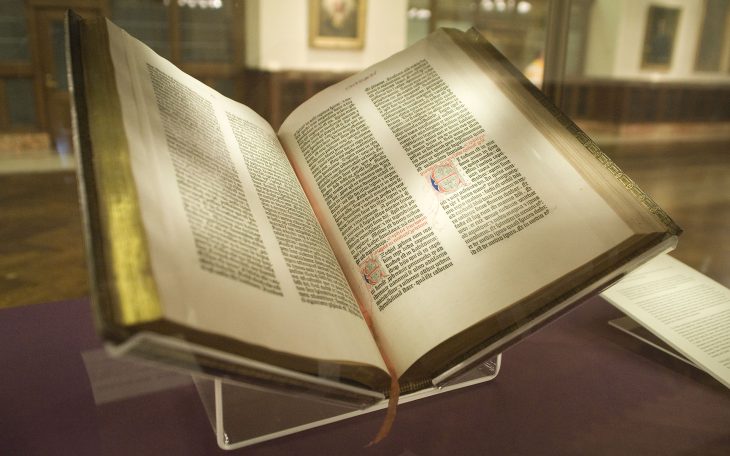
The Gutenberg Bible is the first Bible to be printed by movable type, an invention of the Deutsch printer Johannes Gutenbert. “Preparation of the Bible probably began soon after 1450, and the first finished copies were available in 1454 or 1455. It is not known exactly how long the Bible took to print” (https://en.wikipedia.org/wiki/Gutenberg_Bible). Gutenberg introduced the movable type printing press to Europe, and he had to make a number of inventions to make the mass production of books something practical and affordable. For instance, he created a new kind of ink for printing. The people, mostly monks, who copied manuscripts by hand used a water-based ink, but such an ink would have not worked on the metal surfaces of the printing press.
The Gutenberg Bible is a printing of the Vulgate, a Latin-language Bible translated from the Hebrew (Old Testament) and Greek (New Testament). Later, there would be translations of the Bible into many other languages. These translations were not forbidden by the Roman Catholic Church. However, the Church did uphold the local bishops and cardinals, and the secular rulers, who did ban the publishing of such translations. The fear was that translating the Bible out of the Latin would lead to errors that would lead relatively uneducated readers into error; for example,
- “Pope Innocent III’s Cum ex iniuncto (1199) did not ban vernacular Bibles or translation, but the secret meetings of the Waldensians;
- “John Wycliffe’s 1382 censure by the University of Oxford did not mention vernacular Bibles or translation, but primarily concerned his eucharistic doctrine. The Pope’s subsequent censure of his twenty-four propositions did not mention vernacular Bibles or translation;
- “De heretico comburendo (1401) does not mention the vernacular Bibles or translation. The implementation act, the Suppression of Heresy Act 1414, similarly does not ban vernacular Bibles or translation, and indeed specifies that possession of such must not be taken as evidence of heresy;
- “The heresy condemnations of Wycliffe and Huss at the ecumenical Council of Constance did not mention vernacular Bibles or translation;
- “Tyndale’s heresy charges did not mention vernacular Bibles or translation, nor were they illegal in the jurisdiction of his arrest and trial” (https://en.wikipedia.org/wiki/Censorship_of_the_Bible).
What Gutenberg’s Bible did was to make copies of the Bible much less expensive, although average people still couldn’t afford one, and much easier to produce in large quantities, although “large” is a relative term. And because of those effects, it became much harder for the authorities to ban and burn translations of the Bible that they didn’t like.
What the Roman Catholic Church was trying to proscribe in the Late Middle Ages was not vernacular translations of the Bible; it was trying to prevent people other than the clergy from being able to access the Bible at all. “Oral translation or paraphrase of scripture readings embedded into the homily was a required duty for parish priests and bishops at all times, sometimes requiring consultation, and the most common form of sermon. For example, in 1051 Archbishop Ælfric Puttoc ordered ‘The mass-priest shall, on Sundays and mass-days, tell to the people the sense of the gospel in English.’ This practise is attested by written sermons from the Old English Blickling Homilies (971) to the Middle English Northern Homily Cycle (1315)” (ibid.).
In Philippians, St. Paul tells the people to “work out your salvation with fear and trembling” (2:12 NIV: https://www.biblegateway.com/passage/?search=Philippians%202&version=NIV). This is exactly what the Roman Catholic Church of the Middle Ages proscribed. The moveable type printing press helped to free us from that proscription.
Today’s image is of the “Gutenberg Bible of the New York Public Library; purchased by James Lenox in 1847, it was the first Gutenberg Bible to be acquired by a United States citizen” (https://en.wikipedia.org/wiki/Gutenberg_Bible).