Word of the Day: Lachrymose
Today’s word of the day, courtesy of the Words Coach (https://www.wordscoach.com/dictionary), is lachrymose. Pronounced / ˈlæk rəˌmoʊs /, this adjective means “suggestive of or tending to cause tears; mournful” or “given to shedding tears readily; tearful,” depending upon whether the word is modifying a thing or a person (https://www.dictionary.com/browse/lachrymose).
In its “Did You Know” section, Merriam-Webster says, “The misty-eyed souls among us will appreciate lachrymose, a word that can describe a person who tends to cry often, or an emotional trigger that induces tears. Those more stoic in disposition might be moved (though not to tears) to learn that lachrymose also has a scientific counterpart: its older cousin lachrymal can mean “of, relating to, or marked by tears,” or (usually with the alternative spelling lacrimal) ‘of, relating to, or being glands that produce tears.” Both lachrymose and lachrymal come from the Latin noun lacrima, meaning ‘tear’” (https://www.merriam-webster.com/dictionary/lachrymose).
The word first appears in English in the “1660s, ‘tear-like,’ from Latin lacrimosus ‘tearful, sorrowful, weeping, also ‘causing tears, lamentable,’ from lacrima, lacryma ‘a tear,’ a dialect-altered borrowing of Greek dakryma ‘a tear,’ from dakryein ‘to shed tears, weep, lament with tears,’ from dakry ‘a tear’ (reconstructed in Watkins to be from PIE *dakru- ‘tear;’ see tear).
“The meaning ‘given to tears, tearful’ is attested by 1727; the meaning ‘of a mournful character’ is by 1822….
“The -d- to -l- alteration in Latin is the so-called ’Sabine -L-‘; compare Latin olere ‘smell,’ from root ofodor, and Ulixes, the Latin form of Greek Odysseus” (https://www.etymonline.com/search?q=lachrymose).
What makes you cry?
I have to tell you that I grew up in a Lutheran household, the great grandchild of German immigrants. And there isn’t much that makes me cry. When I first started teaching at the small, private Christian college where I taught for 28 years, students in chapel would sometimes be invited to ask for prayer requests. Occasionally, a student, on the verge of tears, would ask for prayers for a pet who had been injured by a car, or some such thing. I would wonder why they were crying!
But there are some things. For instance, we had a family tradition when I was growing up; we used to watch a movie every Christmas season called All Mine to Give. Here’s a summary from the wiki: “All Mine to Give (British title: The Day They Gave Babies Away) is a 1957 Technicolor melodrama film directed by Allen Reisner and starring Glynis Johns, Cameron Mitchell, and Rex Thompson. When first one parent, then the other, dies, their six children have to look after themselves in the Wisconsin of the mid-19th century” (https://en.wikipedia.org/wiki/All_Mine_to_Give). But that doesn’t really describe the ending. The second parent, the mother (played by Johns), dies right before Christmas. Before she dies, she calls her oldest son in to talk to her, and she tells him that it is his responsibility to find homes for his younger siblings. But when the town finds out that the mother has died, one of the women wants to take away one of the daughters. So Robby asks the town, Can we stay together for Christmas Eve and Christmas Day. The town agrees.
The children return to the family home, and the next day, Christmas, Robby takes his siblings around the town and gives away his siblings. The last one is the youngest daughter, and as Robby is walking through the snow pulling her on a sled, he comes across a house. He stops, knocks on the door, and asks the woman who answers if she would like his little sister. Having given her away, he walks on through the snow, on the way to a lumber camp. I have to admit that I choke up even thinking about the ending.
Then there is La Boheme. I know that not everyone is fond of opera, and I don’t go to the opera frequently, but La Boheme is wonderful. The story is “based on Henry Murger’s novel Scenes de la vie de Bohème.
“Four struggling bohemians – a poet, a painter, a musician and a philosopher are living together in Paris, when one freezing Christmas Eve their lives are changed forever. A girl named Mimì knocks on their door looking for a candle light, and she and Rodolfo fall in love.
“However, the rush of love at first sight soon gives way to something much darker – it becomes clear that Mimì is desperately ill, and that Rodolfo, in his poverty, cannot provide for her. Our bohemians try to find their way, but are soon sharply awoken to the harsh realities of life” (https://www.operanorth.co.uk/news/la-boheme-in-a-nutshell/). The story, in four acts, is a bit more complicated as Mimi spends some time away from Rodolfo, connected to a sugar daddy with the goal of getting some money. And Rodolfo and his friends struggle with their arts.
Spoiler alert: Mimi dies at the end, and the very last thing you hear, if you’re in the audience, is Rodolgo singing a single word: “Mimi.” Now, I know the opera; I’ve seen it several times. And I choke up if I just hear that being sung, on the radio or television.
I have cried on other occasions—the death of my father, for instance, or the death of our cocker spaniel, Joey. But I’m not exactly a lachrymose person. There are, however, lachrymose things all around us.
What makes you cry?
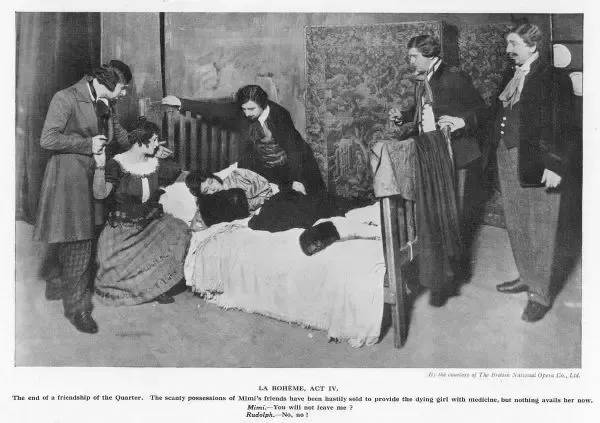
Today’s image is Mimi’s death in a production of La Boheme (https://forbiddenmusic.org/2022/09/05/eduard-hanslick-on-puccinis-la-boheme-at-viennas-court-opera-conducted-by-gustav-mahler/). “The end of a friendship of the Quarter. The scanty possession of Mimi’s friends have been hastily sold to provide the dying girl with medicine, but nothing avails her now” (ibid.). The production took place in 1903 at the “Vienna State Opera in Vienna with Selma Kurz as Mimì, Marie Gutheil-Schoder as Musetta, Fritz Schrödter as Rodolfo, Gerhard Stehmann as Marcello, and Gustav Mahler conducting” (https://en.wikipedia.org/wiki/La_boh%C3%A8me).