Word of the Day: Adumbrate
Today’s word of the day, thanks to the Words Coach (https://www.wordscoach.com/dictionary), is adumbrate. Pronounced / æˈdʌm breɪt / or / ˈæd əmˌbreɪt /, this transitive verb means “to produce a faint image or resemblance of; to outline or sketch,” “to foreshadow; prefigure,” or “to darken or conceal partially; overshadow” (https://www.dictionary.com/browse/adumbrate).
Merriam-Webster, in its “Did You Know” section, says, “Don’t throw shade our way if you’ve never crossed paths with adumbrate—the word’s shadow rarely falls across the pages of casual texts. It comes from the Latin word umbra, meaning ‘shadow,’ and is usually used in academic and political writing to mean ‘to foreshadow’ (as in ‘protests that adumbrated a revolution’) or ‘to suggest or partially outline’ (as in ‘a philosophy adumbrated in her early writings’). Adumbrate is a definite candidate for those oft-published lists of words you should know, and its relations range from the quotidian (umbrella) to the somewhat formal (umbrage) to the downright obscure (umbra). But it’s a word worth knowing, beyond a shadow of a doubt” (https://www.merriam-webster.com/dictionary/adumbrate).
The word first appears in English in the “1580s, ‘to outline, to sketch,’ from Latin adumbrates ‘sketched, shadowed in outline,’ also ‘feigned, unreal, sham, fictitious,’ past participle of adumbrare ‘cast a shadow over;’ in painting, ‘to represent (a thing) in outline,’ from ad ‘to’ (see ad-) + umbrare ‘to cast in shadow’ (from PIE root *andho- ‘blind; dark;’ see umbrage). The meaning ‘overshadow’ is from 1660s in English” (https://www.etymonline.com/search?q=adumbrate). But the website also says that adumbration entered the language in 1550s, so it may be that the verb adumbrate is a back formation.
I also find it interesting that “to darken or conceal partially” could be seen as the opposite of “to foreshadow, prefigure.” That would make adumbrate a contronym or autoantonym or antagonym, “’words that double as their own opposites,’ says Jess Zafarris, an etymology expert. ‘They have mutually contradictory definitions.’ They also have yet another name: Janus words, named for an ancient Roman god with two faces that looked in opposite directions” (https://www.rd.com/list/contronyms-words-opposites/). Contronyms in English include cleave, garnish, oversight, and others.
According to On This Day, on this date in 1881, “Sherlock Holmes and Dr. Watson begin their first case together in ‘A Study in Scarlet’” (https://www.onthisday.com/today/events.php).
Sir Arthur Conan Doyle was born to a Roman Catholic couple who had moved from London to Edinburgh. He attended, for a time, a very strict Jesuit school where he excelled as a student. His mother persuaded him to pursue a medical career, so he attended the University of Edinburgh. But he found the study of medicine to be boring. Nevertheless, he continued and earned his degree (http://sherlockholmes.stanford.edu/biography2.html).
“Among his teachers was the man Conan Doyle later acknowledged as his inspiration for Sherlock Holmes, Dr. Joseph Bell. Dr. Bell taught his students the importance of observation, using all the senses to obtain an accurate diagnosis. He enjoyed impressing students by guessing a person’s profession from a few indications, through a combination of deductive and inductive reasoning, like Holmes. Although Bell’s methods fascinated Conan Doyle, his cold indifference towards his patients repelled the young medical student. Some of this coldness found its way into Sherlock Holmes’s character, especially in the early stories” (ibid.).
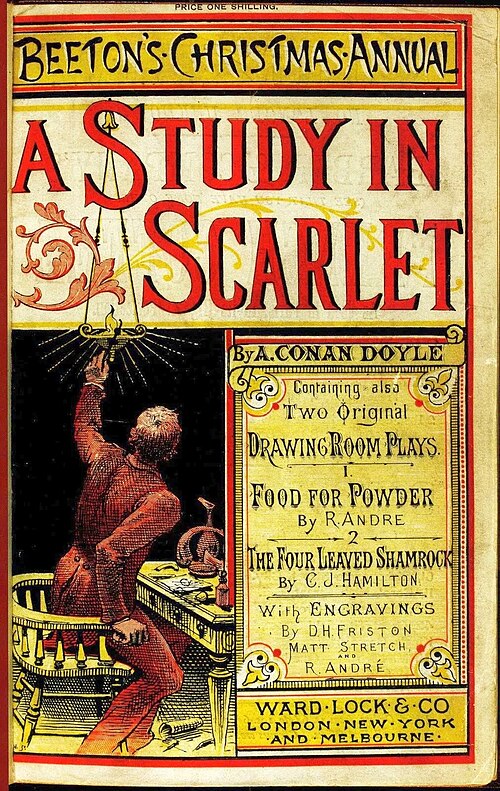
When Doyle had a crisis of faith, causing him to turn away from the Roman Catholic Church, he lost the support of his family; “Because he refused to practice his family’s religion, Conan Doyle was forced to make own way in the medical profession, with neither financial help nor letters of introduction to influential people” (ibid.). He struggled financially, so even when he was in medical school, he began writing short stories for extra income. His dream was to become an important writer of historical novels. But when he was 27, over the course of three weeks he wrote A Study in Scarlet, the first Sherlock Holmes story (ibid.). “The story was originally titled A Tangled Skein and was eventually published by Ward, Lock & Co. in the 1887 edition of Beeton’s Christmas Annual, after many rejections. Conan Doyle had pressed for royalty but instead received £25 in return for the full rights (equivalent to £3,371.95 considering inflation)” (https://en.wikipedia.org/wiki/A_Study_in_Scarlet).
Then we find this passage: “It was upon the 4th of March, as I have good reason to remember, that I rose somewhat earlier than usual, and found that Sherlock Holmes had not yet finished his breakfast. The landlady had become so accustomed to my late habits that my place had not been laid nor my coffee prepared. With the unreasonable petulance of mankind I rang the bell and gave a curt intimation that I was ready. Then I picked up a magazine from the table and attempted to while away the time with it, while my companion munched silently at his toast. One of the articles had a pencil mark at the heading, and I naturally began to run my eye through it” (Doyle, A Study in Scarlet, Chapter 2).And thus begins Dr. Watson’s first adventure with Sherlock Holmes.
If you’ve never read any Sherlock Holmes stories, what he is best known for is his logic and his careful observation. The first meeting between Holmes and Dr. Watson, who is usually the narrator for the stories, goes like this:
“Dr. Watson, Mr. Sherlock Holmes,” said Stamford, introducing us.
“How are you?” he said cordially, gripping my hand with a strength for which I should hardly have given him credit. “You have been in Afghanistan, I perceive.”
“How on earth did you know that?” I asked in astonishment.
“Never mind,” said he, chuckling to himself.
Later we’ll find out that it is a combination of observation and what Holmes calls deductive reasoning, although that is not quite accurate. He really uses a combination of deductive reasoning (reasoning from a general principle to a specific application), inductive reasoning (reasoning from the observation of data to a specific conclusion), and abductive reasoning (“Generating a hypothesis that best fits the facts, even when evidence is incomplete”) (https://sherlockholmes.com/blogs/news/sherlock-holmes-logic-explained). Frequently, the result of Holmes’s reasoning is to adumbrate the perpetrator of a crime before he can bring the criminal into the light completely.
Today’s image is of the cover of Beeton’s Christmas Annual of 1887 featuring Arthur Conan Doyle’s A Study in Scarlet (https://en.wikipedia.org/wiki/A_Study_in_Scarlet).